Key Highlights
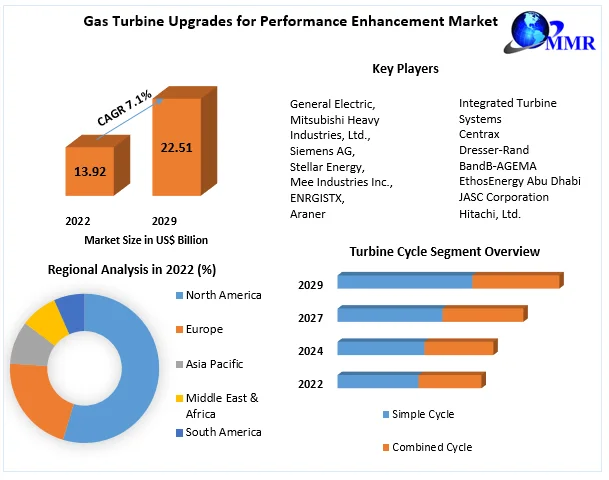
Global Gas Turbine Upgrades for Performance Enhancement Market expected to reach US$ 22.51 Bn by 2029.
Forecast CAGR of 7.1% during the period to 2029, indicating robust upgrade demand.
Growth driven by aging gas turbine fleets requiring output, efficiency and reliability improvements.
Upgrades span hardware, software and service packages across power generation and industrial applications.
Major participation from OEMs and specialized service providers targeting lifecycle extension and emission compliance.
Why This Matters Now
Automotive and transportation plants depend on stable electricity and process heat; unplanned outages or efficiency losses in upstream gas turbine assets can stall assembly lines, disrupt logistics hubs and inflate operating costs. A market growing to US$ 22.51 Bn by 2029 at 7.1% CAGR signals a global push to modernize turbines rather than replace them, reshaping power reliability profiles in key manufacturing regions.
As OEMs and fleet operators accelerate EV programs, connected vehicle launches and high‑automation plants, their exposure to grid stress and industrial power failures increases. Gas turbine upgrades aimed at performance enhancement—higher output, better fuel efficiency, more reliable starts—will quietly decide which geographies can support energy‑intensive automotive clusters and which fall behind in attracting new capacity.
Market Overview
The Gas Turbine Upgrades for Performance Enhancement Market covers retrofit packages, component enhancements, control and software optimization, and service interventions that improve the output, efficiency and reliability of operating gas turbines. Rather than fully replacing aging units, operators invest in targeted upgrades to extend turbine life, reduce emissions and meet new operating requirements at lower capital cost.
Global revenue is expected to reach US$ 22.51 Bn by 2029, supported by a CAGR of 7.1% over the forecast period. Growth is linked to an aging installed base across power generation and industrial sectors, where turbines must adapt to more variable loads, integration with renewables, and stricter regulatory expectations. This raises the strategic relevance of upgrades for automotive and transportation businesses that rely on these assets indirectly through utilities and industrial suppliers.
Key Trends Driving Growth
Aging gas turbine fleets are the most immediate driver: many units installed in previous decades face efficiency degradation, higher maintenance needs and limited compatibility with newer operating regimes. Upgrade programs that include hot section improvements, compressor coatings, and advanced control systems deliver measurable gains in output and fuel consumption, making them attractive to power producers seeking to avoid full replacement.
Emission and efficiency regulations are rising across major markets, increasing pressure on gas turbines to operate cleaner and more flexibly. Performance enhancement packages enable operators to meet tighter limits and participate in balancing markets where fast response and ramping are rewarded. For automotive clusters that need low‑carbon, reliable energy to support EV production and lightweight material processing, these upgrades influence long‑term energy contracts and site selection.
Digital technologies—predictive maintenance, remote diagnostics, and performance monitoring—are increasingly bundled into upgrade solutions. These tools help operators manage turbine health, anticipate failures and optimize dispatch, which in turn stabilizes power quality for industrial users. Automotive plants and logistics networks that negotiate supply from upgraded, digitally monitored assets will likely see fewer disruptions than those connected to older, unmanaged fleets.
Request a Free Sample Copy or View Report Summary: https://www.maximizemarketresearch.com/request-sample/40454/
Segment Insights
Dominant Segment – Power Generation Applications
Power generation is a major application segment for gas turbine upgrades, given the large installed base in utilities and independent power producers. For automotive and transportation, this dominance matters because many manufacturing sites and transport hubs draw electricity directly or indirectly from these turbines, making their performance a foundational factor for plant uptime and fleet operations.Fastest‑Growing Segment – Comprehensive Upgrade Packages
Comprehensive upgrade packages that address multiple performance issues simultaneously—such as efficiency, output, emissions and reliability—are highlighted as a strong growth area. Operators choosing these bundles signal a strategic push to secure long‑term competitiveness of plants without building new generation; automotive regions where utilities adopt comprehensive upgrades gain a more resilient energy platform for future EV and high‑automation demand.Upgrade Type – Hardware, Software, Services
Market segmentation includes hardware modifications, software and control system upgrades, and service‑focused solutions. Hardware and hot section enhancements deliver direct efficiency and output gains, software and controls support flexible dispatch and integration with renewables, and service packages manage lifecycle risks. Automotive and transportation businesses benefit when their regional utilities and large industrial suppliers invest across all three categories rather than focusing narrowly on maintenance.
Regional Growth Story
North America and Europe hold significant shares of the gas turbine upgrade market due to large installed bases and stringent environmental regulations. Utilities and industrial operators in the US and Germany, for example, face pressure to reduce emissions while maintaining reliability, making performance enhancement upgrades a practical path to bridge the transition toward higher renewable penetration.
Asia‑Pacific is projected to grow rapidly as energy demand rises and power generation infrastructure expands. Emerging automotive hubs in China, India and other markets depend on a mix of coal, gas and renewables; upgrades to gas turbines in these systems improve grid stability and support industrial growth. For global automotive OEMs deciding where to place new EV and battery plants, the presence of upgraded gas turbine capacity is an indicator of future energy resilience.
Other regions, including parts of the Middle East, Latin America and Africa, add incremental upgrade demand where gas turbines anchor power systems and industrial operations. Export‑oriented automotive suppliers located in these markets will see their competitiveness tied to whether operators invest in performance enhancement or allow degradation, which can drive volatility in power costs and reliability.
Competitive Landscape
Major turbine OEMs—including players such as General Electric, Siemens and Mitsubishi Hitachi Power Systems—lead upgrade offerings, using their installed base knowledge and service networks to sell performance packages. Their strategies focus on combining hardware, control systems and digital services to lock in long‑term customer relationships and capture recurring revenue as operators seek lifecycle management rather than transactional repairs.
Specialized upgrade firms and coating technology providers compete in niche areas like hot section improvements and advanced compressor coatings. These companies target performance‑critical components, influencing how much value turbine owners can extract from upgrades and occasionally shifting bargaining power if they offer differentiated capabilities. For automotive sector energy buyers, understanding which suppliers dominate local turbine upgrade markets can inform the risk profile of their power contracts.
Competitive activity revolves around R&D investment, service network expansion and digital platform launches. Each move signals intent: capacity expansions and new service centers in key regions suggest confidence in long‑term demand, while digital platform launches indicate a race to define data standards and customer interfaces. Energy users in automotive and transportation that align with tech‑leading upgrade providers are likely to gain earlier access to efficiency improvements and reliability analytics.
Recent Developments
Growing Adoption Of Hot Section And Compressor Coatings
Advancements in hot section and compressor coating technologies deliver performance gains and extended turbine life, attracting investment in upgrade solutions. These developments show operators are willing to tackle thermal and mechanical limits head‑on rather than just adjusting operating profiles.Expansion Of Digital And Predictive Maintenance Solutions
Rising adoption of digital technologies such as predictive maintenance and remote diagnostics is noted across upgrade offerings. This trend moves upgrades away from one‑time events toward ongoing performance management, changing how utilities and industrial operators budget and plan for turbine health.Regional Shift Toward Lifecycle Management
Markets in North America, Europe and Asia‑Pacific increasingly focus on lifecycle management of gas turbines, including hardware, software and service mix. This shift suggests that upgrade decisions are being integrated into long‑term asset strategies rather than treated as ad‑hoc projects.
Strategic Implications
For automotive OEMs, Tier‑1 suppliers and fleet operators, gas turbine upgrades shape an often‑unseen layer of risk: the reliability and cost profile of the energy systems that power plants, logistics hubs and data centers. Regions where utilities invest heavily in performance enhancement will offer more stable, predictable environments for EV manufacturing, high‑automation assembly and energy‑intensive processes such as paint and casting.
Boardrooms planning ICE‑to‑EV transitions, battery plants and digital manufacturing need to ask explicit questions about the upgrade pathways of local gas turbine fleets. If energy providers rely on aging, non‑upgraded turbines, future load growth may translate into higher outage risk and more volatile pricing. Conversely, robust upgrade programs signal a willingness to support industrial expansion and integrate renewables without sacrificing reliability.
The emerging emphasis on comprehensive upgrade packages and digital performance management suggests a convergence between energy and industrial strategies. Automotive firms that build partnerships with utilities and turbine upgrade providers—sharing load forecasts, flexibility needs and decarbonization plans—can influence upgrade design and secure better terms, including tailored reliability commitments and data access.
Future Outlook
Through 2029, the Global Gas Turbine Upgrades for Performance Enhancement Market’s trajectory toward US$ 22.51 Bn at 7.1% CAGR indicates steady, strategic modernization of critical energy infrastructure rather than short‑term spikes. As decarbonization pressures and renewable integration increase, performance enhancement will become a standard expectation for operating turbines, not an optional improvement.
For automotive and transportation, the dividing line will be clear: future leaders will actively factor regional turbine upgrade activity into site selection, power procurement and resilience planning; laggards will ignore this layer, leaving EV plants and logistics networks exposed to avoidable energy risk and cost volatility.
Related Reports
Global ID card Printers Market https://www.maximizemarketresearch.com/market-report/global-id-card-printers-market/81676/
Global Oilfield Biocides Market https://www.maximizemarketresearch.com/market-report/global-oilfield-biocides-market/65563/
Global Industrial and Commercial LED lighting Market https://www.maximizemarketresearch.com/market-report/global-industrial-and-commercial-led-lighting-market/35501/
Analyst Perspective
“Gas turbine upgrades for performance enhancement are no longer a niche engineering decision; they are a strategic variable in industrial competitiveness,” “With the market heading to US$ 22.51 Bn by 2029 at 7.1% CAGR, automotive and transportation players that actively engage with energy providers on upgrade pathways will secure more reliable, efficient power for EV, high‑automation and digital operations than those that treat turbines as someone else’s problem.”-Dharati Raut
About Maximize Market Research
Maximize Market Research Pvt. Ltd. (MMR) is a global market research and consulting company that provides reliable, data-focused, and practical business insights. The firm serves a wide range of industries, including healthcare, pharmaceuticals, technology, automotive, electronics, chemicals, personal care, and consumer goods. Through market forecasts, competitive analysis, strategic consulting, and industry impact assessments, MMR helps organizations understand changing market conditions, identify growth opportunities, and make informed business decisions for long-term success.
2nd Floor, Navale IT Park Phase 3
Pune Banglore Highway, Narhe
Pune, Maharashtra 411041, India
+91 9607365656
sales@maximizemarketresearch.com
