Key Highlights
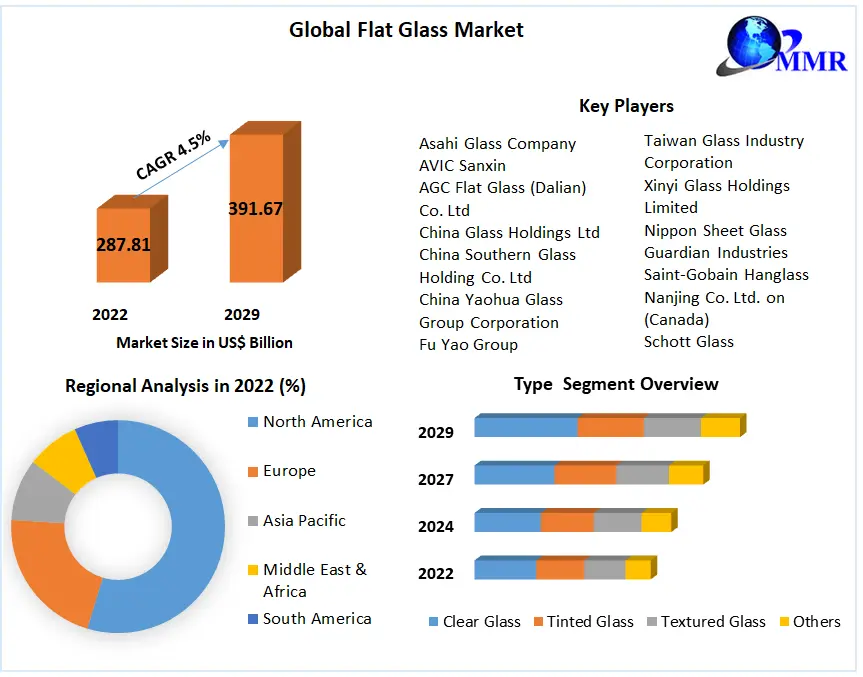
The global market valuation reached USD 320.02 billion in 2025, with expectations to scale up to USD 439.96 billion by 2034 under a steady 3.6% compound annual growth rate.
Insulated glass products represent the dominant market segment, controlling over 44.0% of the total industrial volume due to global building energy efficiency mandates.
Architectural applications dictate the market direction, capturing more than 72.0% of total revenue via commercial storefronts, curtain walls, and residential construction.
Asia Pacific commands a dominant 61.0% share of global flat glass revenue, backed by heavy infrastructure funding and localized chemical manufacturing ecosystems.
Flat glass recycling faces intense bottlenecks, with European cullet usage capped at 26.0% of raw material inputs against a technical ceiling of 37.0%.
High initial capital requirements persist as a barrier to entry, with a single new float glass facility requiring a capital expenditure between 70 million and 200 million Euros.
Why This Matters Now
Volatile energy markets and strict building decarbonization mandates force immediate recalculations for industrial buyers and glass manufacturers worldwide. Float glass production requires continuous, non-stop furnace operations running 24 hours a day, 365 days a year, over a 15-year campaign life. Because these facilities only achieve profitability when capacity utilization exceeds 70.0%, any sudden shift in downstream demand triggers immediate financial stress.
Industrial procurement heads must secure stable supply contracts now to hedge against structural manufacturing vulnerabilities. Rising soda ash and silica sand pricing, combined with localized emissions penalties, alter the foundational cost sheets of global suppliers. The traditional reliance on cheap, low-performance commodity glass is ending as regulatory boards enforce high-performance glazing specifications across major economies.
Market Overview
The global Flat Glass Market size reached USD 320.02 billion in 2025 and must scale to USD 439.96 billion by 2034 to satisfy industrial consumption. This trajectory represents a 3.6% compound annual growth rate over the nine-year forecast window. Production relies on melting precise ratios of high-purity silica sand, soda ash, and limestone into a molten state before forming sheets. The resulting material provides weather resistance, dust prevention, light refraction, and structural insulation across highly exposed environments.
The industry operates under high fixed asset costs and unforgiving supply-demand dynamics. Building a new production asset costs between 70 million and 200 million Euros based on historical industrial baselines. Manufacturers cannot easily throttle output during temporary market slowdowns without risking catastrophic furnace crystallization. Consequently, minor drops in downstream real estate or automotive production generate immediate regional oversupply, driving fierce price competition among Tier 1 producers.
Key Trends Driving Growth
Rapid global urbanization and targeted investments in commercial infrastructure serve as primary demand catalysts for flat glass producers. Modern architectural design favors extensive external glass facades, maximizing natural light absorption while requiring advanced acoustic and thermal barriers. This architectural pivot expands the total square footage of glass required per square meter of building footprint. Furthermore, public and private investments in high-density residential properties increase basic and tempered sheet consumption.
Adoption of advanced glazing solutions also accelerates due to strict net-zero building regulations in Western economies. Governments mandate lower heat transfer coefficients for windows and curtain walls to minimize heating and cooling electricity consumption. This regulatory pressure shifts procurement from cheap monolithic glass to complex double and triple-glazed insulated units. In the automotive sector, the ongoing transition toward electric vehicles alters product specifications. Electric vehicle designers demand lightweight, high-performance acoustic glass to compensate for the absence of engine noise and to maximize battery driving range.
Segment Insights
Dominant Segment: Insulated Flat Glass. This product configuration controlled over 44.0% of global market volume. Increased structural integration of curtain walls, automated storefronts, and overhead glazing drives this dominance.
Fastest-Growing Segment: Tempered and Laminated Glazing. These safety-focused products experience rapid procurement growth within residential shower doors, mobile device displays, and automotive side panels.
Dominant Application: Architectural. Construction applications generated more than 72.0% of total industry revenue. Urban infrastructure projects and commercial office developments sustain this leading market position.
Slowing Segment: Standard Automotive Commodity Glass. Traditional internal combustion vehicle windows show slower growth due to past automotive manufacturing contractions, forcing suppliers to retool lines for electric vehicle specifications.
Regional Growth Story
Asia Pacific maintains a clear stranglehold on the global flat glass industry, accounting for 61.0% of total revenue. China and Japan anchor this dominance through massive domestic manufacturing capacities and aggressive outbound regional investments. Between 2000 and 2019, Japan directed over USD 230 billion into Southeast Asian infrastructure projects, while China injected approximately USD 155 billion. These cross-border investments secure steady downstream channels for industrial flat glass exports across developing ASEAN territories.
The North American market experiences localized demand recoveries, heavily concentrated within the United States residential construction sector. According to United States Census Bureau data, completed new privately-owned housing units in the Southern United States rose by 6.7%. This regional construction surge directly offsets previous commercial real estate stagnation, stimulating short-term flat glass spot prices. Meanwhile, the Middle East and Africa represent a fast-growing frontier, backed by a USD 1 billion developmental fund allocation from a Dubai-based investment bank to stabilize regional infrastructure projects.
Competitive Landscape
The global market features extreme consolidation among a few dominant manufacturing entities, including Saint-Gobain, AGC Inc., Guardian Glass, and Cardinal Glass Industries. These market leaders control the majority of operational float lines and maintain proprietary technology for vacuum-insulated glass production. To defend regional pricing power and optimize logistical footprints, these entities engage in targeted consolidation. For example, Cardinal Glass Industries acquired the North American glass business of AGC Inc., an operational move that consolidated domestic capacity and altered regional supply dynamics.
Smaller regional fabricators face escalating survival pressure due to high energy inputs and strict quality controls. For instance, Fuyao Glass Industry Group Co. reported that its United States subsidiary suffered a net financial loss of 92.1 million yuan, equivalent to USD 13.4 million, during a period of intense operational rebalancing. This loss underscores the razor-thin margins realized by overseas subsidiaries when navigating localized labor costs and supply chain shocks. To survive, specialized players expand niche footprints, as seen when Tomakk Glass Partners opened a dedicated tempered glass fabrication facility in Shreveport, Louisiana, to capture regional architectural contracts.
Recent Developments
Pilkington IGP initiated a major manufacturing expansion at its production unit in Ostroleka, Poland, focusing on highly specialized architectural products to capture rising European green building demand.
Greystar Real Estate Partners formed a strategic development alliance with CPP Investments and Cyrela to fund the Brazilian multifamily rental property sector in São Paulo.
European glass recycling organizations confirmed that flat glass cullet currently constitutes 26.0% of total raw material mixtures across continental float factories.
Industrial recycling assessments revealed that technical, economic, and infrastructural constraints cap maximum potential cullet integration at 37.0% globally.
Strategic Implications
The operational reality of flat glass fabrication requires an immediate shift toward circular economy manufacturing processes. Utilizing cullet lowers furnace melting temperatures, which directly decreases natural gas consumption and associated carbon emissions. However, the widespread integration of specialized coatings, polyvinyl butyral interlayer foils, and liquid crystal layers makes modern architectural and automotive glass difficult to recycle. Processing firms lack uniform national or continental collection frameworks to track, sort, and process complex laminated glass back into high-purity float furnaces.
Procurement executives can no longer treat flat glass as a simple, interchangeable commodity. Suppliers with advanced internal recycling loops and localized sand sources retain significant pricing advantages and lower exposure to cross-border carbon tariffs. Buyers must evaluate the energy mix of their supplier’s float lines, as regions with high carbon taxes pass these operational penalties down the value chain. Contract structures must shift toward long-term volume guarantees to protect buyers from sudden plant maintenance shutdowns or localized float line failures.
Future Outlook
Market expansion will depend entirely on how effectively producers navigate the mismatch between inflexible manufacturing assets and highly volatile downstream construction markets. Companies that invest in flexible, specialized fabrication facilities will capture high-margin architectural projects, while legacy commodity producers will face chronic overcapacity and margin compression.
Analyst Perspective
“The global flat glass sector is undergoing a profound structural shift where energy-efficiency mandates dictate factory utilization rates,” said Ankita Kagwade, Lead Analyst at Maximize Market Research. “Producers cannot afford to run underutilized assets, meaning that the integration of low-carbon cullet and advanced coating technologies is now an operational survival requirement rather than an optional sustainability initiative.”
About Maximize Market Research
Maximize Market Research Pvt. Ltd. (MMR) is a global market research and consulting company that provides reliable, data-focused, and practical business insights. The firm serves a wide range of industries, including healthcare, pharmaceuticals, technology, automotive, electronics, chemicals, personal care, and consumer goods. Through market forecasts, competitive analysis, strategic consulting, and industry impact assessments, MMR helps organizations understand changing market conditions, identify growth opportunities, and make informed business decisions for long-term success.
2nd Floor, Navale IT Park Phase 3
Pune Banglore Highway, Narhe
Pune, Maharashtra 411041, India
+91 9607365656
sales@maximizemarketresearch.com
