Key Highlights
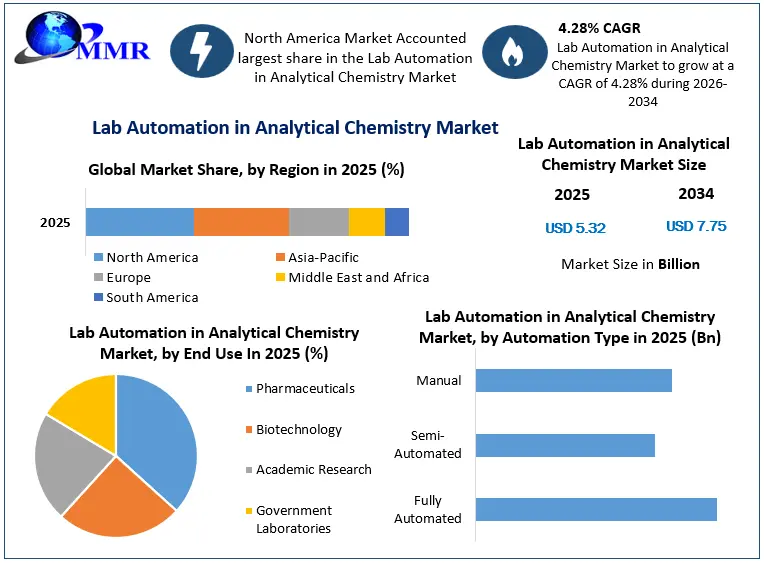
- The market was valued at USD 5.32 billion in 2025.
- Revenue is forecast to reach USD 7.75 billion by 2034.
- The market is expected to grow at a 4.28% CAGR from 2026 to 2034.
- North America accounted for the largest market share, supported by mature pharmaceutical and research ecosystems.
- Automated Plate Handlers remained the leading equipment category.
- Drug Discovery represented the largest application segment.
- AI integration, robotics, and digital laboratory management are accelerating automation adoption.
- Pharmaceutical R&D investments continue to generate sustained demand for analytical laboratory automation.
Why This Matters Now
Laboratories face increasing pressure to process larger sample volumes while maintaining accuracy, regulatory compliance, and operational efficiency. Automation is becoming a strategic necessity rather than a productivity upgrade. Pharmaceutical companies, biotechnology firms, and research institutions are investing in intelligent laboratory platforms to shorten research timelines, improve reproducibility, and reduce manual intervention. Vendors capable of delivering integrated hardware, software, and AI-enabled workflow solutions are positioned to capture long-term enterprise spending.
Market Overview
Lab Automation in Analytical Chemistry Market in analytical chemistry encompasses robotic equipment, automated sample preparation, liquid handling technologies, analytical instruments, and laboratory software that streamline testing workflows. These systems reduce human error, improve reproducibility, and enable laboratories to process thousands of samples with minimal operator intervention.
Demand is primarily supported by expanding pharmaceutical research, growing clinical diagnostics volumes, stricter laboratory quality standards, and increasing investment in biotechnology innovation. High-throughput screening has become essential for modern drug discovery, creating sustained demand for automated analytical platforms capable of delivering faster and more consistent results.
Supply-side innovation is equally important. Equipment manufacturers are integrating artificial intelligence, predictive maintenance capabilities, cloud connectivity, and modular automation architectures to improve operational flexibility. These developments allow laboratories to scale automation without replacing entire analytical infrastructures.
Despite strong adoption, high implementation costs, platform integration challenges, and reduced flexibility in highly customized laboratory workflows remain key barriers for smaller organizations.
Key Trends Driving Growth
AI and Smart Laboratory Platforms
Artificial intelligence is transforming laboratory operations through predictive maintenance, intelligent workflow scheduling, automated data interpretation, and instrument optimization. Smart laboratories reduce downtime while improving analytical consistency.
End-to-End Workflow Automation
Manufacturers are shifting beyond standalone instruments toward integrated automation ecosystems combining robotics, liquid handling, software, and analytical instruments. This reduces manual transfers and increases laboratory throughput.
Pharmaceutical R&D Expansion
Growing investment in drug discovery requires rapid sample preparation and high-throughput analysis. Automated systems enable pharmaceutical companies to accelerate candidate screening while maintaining data integrity.
Digital Laboratory Management
Laboratory Information Management Systems (LIMS) are increasingly integrated with analytical instruments, enabling centralized sample tracking, regulatory documentation, and real-time workflow monitoring.
Strategic Industry Partnerships
Collaborations between laboratory automation providers and analytical instrument manufacturers are creating interoperable platforms that simplify deployment and improve laboratory productivity.
Segment Insights
Dominant Segment – Automated Plate Handlers
Automated Plate Handlers held the largest market share in 2025 because they serve as the central link between analytical instruments during high-throughput testing. Their ability to automatically load, unload, and transfer microplates significantly reduces manual handling while improving laboratory efficiency.
The business impact is substantial. Laboratories can process hundreds or thousands of samples daily with higher consistency, making automated plate handlers essential infrastructure for pharmaceutical research, biotechnology laboratories, and clinical diagnostics facilities.
Fastest-Growing Segment – Drug Discovery
Drug Discovery emerged as the strongest application segment due to increasing global pharmaceutical research investments and the industry’s need for rapid therapeutic development.
Automation enables high-throughput screening, accurate liquid handling, and standardized analytical workflows that reduce research timelines and improve experimental reproducibility. As pharmaceutical companies compete to accelerate innovation, demand for advanced laboratory automation platforms continues to strengthen.
Additional Key Sub-Segments
Automated Liquid Handlers remain critical for precise reagent dispensing and sample preparation, reducing variability in analytical procedures.
Laboratory Information Management Systems (LIMS) are gaining strategic importance by integrating laboratory workflows, ensuring regulatory compliance, and supporting digital transformation initiatives.
Integrated Smart Laboratories represent an emerging growth opportunity as laboratories increasingly adopt AI, cloud computing, IoT, and digital twins to improve operational intelligence.
Academic research institutions, biotechnology companies, and government laboratories are also expanding automation investments to improve research productivity while addressing workforce shortages.
Explore detailed analysis, insights, and growth opportunities
Regional Growth Story
North America
North America maintained market leadership with approximately 60% market share, supported by advanced pharmaceutical manufacturing, strong biotechnology investment, and continuous laboratory modernization. High merger and acquisition activity further strengthens technology adoption and market consolidation.
Europe
Europe remains a major innovation center with established pharmaceutical companies, strict regulatory standards, and continuous investment in laboratory digitization. Automation adoption is driven by quality assurance requirements and research excellence.
Asia Pacific
Asia Pacific is becoming one of the fastest-expanding markets as pharmaceutical manufacturing continues shifting toward China, India, and Southeast Asia. Lower production costs, expanding biotechnology ecosystems, and increasing research investments are accelerating laboratory automation deployment.
Latin America, Middle East & Africa
Emerging markets are gradually increasing automation investments through expanding healthcare infrastructure, pharmaceutical production capacity, and government-supported scientific research initiatives.
Competitive Landscape
Competition is increasingly centered on integrated automation ecosystems rather than standalone laboratory equipment. Leading companies are expanding portfolios through product innovation, software integration, and strategic partnerships that connect analytical instruments with robotics and AI-powered laboratory management systems.
Agilent Technologies continues strengthening its analytical automation capabilities through strategic collaborations focused on automated sample preparation and chromatography workflows.
Thermo Fisher Scientific is expanding into intelligent laboratory automation by combining robotics with artificial intelligence, reinforcing its leadership in advanced laboratory solutions.
Waters Corporation is focusing on laboratory safety and workflow optimization through automated liquid handling innovations, while Tecan Group, Hamilton Company, PerkinElmer, Abbott, LabWare, and LabVantage Solutions continue enhancing specialized automation capabilities across pharmaceutical, biotechnology, and research applications.
The competitive landscape increasingly favors companies capable of delivering complete laboratory automation platforms supported by software integration, predictive analytics, and scalable workflow management.
Recent Developments
- January 2025: Beckman Coulter Diagnostics introduced fully automated high-throughput biomarker immunoassays for the DxI 9000 platform.
- January 2025: Agilent Technologies partnered with ePrep to deliver integrated automated sample preparation solutions for chromatography workflows.
- January 2025: Waters Corporation launched a new automated benchtop liquid handling enclosure with advanced air filtration options.
- March 2025: Thermo Fisher Scientific commercially launched the Thermo Scientific Vulcan™ Automated Lab integrating robotics with artificial intelligence.
- May 2026: Agilent Technologies introduced the 8890B and 8860B intelligent gas chromatography systems featuring predictive diagnostics.
- June 2026: HighRes® and Waters collaborated to integrate flow cytometry with laboratory automation software for fully unattended experimental workflows.
Future Outlook
Organizations that combine AI-enabled software, robotics, and fully integrated laboratory automation platforms will capture the greatest competitive advantage as pharmaceutical and analytical laboratories prioritize speed, precision, and scalable digital operations.
Analyst Perspective — Dharti Raut
Laboratory automation is entering a new phase where competitive differentiation extends beyond hardware performance to intelligent workflow orchestration. Vendors that integrate robotics, AI, cloud connectivity, and laboratory informatics into unified platforms will be best positioned to serve pharmaceutical R&D, clinical diagnostics, and advanced analytical laboratories.
About Maximize Market Research
Maximize Market Research Pvt. Ltd. (MMR) is a global market research and consulting company that provides reliable, data-focused, and practical business insights. The firm serves a wide range of industries, including healthcare, pharmaceuticals, technology, automotive, electronics, chemicals, personal care, and consumer goods. Through market forecasts, competitive analysis, strategic consulting, and industry impact assessments, MMR helps organizations understand changing market conditions, identify growth opportunities, and make informed business decisions for long-term success.
Contact Us :
2nd Floor, Navale IT Park Phase 3
Pune Banglore Highway, Narhe
Pune, Maharashtra 411041, India
+91 9607365656
sales@maximizemarketresearch.com
