Key Highlights
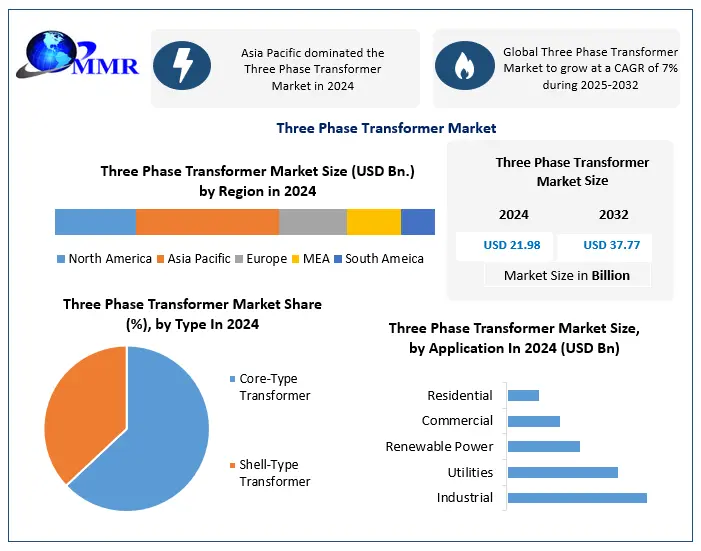
Three Phase Transformer Market valued at USD 21.98 Bn in 2024.
Total global market revenue expected to reach nearly USD 37.77 Bn by 2032, at a 7% CAGR from 2025 to 2032.
Growth driven by rising demand for electricity across industrial and commercial sectors.
Market serves industrial, commercial and other end‑use applications requiring three‑phase power distribution.
Segmentation includes core‑type and shell‑type transformers, with multiple voltage and cooling configurations.
Why This Matters Now
Automotive OEMs, battery manufacturers and logistics operators are adding megawatts of load through EV assembly plants, gigafactories and high‑capacity charging depots. A three phase transformer market scaling from USD 21.98 Bn in 2024 to nearly USD 37.77 Bn by 2032 at 7% CAGR signals that grid and industrial power constraints will shape where EV and advanced manufacturing clusters can realistically grow.
Fleet electrification and fast‑charging corridors will fail if local distribution networks cannot safely and efficiently move large amounts of power. Three‑phase transformers are the workhorses of this system. Boardrooms that ignore transformer capacity, efficiency and availability risk building plants and depots on fragile electrical foundations, exposing launches, uptime and carbon targets.
Market Overview
Three‑phase transformers transfer electrical energy between circuits at different voltage levels while maintaining three‑phase relationships, enabling efficient distribution across industrial and commercial facilities. They step power up or down in grid substations, industrial parks, manufacturing plants and large commercial complexes, making them foundational for automotive production lines, EV charging plazas and intermodal hubs.
With USD 21.98 Bn market value in 2024 and a forecast to nearly USD 37.77 Bn by 2032 at 7% CAGR, demand reflects rapid electrification of processes and rising peak loads. Industrial sectors, including automotive manufacturing, rely on three‑phase power for motors, robotics, HVAC, paint shops and welding lines. Commercial growth—from data centers to large retail complexes—adds further pressure, requiring more transformers and higher performance in terms of efficiency, cooling and monitoring.
Key Trends Driving Growth
The primary driver is rising electricity demand from industrial and commercial sectors. Automotive and transportation plants are scaling up robot density, paint and curing ovens, metal processing and digital systems, all of which consume significant three‑phase power. EV battery plants and component facilities add continuous, high‑load demand that must be served stably.
Grid modernization and renewable integration also push transformer upgrades and new installations. Global transformer studies highlight investment in more efficient designs, smart grid initiatives and capacity to connect wind, solar and other renewables to industrial loads. Automotive hubs with ambitious decarbonization and carbon‑neutral plant targets depend on transformers capable of handling variable generation and bidirectional flows.
Urbanization and commercial real estate expansion in Asia‑Pacific, the US and key European markets further support growth. As cities add mixed‑use developments, transit hubs and EV charging clusters, three‑phase transformers are deployed to manage complex load patterns across transport, retail and residential functions.
Request a Free Sample Copy or View Report Summary: https://www.maximizemarketresearch.com/request-sample/71813/
Segment Insights
Dominant Segment – Application: Industrial
In global three‑phase transformer analyses, industrial applications—including manufacturing plants and process industries—represent the largest demand segment. For automotive and transportation, this dominance reflects the heavy reliance of assembly plants, component factories and logistics hubs on three‑phase power distribution for motors, conveyors, robotics and heating processes.Fastest‑Growing Segment – Utilities And Smart Grid / Renewable Integration
Reports highlight strong growth where transformers serve utilities, smart grids and renewable integration. As EV charging networks expand and automotive OEMs sign long‑term renewable PPA deals, these transformer deployments become critical to delivering low‑carbon, reliable power to industrial and fleet sites.Type – Core‑Type And Shell‑Type Transformers
Market segmentation includes core‑type three‑phase transformers (single or multiple cores) and shell‑type designs. Core‑type units dominate many conventional distribution applications; shell‑type solutions are favored for specific performance or space constraints. Automotive plants must match type and configuration to voltage levels, fault‑current requirements and physical layout.Voltage And Cooling – Low, Medium, High Voltage; Oil‑Cooled, Air‑Cooled
Broader power transformer reports cite segmentation by voltage class and cooling method. High‑voltage units feed large industrial campuses and regional grids; low‑ and medium‑voltage transformers operate inside plant networks and commercial facilities. Oil‑cooled designs handle higher loads and thermal stress, while air‑cooled units fit indoor or smaller installations. These choices impact safety, footprint, maintenance and energy efficiency at automotive sites.
Regional Growth Story
The Three Phase Transformer Market spans North America, Europe, Asia‑Pacific, South America and Middle East & Africa, with growth linked to infrastructure spending and industrial expansion. Asia‑Pacific—driven by China, India and Japan—shows strong growth as governments and private investors build new grids, industrial parks and transport hubs, many of which host automotive and EV facilities.
Europe, led by Germany, France, the UK and Italy, focuses on sustainable energy infrastructure and grid modernization. Automotive clusters there—especially in Germany and emerging EV hubs—depend on transformers that support high renewable penetration and smart grid features, aligning manufacturing with decarbonization strategies.
North America, including the US, continues to invest in power infrastructure upgrades and new industrial capacity. Market commentary points to transformer manufacturing investments and plant expansions, such as new facilities in states like South Carolina. For American EV plants and battery factories, local transformer manufacturing and modern grid assets can reduce lead times and supply risk for large projects.
Competitive Landscape
The global three‑phase transformer space features major electrical equipment companies and regional specialists. Lists of key players include Mitsubishi Electric, Schneider Electric, GE Vernova, HD Hyundai Electric, Hyosung Heavy Industries, CG Power & Industrial Solutions, Voltamp Transformers Limited, Bharat Bijlee and numerous others across Asia, Europe, the Middle East and the Americas.
Competition centers on efficiency, reliability, voltage range, cooling technology, digital monitoring and service support. Suppliers investing in amorphous metal cores and advanced insulating oils improve efficiency and environmental performance, while those deploying IoT‑enabled sensors and digital twin models provide predictive maintenance and lifecycle optimization capabilities. These moves signal a shift from commodity hardware toward integrated, data‑rich infrastructure.
For automotive OEMs and fleet operators, choosing transformer partners becomes part of broader infrastructure strategy. Vendors with strong regional manufacturing bases and service networks can support multi‑site rollout and long‑term reliability, while those pioneering smart grid features can align with EV charging and energy‑management ambitions.
Recent Developments
Efficiency‑Enhancing Materials And Designs
Industry analyses highlight adoption of amorphous metal cores that can cut no‑load losses by up to 70%, and ester‑based biodegradable insulating oils for eco‑safety. These developments improve transformer efficiency and environmental performance, supporting automotive and EV plants seeking lower indirect emissions.Digital Monitoring And Predictive Maintenance
IoT‑enabled sensors, remote monitoring and digital twin models are being deployed to track transformer health and predict failures. This allows utilities and industrial operators to move from reactive replacement to proactive lifecycle management, reducing outage risk for manufacturing and charging assets.Manufacturing Capacity Expansion
Market updates cite investments in new transformer manufacturing plants, including large facilities in North America. Capacity expansion signals confidence in long‑term demand and may reduce lead times and regional supply constraints for large industrial and grid projects.
Strategic Implications
Automotive and transportation leaders must treat three‑phase transformers as strategic infrastructure, not just utility assets. As EV penetration rises and plants add automation, power quality and availability become board‑level issues. Grid‑facing investments in industrial campuses, supplier parks and charging hubs should explicitly assess transformer capacity, efficiency and digital readiness.
OEMs choosing locations for new EV factories, battery plants or high‑capacity depots should evaluate local transformer networks and upgrade plans alongside labor and logistics. Sites linked to modern, digitally monitored transformers will be better able to handle growing loads and renewable integration without frequent outages or voltage issues. Conversely, areas dependent on aging, inefficient transformers will require additional backup and risk mitigation.
Tier‑1 suppliers and logistics operators should also consider direct investment or partnerships around on‑site transformers, especially for large facilities. Aligning transformer technology with plant energy management—using smart sensors, data analytics and high‑efficiency designs—can reduce long‑term operating costs and support corporate carbon targets.
Future Outlook
By 2032, with the Three Phase Transformer Market approaching USD 37.77 Bn at a 7% CAGR, pressure to modernize power distribution will intensify across industrial and commercial sectors. Grid modernization, renewable integration and industrial electrification trends suggest continued demand for higher‑efficiency, digitally enabled transformers rather than basic replacements.
For automotive and transportation, future leaders will factor transformer technology and grid resilience into every major plant, battery and charging investment decision; laggards will treat transformers as background infrastructure and discover too late that energy constraints and reliability issues limit their ability to scale EV production and fleet electrification.
Related Reports
Global Magnetic Separator Market https://www.maximizemarketresearch.com/market-report/global-magnetic-separator-market/116659/
Global Robotic Grippers Market https://www.maximizemarketresearch.com/market-report/global-robotic-grippers-market/119521/
Global Automotive Pneumatic Disc Brake Market https://www.maximizemarketresearch.com/market-report/global-automotive-disc-brake-market/54771/
Analyst Perspective
“With the market rising from USD 21.98 Bn in 2024 to nearly USD 37.77 Bn by 2032 at 7% CAGR, automotive and transportation players that engage early with utilities and transformer suppliers on grid capacity, efficiency and digital monitoring will secure more reliable, lower‑carbon power for EV, battery and high‑automation plants than those that treat power distribution as an external constraint.”-Dharati Raut
About Maximize Market Research
Maximize Market Research Pvt. Ltd. (MMR) is a global market research and consulting company that provides reliable, data-focused, and practical business insights. The firm serves a wide range of industries, including healthcare, pharmaceuticals, technology, automotive, electronics, chemicals, personal care, and consumer goods. Through market forecasts, competitive analysis, strategic consulting, and industry impact assessments, MMR helps organizations understand changing market conditions, identify growth opportunities, and make informed business decisions for long-term success.
2nd Floor, Navale IT Park Phase 3
Pune Banglore Highway, Narhe
Pune, Maharashtra 411041, India
+91 9607365656
sales@maximizemarketresearch.com
