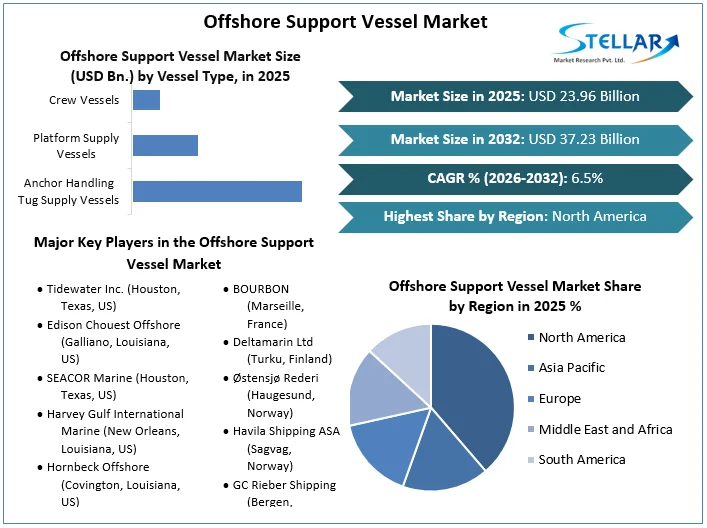
The offshore energy industry is entering a new phase of growth as investments in offshore oil and gas exploration, deepwater drilling, and renewable energy projects continue to rise. At the heart of these operations are Offshore Support Vessels (OSVs), specialized ships that provide transportation, logistics, maintenance, and technical support for offshore facilities. According to Stellar Market Research, the global Offshore Support Vessel Market was valued at USD 23.96 billion in 2025 and is expected to reach USD 37.23 billion by 2032, growing at a CAGR of 6.5% during the forecast period.
What Are Offshore Support Vessels?
Offshore Support Vessels are purpose-built ships designed to assist offshore operations across the oil & gas and renewable energy sectors. They transport personnel, equipment, fuel, and supplies while supporting drilling, construction, inspection, maintenance, and emergency response activities.
Major vessel types include:
- Platform Supply Vessels (PSVs)
- Anchor Handling Tug Supply (AHTS) vessels
- Multi-Purpose Support Vessels (MPSVs)
- Subsea construction vessels
- Cable-laying vessels
- Wind farm support vessels
These vessels play a critical role in ensuring offshore projects operate safely and efficiently in challenging marine environments.
𝐃𝐨𝐰𝐧𝐥𝐨𝐚𝐝 𝐅𝐫𝐞𝐞 𝐏𝐃𝐅 𝐁𝐫𝐨𝐜𝐡𝐮𝐫𝐞: https://www.stellarmr.com/report/req_sample/Offshore-Support-Vessel-Market/2791
Rising Offshore Energy Investments Fuel Market Growth
Growing global energy demand is one of the primary drivers of the Offshore Support Vessel Market. As energy companies invest in new offshore oil and gas reserves, the need for specialized support vessels continues to increase.
Deepwater and ultra-deepwater exploration projects require advanced logistics, equipment transportation, and maintenance services throughout their operational lifecycle. Offshore support vessels enable these complex operations by delivering supplies, positioning drilling rigs, and assisting subsea infrastructure installation.
Offshore Wind Industry Creates New Opportunities
Beyond traditional oil and gas applications, offshore renewable energy is becoming a major growth engine for the market.
Governments worldwide are expanding offshore wind capacity to achieve carbon reduction goals. Every offshore wind project requires vessels for:
- Site surveys
- Turbine installation
- Cable laying
- Equipment transportation
- Maintenance and inspection
- Crew transfer operations
As offshore wind farms expand across Europe, Asia-Pacific, and North America, demand for modern offshore support vessels is expected to increase significantly.
Platform Supply Vessels Lead the Market
Among vessel categories, Platform Supply Vessels (PSVs) remain one of the most widely deployed due to their versatility.
These vessels transport:
- Drilling equipment
- Fuel
- Water
- Food supplies
- Construction materials
- Industrial chemicals
Modern PSVs are increasingly equipped with fuel-efficient propulsion systems, digital navigation technologies, and dynamic positioning capabilities that improve operational safety while reducing emissions.
Technological Innovation Enhances Fleet Performance
Digital transformation is reshaping offshore vessel operations. Shipowners are investing in advanced technologies that improve efficiency, reduce operating costs, and enhance safety.
Key innovations include:
- Hybrid and low-emission propulsion systems
- Dynamic positioning (DP) technology
- Predictive maintenance using AI
- Remote fleet monitoring
- Autonomous navigation assistance
- Real-time fuel optimization
These technologies help operators reduce downtime while complying with increasingly strict environmental regulations.
Challenges Facing the Offshore Support Vessel Market
Despite strong growth prospects, the market faces several challenges.
Building and maintaining offshore support vessels requires substantial capital investment. In addition, fluctuations in crude oil prices can delay offshore exploration projects, directly affecting vessel demand.
The industry also faces challenges related to:
- High maintenance costs
- Crew shortages
- Environmental compliance
- Geopolitical uncertainties
- Rising fuel prices
To remain competitive, operators are modernizing fleets and expanding services for offshore renewable energy projects to reduce dependence on oil and gas cycles.
𝐃𝐨𝐰𝐧𝐥𝐨𝐚𝐝 𝐅𝐫𝐞𝐞 𝐏𝐃𝐅 𝐁𝐫𝐨𝐜𝐡𝐮𝐫𝐞: https://www.stellarmr.com/report/req_sample/Offshore-Support-Vessel-Market/2791
Regional Outlook
Asia-Pacific is expected to remain a key market due to increasing offshore exploration activities, expanding shipbuilding capabilities, and growing investments in offshore wind energy. Countries such as China, India, South Korea, and Southeast Asian nations continue to strengthen offshore infrastructure.
Europe remains a major hub for offshore wind development, driving demand for specialized installation and maintenance vessels, while North America benefits from renewed offshore oil exploration and expanding renewable energy initiatives.
Competitive Landscape
The Offshore Support Vessel Market is highly competitive, with companies focusing on fleet modernization, sustainability, and operational efficiency.
Key industry participants are investing in:
- Hybrid-powered offshore vessels
- Digital fleet management platforms
- Low-emission propulsion technologies
- Offshore wind support capabilities
- Strategic mergers and fleet expansion
Companies that diversify their services across both offshore oil & gas and renewable energy sectors are expected to strengthen their competitive position in the coming years.
Future Outlook
The future of the Offshore Support Vessel Market is closely tied to the global transition toward a diversified energy mix. While offshore oil and gas exploration continues to generate steady demand, rapid growth in offshore wind projects is creating significant new opportunities for vessel operators.
Advancements in vessel automation, hybrid propulsion, digital navigation, and predictive maintenance will further improve operational efficiency and sustainability. As offshore energy infrastructure expands worldwide, offshore support vessels will remain indispensable to the development, operation, and maintenance of critical marine energy assets.
