Market Overview
The Snack Food Packaging Market is experiencing strong transformation as changing consumer lifestyles, increasing demand for convenient food products, and growing sustainability expectations reshape the global packaging industry. Snack food packaging plays a critical role in protecting products such as chips, nuts, confectionery, bakery snacks, and savory foods by maintaining freshness, extending shelf life, improving portability, and enhancing brand visibility.
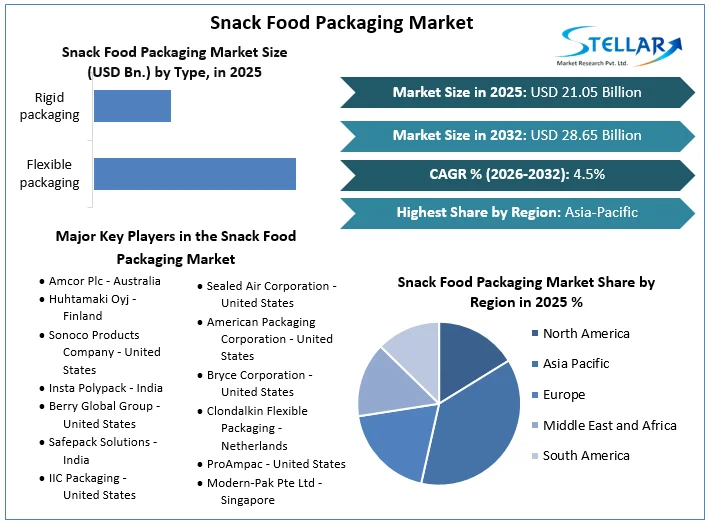
According to Stellar Market Research, the Snack Food Packaging Market was valued at USD 21.05 billion in 2025 and is projected to reach nearly USD 28.65 billion by 2032, growing at a CAGR of 4.5% during 2026–2032. The market growth is being driven by the expansion of ready-to-eat food consumption, rising retail penetration, demand for sustainable packaging formats, and advancements in flexible packaging technologies.
The snack industry has evolved significantly as consumers increasingly prefer portable, single-serving, and easy-to-store food products. This shift has encouraged manufacturers to invest in innovative packaging formats that combine convenience, durability, and environmental responsibility.
Download Free PDF Brochure: https://www.stellarmr.com/report/req_sample/Snack-Food-Packaging-Market/2139
Rising Demand for Convenient and Ready-to-Eat Snacks
One of the major factors supporting the growth of the Snack Food Packaging Market is the increasing popularity of on-the-go eating habits. Urbanization, busy work schedules, and changing lifestyles have encouraged consumers to choose packaged snacks that offer quick consumption without compromising taste or quality.
Ready-to-eat snacks, protein bars, nuts, dried fruits, and functional snack products are gaining popularity among health-conscious consumers. These trends are increasing demand for packaging solutions that provide portion control, resealable features, and longer shelf life.
Food manufacturers are focusing on packaging designs that improve consumer convenience while maintaining product freshness. Resealable pouches, lightweight bags, and flexible packaging formats are becoming increasingly popular due to their ease of handling and transportation benefits.
Flexible Packaging Driving Market Growth
Flexible packaging has emerged as a key growth segment within the snack food packaging industry due to its lightweight structure, cost efficiency, and adaptability. Flexible materials such as films, laminates, and pouches provide excellent barrier protection against moisture, oxygen, and external contamination.
The increasing adoption of flexible packaging is supported by its ability to reduce transportation costs, optimize storage space, and improve product shelf appeal. Snack brands are increasingly using stand-up pouches, zipper bags, and innovative film-based packaging to differentiate products in competitive retail environments.
Digital printing technology is further enhancing flexible packaging capabilities by allowing brands to customize designs, launch limited-edition products, and quickly respond to consumer preferences. This enables companies to strengthen branding strategies while reducing waste associated with traditional printing processes.
Sustainability Becomes a Key Market Priority
Environmental concerns surrounding plastic waste are significantly influencing the future direction of the Snack Food Packaging Market. Consumers, governments, and food manufacturers are increasingly demanding packaging solutions that minimize environmental impact.
Companies are investing in recyclable, biodegradable, and compostable packaging materials to meet sustainability goals. Paper-based packaging, mono-material films, and bio-based polymers are gaining attention as alternatives to conventional plastic packaging.
Regulatory pressure is also encouraging manufacturers to redesign packaging structures and improve recycling compatibility. Governments worldwide are introducing policies focused on reducing plastic waste and increasing circular economy practices.
However, sustainable packaging adoption remains challenging due to higher production costs, limited recycling infrastructure, and technical difficulties in maintaining the same level of product protection offered by traditional materials. Manufacturers must balance environmental responsibility with shelf-life requirements and cost efficiency.
Technological Advancements Transforming Packaging Solutions
Technology innovation is playing an important role in improving the performance and functionality of snack food packaging. Modified atmosphere packaging (MAP) technology is increasingly being adopted to preserve freshness and extend product shelf life.
Smart packaging solutions, including QR codes, digital tracking systems, and interactive packaging features, are also gaining importance. These technologies allow brands to provide consumers with product information, authentication features, and improved engagement opportunities.
Advanced barrier coatings and improved material engineering are helping manufacturers develop packaging that offers better protection while using fewer resources. These innovations are expected to support the transition toward more efficient and sustainable packaging solutions.
Material Trends in Snack Food Packaging
The market is segmented based on materials such as plastic, paper, metal, and other alternatives. Plastic remains one of the widely used materials due to its flexibility, durability, lightweight nature, and ability to provide strong barrier properties.
Plastic packaging is commonly used for snack pouches, bags, and containers because it helps preserve product quality and prevents moisture exposure. However, increasing environmental concerns are encouraging companies to explore recyclable and alternative materials.
Paper-based packaging is gaining momentum due to growing demand for sustainable solutions. Brands are adopting paper-based wrappers, cartons, and recyclable packaging formats to improve environmental performance and meet consumer expectations.
Metal packaging continues to serve specialized applications where durability and extended shelf life are important, particularly for premium snack products.
Regional Market Outlook
The Asia Pacific Snack Food Packaging Market is expected to witness significant growth due to increasing snack consumption, rapid urbanization, expanding retail networks, and rising disposable incomes. Countries such as China and India are becoming important markets as demand for packaged snacks continues to rise.
India represents a particularly attractive opportunity due to the growing savory snacks sector and increasing demand for innovative packaging solutions. The expansion of supermarkets, e-commerce platforms, and food delivery services is further supporting market growth.
North America remains a major market due to high snack consumption, established food brands, and early adoption of sustainable packaging technologies. Europe is also experiencing strong demand for eco-friendly packaging solutions due to strict environmental regulations and consumer preference for sustainable products.
Competitive Landscape and Industry Developments
The competitive landscape of the Snack Food Packaging Market includes major packaging companies focusing on sustainability, innovation, and geographic expansion.
Recent industry developments include:
Amcor (2024): Opened its European Innovation Center in Belgium to collaborate with brands and retailers on developing sustainable packaging solutions and improving packaging performance.
Constantia Flexibles (2024): Introduced EcoTwistPaper, a paper-based confectionery packaging solution designed to support recyclable packaging initiatives.
Bryce Corporation (2022): Announced an $80 million investment to expand flexible packaging operations in Arkansas, strengthening manufacturing capacity.
Huhtamaki (2024): Consolidated flexible packaging manufacturing operations in the UAE to improve production efficiency and strengthen regional capabilities.
Leading companies are increasingly focusing on sustainable product development, advanced manufacturing technologies, and strategic partnerships to maintain competitiveness.
Download Free PDF Brochure: https://www.stellarmr.com/report/req_sample/Snack-Food-Packaging-Market/2139
Future Outlook of the Snack Food Packaging Market
The future of the Snack Food Packaging Market will be shaped by sustainability, convenience, digital transformation, and evolving consumer preferences. As snack consumption continues to expand globally, packaging manufacturers will need to deliver solutions that provide product protection while reducing environmental impact.
Flexible packaging, recyclable materials, smart packaging technologies, and digital printing innovations are expected to remain major growth areas through the forecast period. Companies that successfully balance sustainability, cost efficiency, and performance will gain competitive advantages.
With increasing investments in packaging innovation and growing demand for convenient snack products, the market is positioned for steady expansion. The transition toward environmentally responsible packaging solutions will continue to define the next phase of growth in the global snack food packaging industry.
Media Contact
Stellar Market Research
Website: Stellar Market Research – Global Research Reports & Consulting
Email: sales@stellarmr.com
