Key Highlights
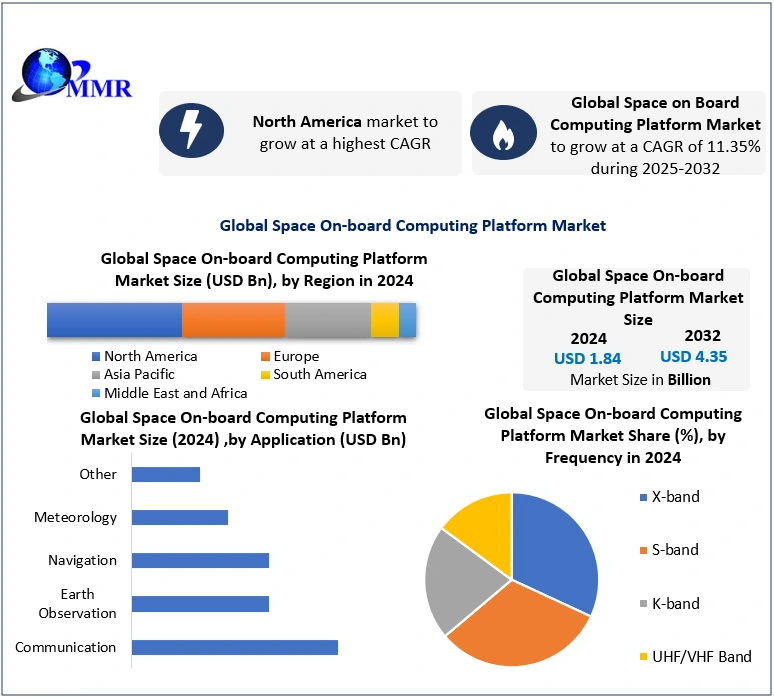
Market Valuation: USD 1.84 billion in 2024.
Forecasted Value: USD 4.35 billion by 2032.
CAGR: 11.35% during the 2025–2032 forecast period.
Dominant Segment: Medium satellites (500–2,000 kg), valued for their balanced payload capacity and mission flexibility.
Fastest-Growing Segment: Low Earth Orbit (LEO) satellite platforms, driven by the massive expansion of CubeSat and small-satellite constellations.
Regional Leader: North America, anchored by major defense primes and aggressive space agency R&D programs.
Why This Matters Now
The paradigm of space operations has shifted from static, ground-commanded missions to dynamic, autonomous orbital intelligence. For defense contractors and space companies, the ability to process data at the “edge”—directly on the satellite—is the new baseline for national security and commercial competitiveness. Organizations that fail to transition their satellite architectures to high-performance, on-board computing risk losing relevance in an environment where speed-to-decision dictates the success of navigation, reconnaissance, and communication missions.
Market Overview
The Space on-Board Computing Market consists of the ruggedized processors, software platforms, and memory systems that govern all satellite functions. These systems manage orbit control, payload data processing, and telemetry management in one of the most hostile environments known to engineering. As missions grow in complexity—from simple scientific research to real-time Earth observation and secure, multi-node communication—the computational requirement has transitioned from basic microcontrollers to advanced, high-throughput processing architectures.
Key Trends Driving Growth
Commercial and civil interest in LEO constellations has triggered a surge in demand for affordable, high-reliability computing. By moving data processing off the ground and onto the satellite, operators reduce latency and bandwidth usage, creating a leaner, more efficient mission profile. The rise of CubeSats and small-sat missions, which prioritize modularity and low-cost hardware, has further expanded the market, creating a vibrant ecosystem of suppliers who can deliver space-hardened, yet high-performance, compute power.
Segment Insights
Dominant Segment: Medium Satellites. In 2024, satellites weighing between 500 and 2,000 kg captured the largest market share. These platforms remain the “workhorses” of the industry, offering the necessary reliability and payload volume for complex, long-duration missions.
Fastest-Growing Segment: Low Earth Orbit (LEO). Rapid deployment of constellations in the 500–1,500 km range is fueling a massive increase in demand for compact, efficient computing systems. This segment now dictates the industry’s innovation pace, with satellites increasingly acting as intelligent, automated nodes in global communication and observation networks.
Regional Growth Story
North America holds the highest market share, supported by a dense concentration of aerospace giants including Lockheed Martin, Northrop Grumman, Honeywell, and Raytheon. This region benefits from a symbiotic relationship between massive government-funded space agency programs and the commercial space industry. Meanwhile, globally, players like BAE Systems (UK), Thales (France), and Israel’s Ramon Space are driving innovation, focusing on radiation-hardened architectures and AI-integrated processing that allow satellites to perform complex tasks previously requiring ground-side relay.
Competitive Landscape
Competition in the orbital computing space is intense, focused on miniaturization and thermal management. The industry is currently moving away from bespoke, ultra-expensive hardware toward “space-grade” adaptations of terrestrial compute architectures. Strategic investments by prime contractors into startups specializing in radiation-tolerant AI chips indicate a market-wide pivot toward autonomous processing. Companies that master the integration of AI software into radiation-hardened hardware will dictate the next decade of space dominance.
Recent Developments
Edge-AI Integration: Increased testing of on-board AI algorithms that allow satellites to filter Earth observation imagery, downlinking only actionable data rather than raw feeds.
Radiation-Tolerant Architectures: Shift toward innovative chip designs that maintain performance under high-radiation conditions without the cost of traditional high-cost shielding.
Standardized Modular Platforms: Rise of “plug-and-play” computing interfaces, enabling faster satellite integration and shorter procurement cycles for commercial constellations.
Strategic Implications
For defense and procurement strategists, the market shift toward modular, high-compute satellite platforms necessitates a change in acquisition strategy. The focus must be on interoperability and “software-defined” orbital assets that can be updated or reprogrammed post-launch. As space becomes an increasingly contested theater, the ability to deploy compute-heavy, secure platforms that can autonomously adapt to jamming or hardware degradation will define the future of aerospace superiority.
Future Outlook
The divide in the space computing industry will widen between legacy providers who rely on slow, high-cost innovation cycles and the new vanguard of aerospace leaders who treat orbit-based processing as a scalable, software-driven asset.
Analyst Perspective
“The space on-board computing market is rapidly evolving into the central nervous system of the space economy,” says Rucha Deshpande, Analyst at Maximize Market Research. “As we approach 2032, the transformation of satellites from passive relays into intelligent edge-computing nodes will not only lower the cost of missions but will completely redefine how we manage and utilize data in orbit.”
About Maximize Market Research
Maximize Market Research Pvt. Ltd. (MMR) is a global market research and consulting company that provides reliable, data-focused, and practical business insights. The firm serves a wide range of industries, including healthcare, pharmaceuticals, technology, automotive, electronics, chemicals, personal care, and consumer goods. Through market forecasts, competitive analysis, strategic consulting, and industry impact assessments, MMR helps organizations understand changing market conditions, identify growth opportunities, and make informed business decisions for long-term success.
2nd Floor, Navale IT Park Phase 3
Pune Banglore Highway, Narhe
Pune, Maharashtra 411041, India
+91 9607365656
sales@maximizemarketresearch.com
