Home Use Air Purifiers Market: Smart Air Quality Solutions Drive the Future of Healthy Living
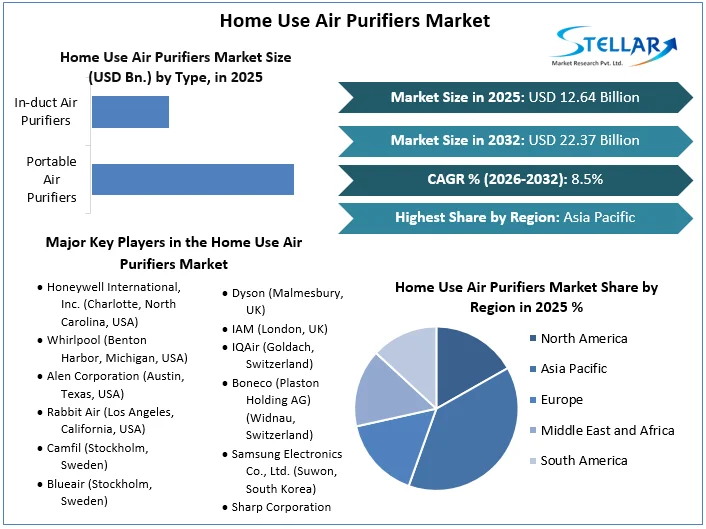
Growing concerns about indoor air pollution, allergies, and respiratory health are transforming the way consumers think about home environments. As urbanization and industrialization continue to impact air quality, the Home Use Air Purifiers Market is witnessing robust growth. Technological innovations such as HEPA filtration, IoT-enabled monitoring, and smart home integration are making air purifiers more efficient and accessible. According to Stellar Market Research, the global Home Use Air Purifiers Market was valued at USD 12.64 billion in 2025 and is projected to reach USD 22.37 billion by 2032, growing at a CAGR of 8.5% during the forecast period.
What Are Home Use Air Purifiers?
Home-use air purifiers are devices designed to improve indoor air quality by removing airborne contaminants such as dust, pollen, pet dander, smoke, bacteria, viruses, and volatile organic compounds (VOCs). Modern air purifiers use advanced filtration technologies to create healthier indoor environments for homes, apartments, and residential spaces.
Common product types include:
- Portable air purifiers
- In-duct air purifiers
- HEPA filter-based systems
- Activated carbon air purifiers
- UV-C air purifiers
- Smart connected air purifiers
These products are increasingly becoming essential household appliances, particularly in urban areas with high pollution levels.
𝐃𝐨𝐰𝐧𝐥𝐨𝐚𝐝 𝐅𝐫𝐞𝐞 𝐏𝐃𝐅 𝐁𝐫𝐨𝐜𝐡𝐮𝐫𝐞: https://www.stellarmr.com/report/req_sample/Home-Use-Air-Purifiers-Market/1898
Rising Awareness of Indoor Air Quality Fuels Market Growth
One of the primary drivers of the Home Use Air Purifiers Market is the growing awareness of the health risks associated with indoor air pollution. Pollutants generated from cooking, cleaning products, furniture, paints, and outdoor pollution can accumulate indoors, contributing to allergies, asthma, and other respiratory conditions.
Consumers are increasingly investing in air purification systems to:
- Reduce allergens
- Remove harmful airborne particles
- Improve sleep quality
- Minimize exposure to viruses and bacteria
- Create healthier living environments
This heightened focus on preventive healthcare continues to support market expansion worldwide.
Smart Air Purifiers Transform Home Air Management
Technology is playing a major role in the evolution of residential air purification. Modern smart air purifiers offer intelligent features that improve both convenience and performance.
Key innovations include:
- Real-time air quality monitoring
- Wi-Fi and IoT connectivity
- Smartphone app control
- Voice assistant compatibility
- Automatic fan speed adjustment
- Filter replacement notifications
These smart features enable users to monitor and control indoor air quality remotely while optimizing energy consumption.
Portable Air Purifiers Lead the Market
Among product categories, portable air purifiers hold the largest share of the Home Use Air Purifiers Market.
Their popularity is driven by:
- Easy installation
- Room-to-room portability
- Affordable pricing
- Compact designs
- High filtration efficiency
Modern portable units often incorporate H13 True HEPA filters, activated carbon filters, and ultra-quiet operation, making them suitable for bedrooms, living rooms, nurseries, and home offices.
Advanced Filtration Technologies Improve Performance
Manufacturers continue to invest in advanced filtration systems capable of capturing even microscopic pollutants.
Leading technologies include:
- HEPA filtration for fine particles
- Activated carbon filters for odors and VOCs
- UV-C sterilization for microorganisms
- Multi-stage filtration systems
- Air quality sensors with automatic purification modes
These technologies help improve indoor air quality while enhancing user confidence in product effectiveness.
Challenges Facing the Market
Despite strong growth prospects, several challenges remain.
Regular filter replacement increases long-term ownership costs, particularly for HEPA-based systems. Additionally, premium smart air purifiers often carry higher upfront prices, which may limit adoption among price-sensitive consumers.
Other challenges include:
- Maintenance expenses
- Limited coverage areas for portable units
- Noise levels at higher fan speeds
- Consumer concerns regarding ozone-generating technologies
Manufacturers are addressing these issues by developing quieter, energy-efficient, and low-maintenance products with longer-lasting filters.
Asia-Pacific Dominates Global Demand
According to the report, Asia-Pacific accounted for the largest market share in 2025 and is expected to maintain its leadership throughout the forecast period.
The region’s growth is supported by:
- Rapid urbanization
- Increasing industrial emissions
- Rising disposable incomes
- Growing health awareness
- Government initiatives promoting cleaner air
Countries such as China, India, Japan, and South Korea continue to witness rising adoption of residential air purifiers as consumers become more conscious of indoor air quality.
Competitive Landscape
Leading manufacturers are focusing on innovation, smart connectivity, and energy efficiency to strengthen their market positions.
Major industry trends include:
- AI-powered air quality optimization
- Smart home ecosystem integration
- Multi-stage filtration technologies
- Energy-efficient product development
- Compact and aesthetically designed air purifiers
Companies are also expanding their online distribution channels and introducing models tailored to different room sizes and consumer budgets.
𝐃𝐨𝐰𝐧𝐥𝐨𝐚𝐝 𝐅𝐫𝐞𝐞 𝐏𝐃𝐅 𝐁𝐫𝐨𝐜𝐡𝐮𝐫𝐞: https://www.stellarmr.com/report/req_sample/Home-Use-Air-Purifiers-Market/1898
Future Outlook
The future of the Home Use Air Purifiers Market looks highly promising as consumers increasingly prioritize healthier indoor environments. Growing awareness of airborne pollutants, advances in smart home technology, and continuous improvements in filtration systems will continue to drive market growth.
With rising demand for connected appliances, energy-efficient designs, and intelligent air quality management, home-use air purifiers are expected to become an integral part of modern households. As manufacturers continue to innovate and expand their product offerings, the market is well positioned for sustained growth through 2032.
