Market Overview
The global Commercial Earth Observation Market is entering a period of rapid transformation as businesses, governments, and research organizations increasingly depend on satellite-based intelligence for real-time decision-making. Earth observation technologies provide critical insights through satellite imagery, remote sensing, geospatial analytics, and advanced data-processing solutions, enabling industries such as agriculture, defense, urban planning, environmental monitoring, and disaster management to improve operational efficiency.
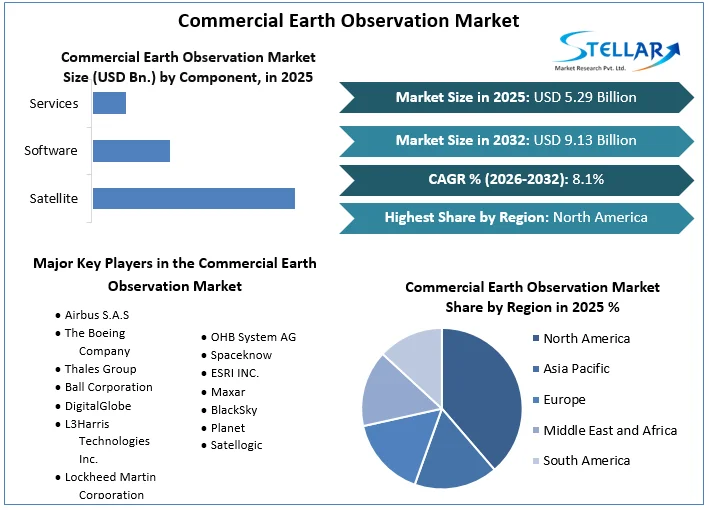
According to Stellar Market Research, the Commercial Earth Observation Market was valued at USD 5.29 billion in 2025 and is expected to reach nearly USD 9.13 billion by 2032, growing at a CAGR of 8.1% during the forecast period of 2026–2032. The market expansion is being driven by increasing demand for high-resolution satellite data, advancements in artificial intelligence (AI), cloud-based analytics, and the growing commercialization of space technologies.
The increasing accessibility of satellite data has shifted Earth observation from a government-focused technology into a commercially valuable intelligence platform. Organizations are now using geospatial insights to optimize supply chains, monitor climate risks, improve agricultural productivity, and support strategic planning.
Download Free PDF Brochure: https://www.stellarmr.com/report/req_sample/Commercial-Earth-Observation-Market/2204
Rising Demand for Satellite Data and Geospatial Intelligence
One of the primary factors driving the growth of the Commercial Earth Observation Market is the rising need for accurate and timely information. Companies across multiple sectors are adopting satellite-based analytics to make data-driven decisions and manage complex operational challenges.
The agriculture industry is among the largest users of Earth observation solutions. Farmers and agricultural enterprises are utilizing satellite imagery for crop monitoring, soil analysis, irrigation management, and yield prediction. These technologies enable precision farming practices that reduce resource consumption while improving productivity.
Environmental monitoring is another major application area. Governments, conservation organizations, and businesses are using Earth observation data to track deforestation, biodiversity changes, carbon emissions, and climate-related risks. The ability to monitor large geographical areas continuously makes satellite-based solutions valuable for sustainability initiatives.
Urban development and infrastructure management are also contributing to market growth. Cities are increasingly using geospatial data for smart city planning, traffic management, land-use monitoring, and infrastructure assessment.
Artificial Intelligence and Cloud Analytics Reshape the Industry
Technology advancements are significantly influencing the evolution of the Commercial Earth Observation Market. Artificial intelligence, machine learning, and cloud computing are improving the speed and accuracy of satellite data analysis.
Traditional satellite imagery often generated large volumes of raw information that required extensive manual processing. AI-powered analytics platforms can now automatically identify patterns, detect changes, and generate actionable insights from satellite images. This capability allows organizations to respond faster to environmental changes, security threats, and business challenges.
Cloud-based Earth observation platforms are also improving accessibility by allowing users to store, process, and analyze large datasets without investing in expensive infrastructure. This has opened opportunities for small and medium-sized enterprises to adopt satellite intelligence solutions.
The integration of advanced sensors, hyperspectral imaging, radar technologies, and improved satellite communication systems is expected to further expand the capabilities of commercial Earth observation services.
Government and Defense Applications Support Market Expansion
Government agencies and defense organizations remain important contributors to the Commercial Earth Observation Market. Satellite-based monitoring plays a critical role in border surveillance, national security, disaster response, and infrastructure protection.
Defense agencies are increasingly partnering with commercial satellite operators to access high-resolution imagery and real-time intelligence. This shift toward public-private collaboration is creating new revenue opportunities for commercial Earth observation providers.
Disaster management is another growing application area. Satellite data enables authorities to monitor floods, wildfires, hurricanes, and other natural disasters. Early detection and accurate mapping help emergency response teams improve preparedness and reduce economic losses.
The increasing frequency of climate-related events worldwide is expected to strengthen demand for satellite-based monitoring solutions.
Market Segmentation and Growth Opportunities
The Commercial Earth Observation Market is segmented based on components and applications. The major components include satellite systems, software platforms, and services. Among these, data analytics and service-based solutions are gaining importance as organizations increasingly focus on extracting business value from satellite information.
By application, major segments include environmental monitoring, mapping and surveying, agriculture, security and intelligence, disaster management, and natural resource exploration.
Environmental monitoring and agriculture applications are expected to experience significant growth due to rising sustainability requirements and increasing adoption of precision farming technologies.
Commercial enterprises represent a major opportunity area as industries beyond aerospace and defense begin integrating satellite intelligence into daily operations.
Regional Market Insights
North America currently dominates the Commercial Earth Observation Market due to strong technological capabilities, established satellite companies, and significant investments in space-based technologies. The region benefits from the presence of major players and increasing demand from defense, agriculture, and environmental monitoring sectors.
The United States continues to lead commercial satellite innovation through private space companies, advanced analytics providers, and government-supported space programs.
Europe is also witnessing steady market growth due to investments in climate monitoring, sustainability initiatives, and satellite-based environmental programs. Countries such as Germany, France, and the United Kingdom are expanding their capabilities in geospatial intelligence.
The Asia-Pacific region is emerging as a high-growth market due to increasing space investments, expanding satellite programs, and growing demand for agricultural and infrastructure monitoring solutions. Countries including India, China, Japan, and South Korea are strengthening their commercial space ecosystems. India, in particular, is encouraging private participation in space technologies and satellite-based services.
Competitive Landscape and Industry Developments
The Commercial Earth Observation Market includes global satellite operators, analytics providers, and technology companies competing through innovation, partnerships, and service expansion.
Key players are focusing on improving satellite resolution, expanding satellite constellations, developing AI-based analytics platforms, and creating industry-specific solutions.
Recent developments include:
Planet Labs (2025): Expanded commercial Earth observation capabilities through satellite constellation improvements and enhanced geospatial data services for enterprise customers.
Maxar Technologies (2025): Continued development of advanced high-resolution imaging solutions to support defense, intelligence, and commercial applications.
Airbus Defence and Space (2025): Strengthened Earth observation services through satellite imagery innovation and expanded geospatial intelligence offerings.
Spire Global (2025): Increased focus on satellite data analytics solutions for weather monitoring, maritime intelligence, and environmental applications.
Pixxel (2025): Advanced hyperspectral Earth observation satellite initiatives to provide detailed data for agriculture, climate monitoring, and industrial applications.
Download Free PDF Brochure: https://www.stellarmr.com/report/req_sample/Commercial-Earth-Observation-Market/2204
Future Outlook of the Commercial Earth Observation Market
The future of the Commercial Earth Observation Market is expected to be shaped by increasing satellite deployments, AI-powered analytics, and growing demand for real-time intelligence. As businesses continue adopting data-driven strategies, Earth observation will become an essential tool for decision-making across industries.
The combination of lower satellite deployment costs, improved sensor technologies, and advanced data-processing capabilities will create new commercial opportunities. Companies are expected to move beyond traditional imagery services toward value-added analytics and predictive intelligence platforms.
Sustainability goals, climate monitoring requirements, and increasing digital transformation across industries will further accelerate market adoption. The growing collaboration between governments, private space companies, and technology providers will strengthen the commercial space ecosystem.
With continued investment in satellite infrastructure and analytics innovation, the Commercial Earth Observation Market is positioned for sustained growth through 2032, becoming a key technology platform for managing resources, protecting the environment, and enabling smarter global decision-making.
Media Contact
Stellar Market Research
Website: Stellar Market Research – Global Research Reports & Consulting
Email: sales@stellarmr.com
