Printed and Flexible Sensors Market Overview
The global Printed and Flexible Sensors Market is experiencing significant growth as industries increasingly adopt lightweight, adaptable, and cost-effective sensing technologies for next-generation applications. Printed and flexible sensors are transforming traditional sensor systems by enabling integration into curved, wearable, and compact surfaces that were previously difficult to monitor. These advanced sensors are becoming essential components in consumer electronics, healthcare devices, automotive systems, industrial automation, and smart packaging solutions.
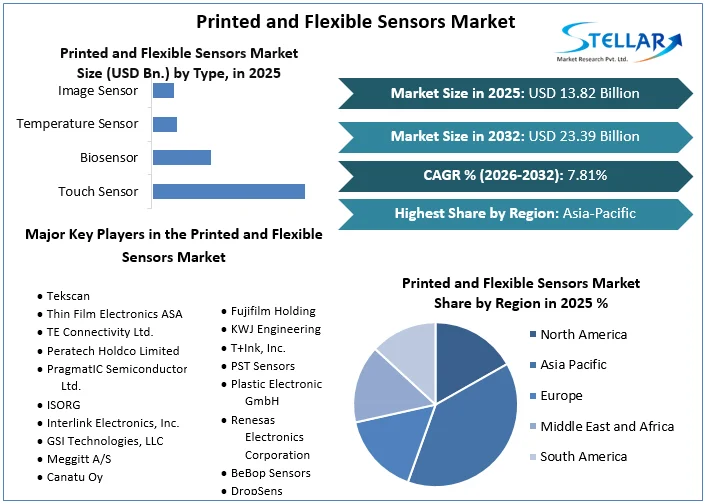
According to Stellar Market Research, the Printed and Flexible Sensors Market was valued at approximately USD 13.82 billion in 2025 and is projected to reach nearly USD 23.39 billion by 2032, expanding at a CAGR of 7.81% during the forecast period of 2026–2032. The growing adoption of flexible electronics, wearable technology, Internet of Things (IoT) devices, and demand for energy-efficient sensing solutions are key factors driving market expansion.
Unlike conventional rigid sensors, printed and flexible sensors can be manufactured using advanced printing techniques on flexible substrates such as plastic, paper, and thin films. Their ability to provide accurate sensing capabilities while reducing weight, size, and production costs is creating new opportunities across multiple industries.
Download Free PDF Brochure: https://www.stellarmr.com/report/req_sample/Printed-and-Flexible-Sensors-Market/2206
Increasing Demand for Wearable Technology Drives Market Growth
One of the major factors supporting the growth of the Printed and Flexible Sensors Market is the rapid expansion of wearable technology. Smartwatches, fitness trackers, medical monitoring devices, and smart clothing increasingly require flexible sensors capable of measuring body temperature, heart rate, motion, pressure, and other biological signals.
Healthcare providers are adopting wearable sensing technologies for remote patient monitoring and personalized healthcare solutions. Flexible biosensors allow continuous monitoring of health conditions without causing discomfort to users. This capability is particularly valuable for elderly care, chronic disease management, and preventive healthcare applications.
The growing consumer preference for compact and multifunctional electronic devices is also increasing demand for flexible sensing components. Manufacturers are focusing on developing sensors that can be integrated into lightweight and portable devices without compromising performance.
Advancements in Printing Technologies Enhance Production Efficiency
Technological advancements in printing methods are playing a crucial role in expanding the Printed and Flexible Sensors Market. Manufacturing techniques such as screen printing, inkjet printing, flexographic printing, and roll-to-roll processing enable large-scale production of flexible sensors with improved efficiency.
Screen printing remains widely adopted due to its cost-effectiveness and ability to produce sensors on various materials. Inkjet printing is gaining attention because of its precision, customization capabilities, and suitability for advanced electronic applications.
Roll-to-roll manufacturing is another emerging technology expected to influence market development. This process enables high-volume production of flexible electronic components at lower costs, supporting the commercialization of smart devices and large-area sensor applications.
Continuous innovation in conductive inks, nanomaterials, graphene-based technologies, and organic electronics is further improving sensor sensitivity, durability, and performance.
Healthcare and Automotive Applications Create New Opportunities
The healthcare sector represents one of the most promising application areas for printed and flexible sensors. The increasing demand for remote monitoring devices, wearable medical equipment, and smart diagnostic tools is encouraging healthcare companies to integrate flexible sensing technologies.
Flexible biosensors can detect various health indicators, including glucose levels, body temperature, and chemical biomarkers. These capabilities support early disease detection and personalized treatment approaches.
The automotive industry is another important growth area. Modern vehicles increasingly rely on advanced sensing systems for safety, comfort, and automation. Flexible sensors are being used in applications such as pressure monitoring, seat occupancy detection, touch interfaces, and interior environmental monitoring.
The rise of electric vehicles and autonomous driving technologies is expected to create additional demand for lightweight and efficient sensor solutions. Flexible sensors can contribute to improved vehicle design by enabling integration into unconventional surfaces and compact spaces.
Growth of IoT and Smart Electronics Accelerates Adoption
The expansion of the Internet of Things (IoT) ecosystem is significantly influencing the demand for printed and flexible sensors. Smart homes, industrial automation systems, and connected devices require sensors that are affordable, reliable, and easy to integrate.
Flexible sensors enable manufacturers to create intelligent surfaces capable of collecting real-time data. Applications include smart packaging, environmental monitoring systems, wearable devices, and industrial equipment monitoring.
In industrial environments, these sensors support predictive maintenance by detecting changes in temperature, pressure, vibration, and equipment performance. Companies are using sensor-based monitoring systems to reduce downtime, improve operational efficiency, and optimize resource utilization.
The increasing adoption of Industry 4.0 technologies is expected to strengthen demand for flexible sensing solutions across manufacturing sectors.
Regional Insights of the Printed and Flexible Sensors Market
North America holds a significant position in the Printed and Flexible Sensors Market due to strong investments in advanced electronics, healthcare innovation, and IoT technologies. The presence of leading technology companies, research institutions, and flexible electronics developers supports regional market growth.
The United States is a major contributor due to increasing adoption of wearable healthcare devices, smart consumer electronics, and automotive sensing technologies. Government and private-sector investments in advanced manufacturing are also supporting innovation.
Europe is witnessing steady growth due to increasing demand for sustainable electronics, smart manufacturing solutions, and healthcare monitoring technologies. Countries including Germany, the United Kingdom, and France are focusing on flexible electronics research and industrial applications.
The Asia-Pacific region is expected to experience significant growth during the forecast period. Countries such as China, Japan, South Korea, and India are investing heavily in electronics manufacturing, semiconductor technologies, and consumer device production. The region benefits from strong manufacturing capabilities and growing demand for smart devices.
Competitive Landscape and Industry Developments
The Printed and Flexible Sensors Market includes technology companies, sensor manufacturers, and electronics innovators focusing on product development, partnerships, and commercialization strategies.
Key companies are investing in advanced materials, expanding manufacturing capabilities, and developing application-specific sensor solutions.
Recent industry developments include:
FlexEnable (2025): Expanded flexible electronics technology development to support next-generation displays and sensor applications.
Canatu (2025): Advanced carbon nanotube-based flexible sensing technologies for electronics and healthcare applications.
Interlink Electronics (2025): Continued development of printed force and pressure sensing solutions for industrial and consumer applications.
Tekscan (2024): Enhanced thin-film sensor technologies for medical, automotive, and industrial markets.
ISORG (2025): Increased focus on printed image sensor technologies for advanced imaging applications.
Download Free PDF Brochure: https://www.stellarmr.com/report/req_sample/Printed-and-Flexible-Sensors-Market/2206
Future Outlook of the Printed and Flexible Sensors Market
The future of the Printed and Flexible Sensors Market is expected to be shaped by rapid advancements in flexible electronics, wearable technologies, and smart connected systems. As industries continue to prioritize lightweight, energy-efficient, and adaptable sensing solutions, demand for printed sensors will continue expanding.
Healthcare transformation, IoT adoption, automotive innovation, and smart manufacturing will remain key growth drivers. Manufacturers are expected to focus on improving sensor accuracy, reducing production costs, and developing sustainable materials to meet evolving market requirements.
The integration of artificial intelligence, advanced analytics, and connected technologies will further enhance the value of flexible sensors by enabling real-time data processing and intelligent decision-making.
With increasing investments in research, expanding commercial applications, and growing demand for smart technologies, the Printed and Flexible Sensors Market is positioned for strong growth through 2032, becoming a critical component of the future digital ecosystem.
Media Contact
Stellar Market Research
Website: Stellar Market Research – Global Research Reports & Consulting
Email: sales@stellarmr.com
