Retail Logistics Market: Smart Supply Chains and E-commerce Revolution Drive Global Growth
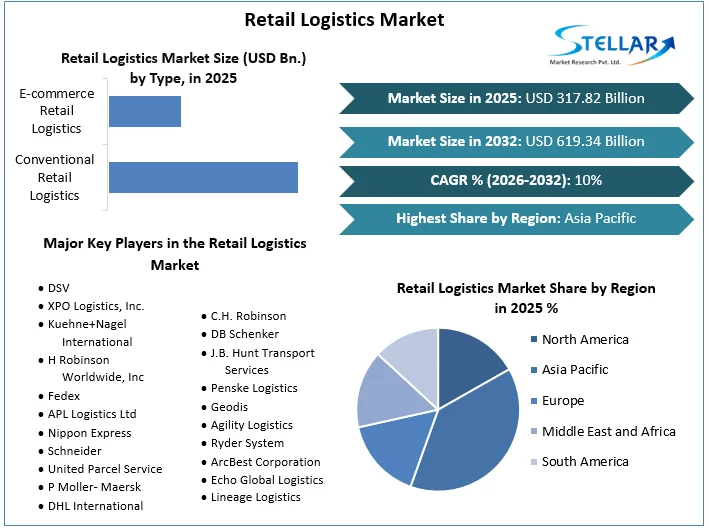
The rapid growth of e-commerce, changing consumer expectations, and advances in digital technologies are transforming the global Retail Logistics Market. Retailers are investing heavily in intelligent supply chain solutions, automated warehouses, and faster last-mile delivery services to meet rising demand for quick, reliable, and cost-effective fulfillment. According to Stellar Market Research, the global Retail Logistics Market was valued at USD 317.82 billion in 2025 and is projected to reach USD 619.34 billion by 2032, growing at a CAGR of 10% during the forecast period.
What Is Retail Logistics?
Retail logistics encompasses all activities involved in moving products from manufacturers and distribution centers to retail stores or directly to consumers. It includes inventory management, warehousing, order fulfillment, transportation, and returns management.
The market covers:
- Warehousing and storage
- Inventory management
- Order fulfillment
- Transportation management
- Last-mile delivery
- Reverse logistics
- Supply chain solutions
Efficient retail logistics enables businesses to reduce costs, improve customer satisfaction, and maintain product availability across multiple sales channels.
𝐃𝐨𝐰𝐧𝐥𝐨𝐚𝐝 𝐅𝐫𝐞𝐞 𝐏𝐃𝐅 𝐁𝐫𝐨𝐜𝐡𝐮𝐫𝐞: https://www.stellarmr.com/report/req_sample/Retail-Logistics-Market/2017
E-commerce Expansion Fuels Market Growth
The rapid expansion of online shopping is the primary driver of the Retail Logistics Market. Consumers increasingly expect same-day or next-day deliveries, encouraging retailers to modernize their logistics networks.
Key growth drivers include:
- Rising online retail sales
- Omnichannel retail strategies
- Growing demand for fast delivery
- Expansion of direct-to-consumer (DTC) brands
- Increasing cross-border e-commerce
To meet these expectations, retailers are investing in advanced fulfillment centers and technology-driven logistics operations.
Automation and AI Improve Supply Chain Efficiency
Technology is revolutionizing retail logistics through automation and artificial intelligence.
Major innovations include:
- AI-powered demand forecasting
- Automated warehouse systems
- Robotics for order picking
- Internet of Things (IoT) inventory tracking
- Warehouse Management Systems (WMS)
- Real-time shipment visibility
These technologies improve inventory accuracy, reduce operational costs, and enable retailers to deliver products more efficiently.
Last-Mile Delivery Becomes a Competitive Advantage
Last-mile delivery has become one of the most critical components of modern retail logistics.
Retailers are expanding delivery options through:
- Same-day delivery
- Next-day delivery
- Click-and-collect services
- Parcel lockers
- Micro-fulfillment centers
- Crowdsourced delivery networks
Efficient last-mile operations help businesses improve customer satisfaction while strengthening brand loyalty in an increasingly competitive retail environment.
Omnichannel Retailing Drives Logistics Innovation
Consumers now shop across physical stores, websites, mobile apps, and social commerce platforms. This shift has increased the complexity of retail logistics.
Modern logistics networks must support:
- Store replenishment
- Online order fulfillment
- Buy Online, Pick Up In Store (BOPIS)
- Ship-from-store operations
- Unified inventory management
Integrated omnichannel logistics allows retailers to deliver seamless shopping experiences while maximizing inventory utilization.
Sustainability Gains Importance
Retailers are increasingly focusing on sustainable logistics practices to reduce environmental impact and meet consumer expectations.
Current sustainability initiatives include:
- Electric delivery vehicles
- Route optimization software
- Eco-friendly packaging
- Energy-efficient warehouses
- Carbon emission reduction programs
- Reverse logistics for product recycling
Green logistics not only supports environmental goals but also improves operational efficiency and brand reputation.
Challenges Facing the Market
Despite strong growth prospects, the Retail Logistics Market faces several operational challenges.
Major challenges include:
- Demand forecasting inaccuracies
- Rising transportation costs
- Labor shortages
- Complex regulatory compliance
- Supply chain disruptions
- High investment requirements for automation
Retailers are addressing these issues by adopting AI-driven forecasting tools, cloud-based logistics platforms, and flexible supply chain strategies.
Regional Outlook
Asia-Pacific is expected to remain one of the fastest-growing regional markets due to expanding e-commerce, rapid urbanization, and increasing consumer spending. Countries such as China and India continue to invest heavily in logistics infrastructure and warehouse automation.
North America and Europe also maintain significant market shares, supported by advanced logistics technologies, mature retail industries, and strong adoption of omnichannel retailing.
𝐃𝐨𝐰𝐧𝐥𝐨𝐚𝐝 𝐅𝐫𝐞𝐞 𝐏𝐃𝐅 𝐁𝐫𝐨𝐜𝐡𝐮𝐫𝐞: https://www.stellarmr.com/report/req_sample/Retail-Logistics-Market/2017
Competitive Landscape
Leading logistics providers and retailers continue to invest in automation, digital platforms, and strategic partnerships to strengthen their supply chain capabilities.
Major competitive strategies include:
- Expanding fulfillment center networks
- Investing in AI and robotics
- Enhancing last-mile delivery services
- Developing cloud-based logistics platforms
- Strengthening third-party logistics (3PL) partnerships
- Improving real-time supply chain visibility
These investments enable companies to improve operational efficiency while meeting growing customer expectations for speed and reliability.
Future Outlook
The future of the Retail Logistics Market will be defined by intelligent automation, omnichannel fulfillment, and sustainable supply chain practices. As online shopping continues to expand and consumers demand faster, more flexible delivery options, retailers will increasingly rely on AI, robotics, IoT, and advanced analytics to optimize logistics operations.
With continuous investments in warehouse automation, digital supply chain technologies, and green logistics initiatives, the Retail Logistics Market is well positioned for sustained growth through 2032, supporting the evolving needs of global retail and e-commerce businesses.
