Automotive Drivetrain Market: Industry Analysis, Growth Trends, Opportunities, and Future Outlook (2026-2032)
Automotive Drivetrain Market Overview
The global Automotive Drivetrain Market is witnessing continuous growth as vehicle manufacturers focus on improving efficiency, performance, and electrification technologies. The drivetrain system plays a crucial role in transferring power generated by the engine or electric motor to the wheels, enabling vehicle movement and improving driving performance. It includes key components such as transmissions, axles, driveshafts, differentials, CV joints, and wheels.
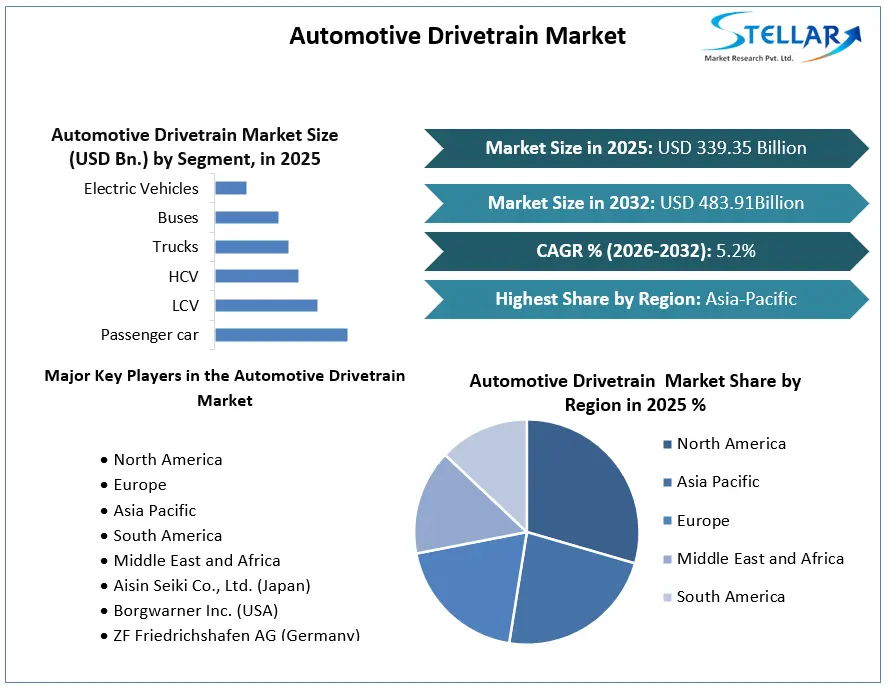
According to Stellar Market Research, the Automotive Drivetrain Market was valued at USD 339.35 billion in 2025 and is expected to reach nearly USD 483.91 billion by 2032, growing at a CAGR of 5.2% during 2026-2032. Increasing vehicle production, rising demand for fuel-efficient vehicles, and rapid adoption of electric and hybrid vehicles are major factors driving market expansion.
Rising Adoption of Electric and Hybrid Vehicles Driving Market Growth
The increasing transition toward electric mobility is one of the major factors influencing the automotive drivetrain industry. Electric vehicles require advanced drivetrain systems that provide efficient power transmission, improved range, and better vehicle performance.
Governments worldwide are implementing stricter emission regulations and promoting electric vehicle adoption through incentives and infrastructure development. These initiatives are encouraging automotive manufacturers to invest in advanced electric drivetrains, integrated drive units, and lightweight drivetrain components.
𝐃𝐨𝐰𝐧𝐥𝐨𝐚𝐝 𝐅𝐫𝐞𝐞 𝐏𝐃𝐅 𝐁𝐫𝐨𝐜𝐡𝐮𝐫𝐞: https://www.stellarmr.com/report/req_sample/Automotive-Drivetrain-Market/481
Growing Demand for Fuel-Efficient and High-Performance Vehicles
Consumers are increasingly demanding vehicles that offer improved fuel efficiency, enhanced driving comfort, and better performance. Automotive manufacturers are developing advanced drivetrain technologies to optimize power delivery while reducing fuel consumption.
Technologies such as advanced transmissions, all-wheel-drive systems, and intelligent drivetrain controls are becoming more common in passenger vehicles, SUVs, and commercial vehicles. These innovations help improve traction, stability, and overall driving experience.
Technological Advancements in Automotive Drivetrain Systems
Automotive drivetrain technology is evolving with the integration of electronics, software, and automation. Modern drivetrain systems are increasingly equipped with smart control units that enable real-time power management and improved efficiency.
Key technological developments include:
- Electric drivetrain systems
- Hybrid powertrain integration
- Lightweight drivetrain components
- Advanced transmission technologies
- Software-controlled power distribution
- Intelligent torque management systems
These advancements are helping manufacturers meet emission standards while improving vehicle performance.
Expansion of Commercial Vehicle Applications
Commercial vehicles represent an important segment of the automotive drivetrain market due to increasing demand for transportation, logistics, and industrial mobility solutions.
Heavy-duty vehicles require durable and efficient drivetrain systems to handle higher loads and long-distance operations. The adoption of fuel-efficient and alternative energy commercial vehicles is expected to create new opportunities for drivetrain manufacturers.
Automotive Drivetrain Market Segmentation Analysis
By Drive Type
The market is segmented into:
- Front Wheel Drive (FWD)
- Rear Wheel Drive (RWD)
- All Wheel Drive (AWD)
- Four Wheel Drive (4WD)
Front-wheel-drive systems remain widely adopted due to their cost efficiency and suitability for passenger vehicles, while AWD and 4WD systems are gaining popularity in SUVs and performance vehicles.
By Vehicle Type
The market includes:
- Passenger Cars
- Commercial Vehicles
- Electric Vehicles
Passenger vehicles represent a significant market segment due to increasing global vehicle production and consumer demand for advanced mobility features.
By Component
Major drivetrain components include:
- Transmission
- Axles
- Driveshafts
- Differentials
- Transfer Cases
- CV Joints
Manufacturers are focusing on lightweight and efficient components to improve vehicle performance and reduce emissions.
Regional Market Outlook
North America
North America is an important market for automotive drivetrain technologies due to strong vehicle demand, advanced automotive manufacturing capabilities, and increasing adoption of electric vehicles.
The region is witnessing investments in EV drivetrain development, hybrid technologies, and advanced vehicle platforms.
Europe
Europe is experiencing strong demand for advanced drivetrain systems due to strict emission regulations and increasing focus on sustainable transportation. Automotive manufacturers are investing heavily in electric and hybrid vehicle technologies.
Asia Pacific
Asia Pacific is expected to register significant growth due to high vehicle production volumes, expanding automotive industries, and increasing EV adoption in countries such as China, India, Japan, and South Korea.
Key Growth Drivers of Automotive Drivetrain Market
1. Growth of Electric Vehicle Industry
Increasing EV sales are creating demand for advanced electric drivetrain systems and efficient power transmission technologies.
2. Rising Vehicle Production
Growing demand for passenger and commercial vehicles worldwide is increasing the need for drivetrain components.
3. Stringent Emission Regulations
Governments are encouraging manufacturers to develop fuel-efficient and low-emission vehicle technologies.
4. Demand for Better Vehicle Performance
Consumers are seeking improved acceleration, stability, and driving comfort, supporting innovation in drivetrain systems.
Challenges in the Automotive Drivetrain Market
Despite strong growth opportunities, the market faces challenges such as:
- High development costs for advanced drivetrain technologies
- Expensive electric drivetrain components
- Supply chain disruptions
- Complex manufacturing processes
The high cost of EV drivetrain components remains a challenge, especially in price-sensitive markets.
Future Opportunities in the Automotive Drivetrain Industry
The future growth of the market is expected to be supported by:
- Development of advanced electric drivetrains
- Lightweight material adoption
- Autonomous vehicle integration
- Growth of hybrid vehicles
- Smart drivetrain technologies
- Expansion of EV charging infrastructure
Companies investing in innovative drivetrain solutions and electrification technologies are expected to gain competitive advantages.
Competitive Landscape
Key players operating in the Automotive Drivetrain Market include:
- Aisin Corporation
- BorgWarner Inc.
- ZF Friedrichshafen AG
- Dana Incorporated
- Schaeffler AG
- Magna International Inc.
These companies are focusing on product innovation, partnerships, electrification solutions, and global expansion strategies to strengthen their market positions.
𝐃𝐨𝐰𝐧𝐥𝐨𝐚𝐝 𝐅𝐫𝐞𝐞 𝐏𝐃𝐅 𝐁𝐫𝐨𝐜𝐡𝐮𝐫𝐞: https://www.stellarmr.com/report/req_sample/Automotive-Drivetrain-Market/481
Conclusion
The Automotive Drivetrain Market is expected to grow steadily during 2026-2032 due to increasing vehicle production, rising electric vehicle adoption, and continuous advancements in automotive technology. The shift toward efficient, lightweight, and intelligent drivetrain systems is transforming the future of mobility.
As automotive manufacturers continue investing in electrification and advanced power transmission technologies, drivetrain systems will remain a critical component in next-generation vehicles worldwide.
