Market Overview and Definition
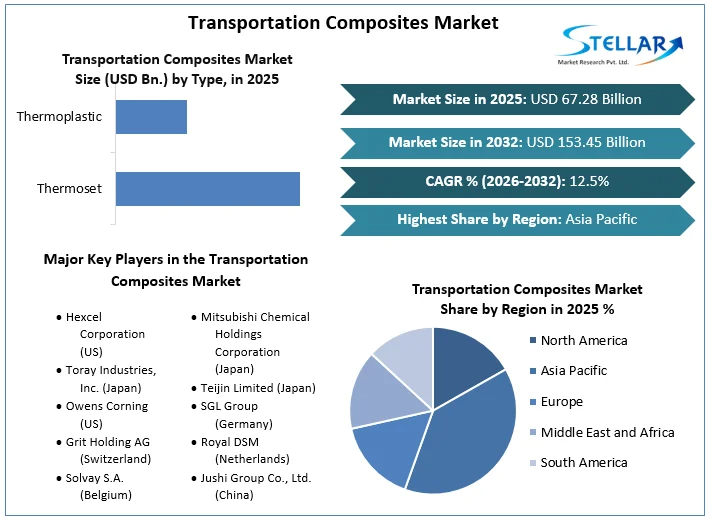
The Transportation Composites Market was valued at USD 67.28 billion in 2025. The Global Transportation Composites Market size is estimated to grow at a CAGR of 12.5 % over the forecast period.
The Transportation Composites Market is experiencing strong growth as automotive, aerospace, marine, and rail industries increasingly adopt lightweight and high-performance materials to improve efficiency, reduce emissions, and enhance vehicle durability. Transportation composites are advanced materials made by combining two or more components, typically fibers such as carbon fiber, glass fiber, or natural fibers with polymer resins, to achieve superior mechanical properties.
These materials offer several advantages over traditional metals, including lower weight, higher strength-to-weight ratios, corrosion resistance, improved fuel efficiency, and greater design flexibility. As industries worldwide focus on sustainability and energy efficiency, composite materials are becoming increasingly important in next-generation transportation systems.
The market is being driven by the rapid growth of electric vehicles (EVs), increasing demand for fuel-efficient aircraft, advancements in composite manufacturing technologies, and stricter emission regulations. Transportation manufacturers are investing in lightweight solutions to meet performance targets while reducing environmental impact.
Download Free PDF Brochure: https://www.stellarmr.com/report/req_sample/Transportation-Composites-Market/722
Growing Importance of Lightweight Materials in Transportation
Weight reduction has become a major priority across transportation industries. Lower vehicle weight directly contributes to improved fuel efficiency, extended battery range in electric vehicles, and reduced operational costs.
Traditional materials such as steel and aluminum are being increasingly replaced or complemented by composites in applications including vehicle body panels, structural components, interiors, aircraft parts, and marine structures.
In the automotive sector, lightweight composites help improve EV performance by compensating for the additional weight of batteries. In aerospace, composites enable aircraft manufacturers to reduce fuel consumption and increase payload capacity.
The growing transition toward sustainable mobility has positioned transportation composites as a critical technology for future transportation solutions.
Key Growth Drivers of the Transportation Composites Market
Rising Adoption of Electric Vehicles
The expansion of electric vehicles is one of the strongest factors supporting growth in the transportation composites market. EV manufacturers are constantly seeking lightweight materials to improve driving range and energy efficiency.
Composite materials are increasingly used in battery enclosures, body structures, interior components, and reinforcement applications. Their lightweight nature helps offset battery weight while improving vehicle performance.
As governments worldwide promote electric mobility through incentives and emission reduction policies, demand for advanced composite materials is expected to increase significantly.
Increasing Demand for Fuel-Efficient Aircraft
The aerospace industry is a major consumer of composite materials due to the need for lightweight and durable components. Aircraft manufacturers use composites to reduce structural weight, improve fuel efficiency, and increase aircraft lifespan.
Modern aircraft increasingly incorporate carbon fiber-reinforced composites in wings, fuselage sections, and other structural components. The aviation sector’s focus on reducing carbon emissions is encouraging manufacturers to expand composite usage.
The recovery of global air travel and increasing aircraft production are expected to create new opportunities for transportation composite suppliers.
Stringent Environmental Regulations
Governments and regulatory organizations are implementing stricter emission standards for vehicles and transportation systems. These regulations are encouraging manufacturers to adopt lightweight materials that improve energy efficiency.
Composite materials support sustainability goals by reducing fuel consumption and enabling the development of more efficient vehicles. The increasing focus on reducing transportation-related emissions is expected to accelerate composite adoption across multiple industries.
Market Challenges and Restraints
High Production Costs
One of the major challenges affecting the transportation composites market is the high cost associated with manufacturing advanced composite materials. Carbon fiber composites, in particular, require expensive raw materials and specialized production processes.
The higher cost compared with traditional materials can limit adoption, especially in cost-sensitive automotive applications.
Manufacturers are investing in improved production technologies and recycling solutions to reduce costs and make composites more accessible.
Complex Manufacturing and Recycling Challenges
Composite manufacturing requires specialized equipment, skilled labor, and advanced processing techniques. Unlike metals, composites can be more difficult to repair and recycle due to their complex material structures.
The development of efficient recycling technologies remains an important focus area for the industry as sustainability requirements continue to increase.
Emerging Technology Trends in Transportation Composites
Development of Sustainable Composite Materials
Sustainability is becoming a major trend in composite material development. Manufacturers are exploring bio-based fibers, recycled carbon fiber, and environmentally friendly resins to reduce environmental impact.
Natural fiber composites made from materials such as flax, hemp, and other renewable sources are gaining attention for automotive interiors and lightweight applications.
The shift toward circular economy practices is expected to encourage innovation in sustainable composite solutions.
Advanced Manufacturing Technologies
Technological advancements are improving composite production efficiency and reducing manufacturing costs. Automated fiber placement, resin transfer molding, and additive manufacturing techniques are enabling faster and more precise production.
Automation is particularly important for large-scale automotive manufacturing, where cost efficiency and production speed are critical.
Increasing Use of Carbon Fiber Composites
Carbon fiber composites are gaining popularity due to their exceptional strength, stiffness, and lightweight characteristics. These materials are widely used in aerospace, high-performance vehicles, and premium automotive applications.
As production technologies improve, carbon fiber composites are expected to become more accessible for broader transportation applications.
Regional Market Insights
North America
North America represents a significant market for transportation composites due to strong aerospace manufacturing capabilities, automotive innovation, and increasing EV adoption.
The United States has a strong presence of aircraft manufacturers, automotive companies, and advanced material developers. Investments in electric mobility and lightweight vehicle technologies are supporting market growth.
Europe
Europe is witnessing increasing demand for transportation composites due to strict environmental regulations and strong focus on sustainable mobility.
Countries such as Germany, France, and the United Kingdom are investing in electric vehicles, aerospace technologies, and advanced manufacturing solutions. The region’s emphasis on carbon reduction is encouraging composite material adoption.
Asia-Pacific
Asia-Pacific is emerging as a high-growth region due to expanding automotive production, increasing electric vehicle manufacturing, and growing aerospace industries.
China, Japan, South Korea, and India are investing heavily in lightweight materials and advanced transportation technologies. The region’s growing industrial base and government support for clean mobility are expected to create significant opportunities.
Competitive Landscape and Industry Developments
The transportation composites market includes global chemical companies, composite material manufacturers, automotive suppliers, and aerospace material providers. Companies are focusing on product innovation, sustainable materials, strategic partnerships, and manufacturing expansion.
Leading players are developing advanced composite solutions designed for automotive, aerospace, marine, and rail applications. Companies are also investing in recycling technologies and cost-effective manufacturing methods to improve market adoption.
Key companies operating in the transportation composites market include Toray Industries, Teijin Limited, Hexcel Corporation, SGL Carbon, Solvay, Owens Corning, Mitsubishi Chemical Group, and BASF.
Strategic collaborations between material suppliers, automotive manufacturers, and aerospace companies are becoming increasingly important for developing next-generation lightweight transportation solutions.
Download Free PDF Brochure: https://www.stellarmr.com/report/req_sample/Transportation-Composites-Market/722
Future Outlook
The Transportation Composites Market is expected to witness continued expansion as industries prioritize lightweight design, sustainability, and energy efficiency. The growth of electric vehicles, increasing aircraft production, and advancements in composite manufacturing technologies will remain key market drivers.
Future developments are likely to focus on reducing production costs, improving recyclability, and expanding the use of sustainable composite materials. Innovations in automation, digital manufacturing, and material science will further enhance the performance and accessibility of composite solutions.
As transportation industries transition toward cleaner and more efficient mobility systems, composites will play a crucial role in enabling lightweight vehicles, reducing emissions, and supporting the future of sustainable transportation.
Media Contact
Stellar Market Research
Website: Stellar Market Research – Global Research Reports & Consulting
Email: sales@stellarmr.com
