Key Highlights
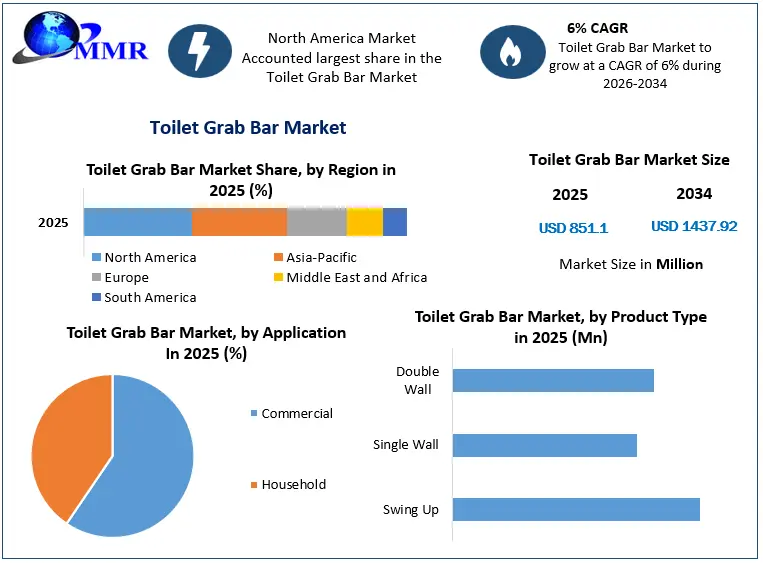
Toilet Grab Bar Market size valued at USD 851.1 Mn in 2025.
Market expected to reach USD 1,437.92 Mn by 2034 at a CAGR of 6% during the forecast period.
Report scope covers global demand for toilet grab bars across multiple end‑use environments.
Analysis includes market size, forecast, CAGR and coverage of key applications and regions.
Why This Matters Now
Automotive OEMs, Tier‑1 suppliers and fleet operators face growing pressure to treat accessibility and worker well‑being as strategic issues, not compliance checkboxes. A Toilet Grab Bar Market rising from USD 851.1 Mn in 2025 to USD 1,437.92 Mn by 2034 at 6% CAGR indicates that governments, building owners and facility managers are investing steadily in safer, more accessible restrooms for aging, disabled and injured users.
Transport depots, logistics hubs and assembly plants are high‑intensity workplaces where slips, fatigue and long shifts are common. Facilities that ignore accessible restroom design risk higher incidents, weaker retention among older workers and scrutiny from regulators. Grab bars may look like small hardware choices, but they are visible signals of how companies treat frontline staff and passengers.
Market Overview
Toilet grab bars are fixed support rails installed near toilets and in adjacent bathroom areas to help users sit, stand and stabilize safely. They are typically manufactured from metal, often stainless steel, and designed to meet safety and accessibility standards in residential, commercial, institutional and healthcare settings.
With market size at USD 851.1 Mn in 2025 and a forecast of USD 1,437.92 Mn by 2034 at 6% CAGR, toilet grab bars form a growing segment of global bathroom safety hardware. The Maximize Market Research report positions this growth in the context of demographic change, accessibility regulation and awareness of fall‑related risks. For automotive and transportation players, these drivers apply directly to worker facilities, customer‑facing spaces and public transport hubs linked to their operations.
Key Trends Driving Growth
Demographic aging is a primary driver. As more workers and passengers in key automotive regions—US, Germany, Japan, South Korea, China and India—enter older age brackets, demand rises for restrooms that minimize fall risk and support users with reduced mobility. Toilet grab bars are a simple, cost‑effective way to adapt existing facilities without full structural redesign.
Regulatory and standards pressure is increasing. Accessibility laws and building codes in many countries now mandate or strongly encourage grab bar installation in public and commercial restrooms. Automotive plants, dealer networks and transit stations connected to OEM brands are drawn into these requirements, particularly where they serve employees and customers directly.
A third trend is the mainstreaming of universal design. Rather than building separate “accessible” facilities, owners increasingly design restrooms that work for a broad range of users from the outset. This mindset favours standardized grab bar deployment, clearer layouts and better materials—aligning corporate ESG narratives with tangible, everyday safety measures.
Request a Free Sample Copy or View Report Summary: https://www.maximizemarketresearch.com/request-sample/113803/
Segment Insights
Dominant Segment – Application: Commercial And Institutional Restrooms
The report covers global toilet grab bar demand, which is heavily driven by commercial, institutional and healthcare applications where codes are strict and footfall is high. For automotive and transportation players, this dominant segment maps directly onto plant restrooms, transit hubs, service centres and logistics depots.Fastest‑Growing Segment – Residential And Aging‑In‑Place
Residential adoption grows as aging‑in‑place and home healthcare trends strengthen. While this is not a core automotive environment, it affects workforce expectations: employees accustomed to supportive home environments increasingly expect similar standards at their workplaces and during travel.Material – Metal Bars (Stainless Steel And Alloys)
The market centres on durable, corrosion‑resistant metal grab bars designed for frequent use and easy cleaning. Industrial and transport facilities benefit from these materials because they withstand harsh cleaning, temperature variations and high usage without costly replacement cycles.Installation Type – Wall‑Mounted Systems
Wall‑mounted bars remain the dominant installation type, integrating with common restroom designs. For plants and hubs, this standardization simplifies retrofit programs and procurement, helping safety teams apply consistent solutions across sites and regions.
Regional Growth Story
Growth in toilet grab bar demand mirrors where accessibility regulations tighten and aging populations grow. North America and Europe have long‑standing accessibility codes, which drive sustained installation across public and semi‑public buildings—including automotive headquarters, R&D centres and plants with visitor traffic.
Asia‑Pacific, including China, Japan, South Korea and India, combines rapid construction, industrial expansion and rising health awareness. As new transport terminals, metro systems, industrial parks and auto corridors are built, grab bars are incorporated into standard restroom designs, often as part of broader safety and hygiene upgrades. This is particularly relevant for new EV factories, logistics hubs and charging‑linked facilities.
Other regions, such as parts of Latin America and the Middle East, are gradually adopting accessibility standards. International hotel chains, airports and large retail sites often lead, with automotive showrooms and service centres following to match expected facility quality and inclusivity.
Competitive Landscape
The Toilet Grab Bar Market features global bathroom fixture brands alongside specialized accessibility and healthcare‑equipment manufacturers. Competition focuses on material quality, load rating certification, design aesthetics, ease of cleaning and price. Vendors that can combine compliant, robust bars with attractive finishes win share in commercial and institutional projects.
For automotive and transportation clients, the key differentiators are reliability, consistency across sites and integration with broader bathroom hardware packages. Suppliers offering standardized portfolios, documentation and installation support become preferred partners in multi‑site retrofit programs. This gives them stronger pricing power and increases their influence in facility design choices.
Smaller regional players compete on cost and localized service, often winning projects in smaller plants or depots. Large OEMs and international transport operators, however, tend to favour vendors with proven compliance histories and global reach, especially where corporate standards require uniform safety hardware.
Recent Developments
Accessibility‑Driven Building Programs
New public and commercial building programs in several regions mandate accessible restroom designs, including grab bars. Automotive‑linked projects—plants, logistics parks, bus depots and rail terminals—benefit from these frameworks, which make grab bar inclusion non‑negotiable.Design And Aesthetic Improvements
Manufacturers are investing in more aesthetically pleasing grab bars, using finishes and forms that blend into modern restroom designs. This supports adoption in corporate and high‑traffic environments where visual identity matters, such as flagship dealerships or premium transit lounges.Integration With Broader Safety Hardware Packages
Grab bars are increasingly sold as part of packaged restroom safety solutions that include non‑slip flooring, raised toilets and accessible fixtures. This encourages automotive and transport facility owners to treat restroom safety as a system, not a single product choice.
Strategic Implications
For automotive OEMs and Tier‑1 suppliers, toilet grab bars should be part of a coherent accessibility strategy covering plants, offices, test tracks and logistics hubs. Safety and HR teams can treat restroom upgrades as quick‑win projects that signal commitment to worker dignity, aging workforce needs and inclusion.
Fleet and depot operators managing bus, truck or rail assets should examine restroom access at depots and driver facilities. Grab bars may reduce fall‑related injuries and improve working conditions for older drivers and staff who spend long hours on the road. In competitive labour markets, small improvements in facility usability can influence retention.
Mobility strategists designing integrated transport hubs—park‑and‑ride facilities, EV charging campuses or multimodal terminals—must consider restroom accessibility alongside core transport services. Doing so aligns physical infrastructure with broader mobility‑as‑a‑service narratives that emphasize inclusivity and ease of use for all passengers.
Future Outlook
By 2034, with the Toilet Grab Bar Market expected to reach USD 1,437.92 Mn at a 6% CAGR, accessible restroom hardware will become standard across most public and industrial facilities rather than a niche retrofit. Automotive and transportation operations that move early will normalize accessibility and safety in their built environments, strengthening ESG stories and worker trust.
Future leaders will treat grab bars and related accessibility features as integral design elements in plants, depots and hubs—planned, budgeted and measured; laggards will retrofit only when forced by regulation or incident and learn that reactive safety investments carry higher cost and weaker cultural impact than proactive design.
Related Reports
Global Smart Textile Market https://www.maximizemarketresearch.com/market-report/global-smart-textile-market/28970/
Global Robotic Lawn Mower Market https://www.maximizemarketresearch.com/market-report/global-robotic-lawn-mower-market/21487/
Smart Factory Market https://www.maximizemarketresearch.com/market-report/global-smart-factory-market/28399/
Analyst Perspective
“With the market growing from USD 851.1 Mn in 2025 to USD 1,437.92 Mn by 2034 at a 6% CAGR, automotive and transportation players that embed accessible restroom design into every new plant, depot and hub will build more resilient, inclusive operations than those treating it as an afterthought.”-Dharati Raut
About Maximize Market Research
Maximize Market Research Pvt. Ltd. (MMR) is a global market research and consulting company that provides reliable, data-focused, and practical business insights. The firm serves a wide range of industries, including healthcare, pharmaceuticals, technology, automotive, electronics, chemicals, personal care, and consumer goods. Through market forecasts, competitive analysis, strategic consulting, and industry impact assessments, MMR helps organizations understand changing market conditions, identify growth opportunities, and make informed business decisions for long-term success.
2nd Floor, Navale IT Park Phase 3
Pune Banglore Highway, Narhe
Pune, Maharashtra 411041, India
+91 9607365656
sales@maximizemarketresearch.com
