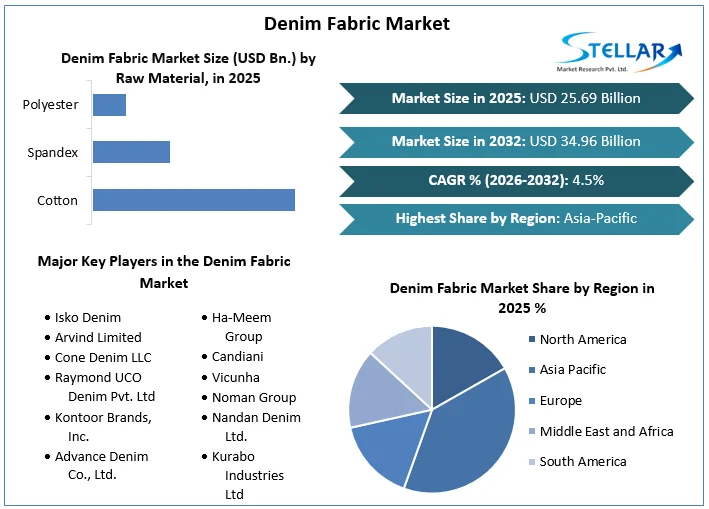
Denim Fabric Market size was valued at USD 25.69 Bn. in 2025 and is expected to reach USD 34.96 Bn. by 2032, at a CAGR of 4.5%.
The global Denim Fabric Market is undergoing a significant transformation as sustainability, innovation, and changing consumer preferences reshape the textile and apparel industry. Denim has long been one of the most versatile and widely used fabrics in fashion, but today’s market extends beyond traditional jeans. Manufacturers are increasingly developing eco-friendly fabrics, recycled fibers, stretch denim, and premium materials to meet evolving consumer expectations while reducing environmental impact. According to industry analysis by Stellar Market Research, rising apparel consumption, technological advancements in textile manufacturing, and growing investments in sustainable production are expected to support steady market expansion throughout the forecast period.
𝐃𝐨𝐰𝐧𝐥𝐨𝐚𝐝 𝐅𝐫𝐞𝐞 𝐏𝐃𝐅 𝐁𝐫𝐨𝐜𝐡𝐮𝐫𝐞: https://www.stellarmr.com/report/req_sample/denim-fabric-market/2352
Market overview
Denim fabric is a durable cotton twill textile characterized by its diagonal weave pattern and exceptional strength. Traditionally made from 100% cotton, modern denim often incorporates elastane, polyester, or recycled fibers to improve comfort, durability, and flexibility. The fabric is widely used in jeans, jackets, shirts, skirts, footwear, bags, upholstery, and industrial applications.
The growing popularity of casual fashion, expanding middle-class populations, and increasing disposable income continue to drive denim demand worldwide. At the same time, manufacturers are responding to environmental concerns by introducing water-saving dyeing processes, organic cotton, recycled yarns, and circular production models.
Key market drivers
Rising demand for casual and premium apparel
Casual clothing has become an everyday wardrobe essential across both developed and emerging economies. Consumers increasingly prefer denim because of its durability, versatility, and timeless appeal. Premium denim products offering improved comfort, stretchability, and superior finishes are also attracting fashion-conscious buyers.
Growing urbanization and rising disposable incomes are encouraging consumers to purchase branded denim apparel, creating new opportunities for fabric manufacturers worldwide.
Sustainability transforming textile manufacturing
Environmental concerns are significantly influencing purchasing decisions. Consumers and global fashion brands are demanding sustainable textiles that minimize water consumption, reduce carbon emissions, and incorporate recycled materials.
Manufacturers are investing heavily in:
Organic cotton cultivation
Water-efficient dyeing technologies
Laser finishing processes
Recycled denim fibers
Chemical-free finishing techniques
These innovations help reduce production costs while supporting global sustainability goals.
Growth of e-commerce and fashion retail
The rapid expansion of online fashion platforms has increased the accessibility of denim products across global markets. Fast-fashion brands and direct-to-consumer retailers continuously introduce new denim collections, increasing demand for innovative fabric varieties.
Digital retail also enables manufacturers to quickly identify consumer trends and respond with customized product offerings.
Emerging trends reshaping the market
Recycled and circular denim
Circular fashion has become one of the strongest trends within the textile industry. Manufacturers increasingly collect post-consumer denim garments, recycle fibers, and produce new fabrics with significantly lower environmental impact.
Global apparel brands are incorporating recycled denim collections to meet sustainability commitments while appealing to environmentally conscious consumers.
Smart manufacturing technologies
Automation, artificial intelligence, and digital textile manufacturing are improving production efficiency. Smart quality inspection systems reduce defects, while automated weaving and dyeing equipment improve consistency and lower operational costs.
Digital technologies also enable manufacturers to optimize inventory management and respond quickly to changing market demand.
Stretch and performance denim
Consumers increasingly expect comfort without sacrificing style. Denim manufacturers are incorporating elastane and performance fibers to produce fabrics offering greater flexibility, moisture management, and durability.
Performance denim is gaining popularity across both fashion and workwear applications.
Market segmentation
The Denim Fabric Market can be segmented by product type, application, distribution channel, and end-use industry.
By material type, cotton denim continues to dominate due to its durability and consumer familiarity. However, blended fabrics containing elastane and recycled fibers are expected to witness faster growth because of increasing demand for stretchability and sustainability.
Based on application, apparel remains the largest segment, accounting for the majority of global demand. Home furnishings, accessories, footwear, and industrial applications are also contributing to market diversification.
Among end users, fashion brands represent the largest customer base, while premium apparel manufacturers are increasingly investing in innovative and sustainable denim materials.
Regional analysis
Asia-Pacific remains the manufacturing powerhouse
Asia-Pacific dominates the global Denim Fabric Market owing to its extensive textile manufacturing infrastructure, competitive production costs, and strong export capabilities.
Countries including China, India, Bangladesh, Pakistan, and Vietnam continue to expand manufacturing capacity to meet growing international demand. Government initiatives supporting textile exports further strengthen regional competitiveness.
India is emerging as an important manufacturing hub due to abundant cotton production, increasing domestic consumption, and expanding investments in sustainable textile technologies.
North America
North America maintains strong demand for premium denim apparel supported by high consumer spending and well-established fashion brands. Sustainable fashion trends are encouraging retailers to source environmentally responsible fabrics.
Europe
European markets emphasize sustainability, ethical sourcing, and circular fashion practices. Strict environmental regulations are encouraging manufacturers to adopt water-efficient production processes and recycled materials.
Countries including Italy, Germany, France, and Spain continue investing in premium denim manufacturing and high-value textile innovation.
Middle East, Africa, and Latin America
These regions are experiencing steady growth due to rising urbanization, expanding retail infrastructure, and increasing demand for affordable fashion products. Growing textile manufacturing investments further support regional market development.
Competitive landscape
- Arvind Limited
- Cone Denim LLC
- Raymond UCO Denim Pvt. Ltd
- Kontoor Brands, Inc.
- Advance Denim Co., Ltd.
- Candiani
- Vicunha
- Noman Group
- Nandan Denim Ltd.
𝐃𝐨𝐰𝐧𝐥𝐨𝐚𝐝 𝐅𝐫𝐞𝐞 𝐏𝐃𝐅 𝐁𝐫𝐨𝐜𝐡𝐮𝐫𝐞: https://www.stellarmr.com/report/req_sample/denim-fabric-market/2352
Challenges facing the market
Despite positive growth prospects, several factors may limit market expansion.
Volatile cotton prices continue affecting production costs and profit margins. Environmental regulations regarding water consumption, chemical usage, and wastewater treatment require continuous investments in cleaner production technologies.
Intense competition from synthetic fabrics and alternative textile materials also presents challenges for traditional denim manufacturers.
Additionally, global supply chain disruptions and fluctuating raw material availability can impact production schedules and operational efficiency.
Future outlook
The future of the Denim Fabric Market appears highly promising as sustainability becomes central to textile manufacturing strategies. Growing consumer awareness regarding environmentally responsible products will encourage greater adoption of recycled fibers, organic cotton, and resource-efficient production methods.
Technological innovations including digital dyeing, laser finishing, automation, and artificial intelligence will improve manufacturing efficiency while reducing waste. Premiumization trends, increasing demand for comfortable apparel, and expanding online retail channels will further strengthen market growth.
Emerging economies are expected to become major consumption centers as disposable incomes rise and fashion awareness continues to increase. Meanwhile, established markets will prioritize sustainable production, premium quality, and circular economy initiatives.
As fashion brands continue balancing performance, affordability, and sustainability, denim manufacturers investing in innovation and environmentally responsible production will be well positioned for long-term success. The Denim Fabric Market is therefore expected to remain a vital component of the global textile industry, supported by continuous product innovation, expanding consumer demand, and the industry’s ongoing transition toward more sustainable manufacturing practices.
Media Contact
Stellar Market Research
Website: Stellar Market Research – Global Research Reports & Consulting
Email: sales@stellarmr.com
