Key Highlights
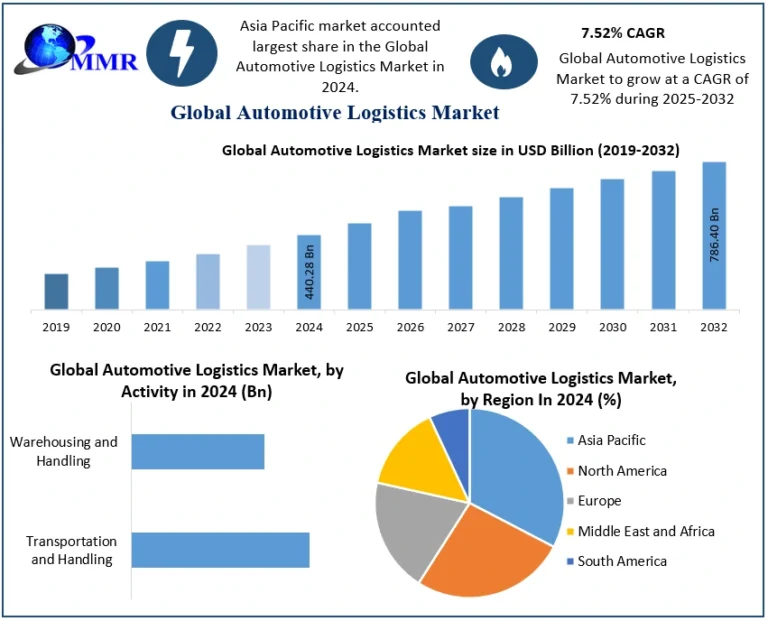
- Global market valued at USD 440.28 billion in 2024.
- Expected to reach USD 786.40 billion by 2032.
- Forecast CAGR stands at 7.52%.
- Asia Pacific remains the largest regional market.
- Outbound logistics dominates service demand.
- Electric vehicle production is reshaping logistics requirements.
- Digital technologies are improving supply chain visibility.
- Sustainability has become a strategic investment priority.
- Fuel price volatility remains the biggest operational challenge.
- Cross-border automotive trade continues to strengthen logistics demand.
Why This Matters Now
The automotive industry is undergoing its largest supply chain transformation in decades. Electric vehicles, connected manufacturing, direct-to-consumer sales, and stricter sustainability targets are forcing logistics providers to redesign transportation networks. Companies that invest in digital platforms, automation, and low-emission logistics solutions will secure stronger partnerships with global automakers while improving operational efficiency and profitability.
Market Overview
The Automotive Logistics Market includes transportation, warehousing, inventory management, distribution, and handling services for raw materials, automotive components, spare parts, and finished vehicles. The industry connects suppliers, manufacturers, dealers, and end customers through integrated logistics networks designed to minimize costs and reduce delivery times.
Market demand continues to rise alongside global vehicle production and expanding automotive trade. Growth in electric vehicle manufacturing has introduced new logistics requirements involving battery transportation, specialized warehousing, and enhanced safety standards.
Supply chain complexity has increased as manufacturers source components from multiple countries while maintaining just-in-time production systems. This has elevated the importance of logistics providers capable of delivering real-time visibility, flexible transportation options, and resilient distribution networks.
Macroeconomic trends including globalization, industrial automation, digital transformation, and sustainability regulations continue influencing logistics investments. However, fluctuating fuel prices remain a major challenge, increasing transportation costs and reducing operating margins across the industry.
Key Trends Driving Growth
Digital Supply Chain Transformation
Automotive logistics providers are integrating IoT, artificial intelligence, blockchain, and cloud-based platforms to improve shipment tracking, inventory visibility, and predictive planning. These technologies reduce delays while improving supply chain transparency.
Electric Vehicle Supply Chains
The rapid expansion of electric vehicle production is reshaping logistics operations. Specialized transportation for lithium-ion batteries and high-value components requires enhanced safety standards and customized logistics capabilities.
Sustainable Logistics Operations
Manufacturers and logistics providers are investing in greener transportation, optimized routing, and energy-efficient warehouses to reduce carbon emissions while meeting environmental regulations and customer expectations.
Automation Across Distribution Networks
Warehouse automation, robotics, and intelligent inventory management systems are improving operational efficiency while reducing labor dependency and handling errors.
Global Trade Expansion
Cross-border automotive manufacturing continues expanding, increasing demand for integrated multimodal transportation networks capable of supporting international production and distribution activities.
Segment Insights
Dominant Segment: Outbound Logistics
Outbound logistics accounted for the largest market share in 2024.
This segment manages the movement of finished vehicles from manufacturing plants to dealerships and customers. Efficient outbound logistics directly affects inventory availability, dealership performance, customer satisfaction, and brand reputation.
Automotive manufacturers increasingly rely on optimized outbound logistics to reduce delivery times while supporting global distribution networks. Faster delivery enables companies to respond more effectively to changing consumer demand and new vehicle launches.
For logistics providers, this segment offers long-term contracts with major vehicle manufacturers, creating stable revenue opportunities.
Fastest-Growing Segment: Road Transport
Road transportation is expected to witness significant growth throughout the forecast period.
Road networks remain the preferred transportation mode because they provide flexible delivery schedules, extensive geographic coverage, and efficient last-mile distribution for dealerships and retail customers.
The rapid expansion of electric vehicle production further increases demand for specialized road transportation capable of safely handling batteries and finished vehicles.
Explore detailed analysis, insights, and growth opportunities
Additional Key Segments
Inbound Logistics
Manufacturers continue investing in inbound logistics to support just-in-time production models. Reliable component delivery minimizes production downtime and improves manufacturing efficiency.
Aftermarket Logistics
Growing global vehicle ownership is increasing demand for aftermarket parts distribution. Faster spare parts delivery enhances customer service while supporting dealership operations.
Reverse Logistics
Reverse logistics is becoming increasingly important as manufacturers focus on recycling, remanufacturing, warranty management, and circular economy initiatives.
Warehousing and Handling
Smart warehouses equipped with automation and digital inventory management systems continue gaining importance as automotive supply chains become increasingly complex.
Regional Growth Story
Asia Pacific
Asia Pacific dominates the Automotive Logistics Market due to its strong automotive manufacturing ecosystem.
China, Japan, South Korea, and India serve as major vehicle production hubs supported by expanding supplier networks, modern transportation infrastructure, and rising domestic vehicle demand.
Growing middle-class populations and increasing vehicle ownership continue strengthening regional logistics investments
North America
North America benefits from advanced logistics infrastructure and high adoption of digital supply chain technologies.
The region continues investing in electric vehicle production, automated warehouses, and connected transportation systems to improve operational efficiency.
Europe
Europe remains a major automotive export center supported by premium vehicle manufacturing and strict sustainability regulations.
Automakers increasingly partner with logistics providers capable of delivering low-emission transportation solutions across cross-border supply chains.
South America
Automotive logistics continues expanding as regional manufacturing capacity improves and vehicle exports gradually increase.
Infrastructure modernization remains essential for improving transportation efficiency across the region.
Middle East & Africa
The region presents emerging opportunities driven by infrastructure development, vehicle imports, and growing investments in logistics hubs supporting international trade.
Competitive Landscape
The Automotive Logistics Market remains highly competitive, with global providers competing through integrated supply chain solutions, digital platforms, multimodal transportation capabilities, and international distribution networks.
DHL Supply Chain, Kuehne + Nagel, DB Schenker, and DSV Panalpina maintain strong market positions through global logistics networks capable of serving multinational automotive manufacturers.
North American companies including XPO Logistics, Ryder System, UPS Supply Chain Solutions, Penske Logistics, Expeditors International, CH Robinson, J.B. Hunt Transport Services, and ArcBest Corporation strengthen competition through advanced transportation management systems and specialized automotive logistics expertise.
European logistics specialists such as CEVA Logistics, DACHSER, BLG Logistics Group, Hellmann Worldwide Logistics, and GEODIS continue expanding value-added warehousing, digital visibility platforms, and sustainable transportation services.
In Asia Pacific, Nippon Express, Kerry Logistics, and Agility Logistics leverage regional manufacturing growth and cross-border trade to strengthen their competitive position.
Competition increasingly depends on technology integration, sustainability performance, multimodal transportation capabilities, and long-term partnerships with global automotive manufacturers rather than transportation capacity alone.
Recent Developments
- Automotive logistics providers increased investments in IoT, AI, and blockchain technologies to improve supply chain visibility and operational efficiency.
- Companies expanded digitalization initiatives supporting connected automotive supply chains and predictive logistics planning.
- Logistics operators accelerated sustainability programs through green transportation initiatives and environmentally efficient warehouse operations.
- Industry participants strengthened logistics capabilities to support increasing electric vehicle production and direct-to-consumer distribution models.
Future Outlook
Automotive logistics providers that combine digital supply chain intelligence, sustainable transportation solutions, and specialized EV logistics capabilities will be best positioned to capture long-term growth as global vehicle production and cross-border trade continue evolving.
Analyst Perspective – Rucha Deshpande
The Automotive Logistics Market is entering a new phase where speed, visibility, and sustainability are becoming stronger competitive differentiators than transportation capacity alone. As electric vehicle production expands and automotive supply chains become more global, manufacturers are demanding logistics partners capable of delivering real-time tracking, resilient multimodal networks, and low-carbon operations.
About Maximize Market Research
Maximize Market Research Pvt. Ltd. (MMR) is a global market research and consulting company that provides reliable, data-focused, and practical business insights. The firm serves a wide range of industries, including healthcare, pharmaceuticals, technology, automotive, electronics, chemicals, personal care, and consumer goods. Through market forecasts, competitive analysis, strategic consulting, and industry impact assessments, MMR helps organizations understand changing market conditions, identify growth opportunities, and make informed business decisions for long-term success.
Contact Us :
2nd Floor, Navale IT Park Phase 3
Pune Banglore Highway, Narhe
Pune, Maharashtra 411041, India
+91 9607365656
sales@maximizemarketresearch.com
