Key Highlights
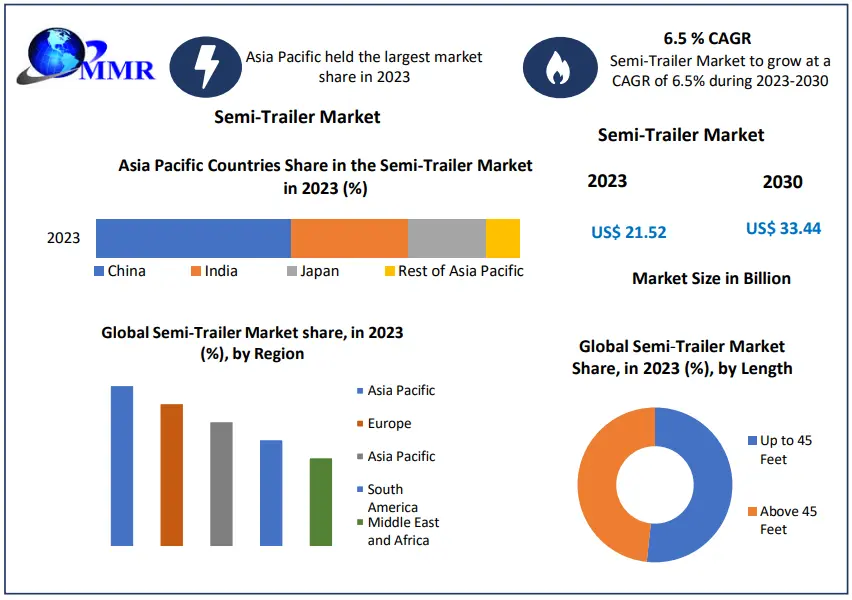
Market Valuation: The global semi-trailer market was valued at approximately USD 34.53 billion in 2026.
Growth Trajectory: The market is projected to reach USD 54.14 billion by 2033, expanding at a CAGR of 6.6%.
Dominant Segment: Dry vans continue to hold the largest market share, serving as the backbone of global retail and e-commerce distribution.
Fastest-Growing Segment: The above 100-ton capacity segment is the fastest-growing by tonnage, driven by massive investments in energy infrastructure, mining, and heavy manufacturing.
Technological Shift: Industry focus is pivoting toward “smart trailers” featuring integrated telematics, real-time cargo monitoring, and predictive maintenance.
Why This Matters Now
The global logistics backbone is undergoing a radical structural transformation as fleet operators balance soaring e-commerce demand with aggressive carbon reduction targets. For OEMs and Tier-1 suppliers, the semi-trailer has evolved from a passive storage container into a sophisticated, data-generating node within the digital supply chain.
Market Overview
The global Semi-Trailer Market, valued at USD 34.53 billion in 2026, is no longer defined by commodity hardware. Instead, it is being reshaped by the “connected fleet” mandate. Rising freight volumes, particularly in the e-commerce and pharmaceutical cold-chain sectors, are necessitating trailers that provide higher utilization rates and visibility. As interest rates and material costs fluctuate, the market is favoring manufacturers who can provide not just steel, but operational efficiency through software and lightweight design.
Key Trends Driving Growth
The Rise of the Smart Trailer: Efficiency is the new currency. Fleet operators are increasingly adopting trailers equipped with GPS tracking, tire pressure monitoring systems (TPMS), and brake diagnostics. These technologies enable predictive maintenance, which directly reduces downtime and improves fleet uptime, a critical metric for long-haul carriers operating on thin margins.
Cold-Chain Expansion: The pharmaceutical and food-and-beverage sectors are driving exponential demand for sophisticated refrigerated units. These trailers must now maintain precise environmental conditions across thousands of miles, turning the semi-trailer into a mobile, climate-controlled laboratory that demands advanced sensor integration.
Infrastructure and Energy Transition: The move toward renewable energy requires the transport of massive components, such as wind turbine blades and heavy-duty power equipment. This has created a lucrative niche for specialized, high-tonnage trailers capable of safely moving infrastructure-critical loads that exceed standard road limits.
Segment Insights
Dominant Segment (Type): Dry Vans. These remain the industry standard due to their versatility in transporting palletized, weather-sensitive goods across both retail and manufacturing networks.
Fastest-Growing Segment (Tonnage): Above 100 Tons. Demand is surging in the energy and mining sectors, where the need to transport oversized, ultra-heavy machinery is outstripping conventional logistics capacities.
Fastest-Growing Segment (Length): Above 45 Feet. This segment is capturing increasing interest as operators seek to maximize cubic capacity per trip, improving the economic efficiency of long-haul routes.
Regional Growth Story
The Asia-Pacific region holds a substantial portion of the global market, anchored by rapid urbanization and infrastructure stimulus in China and India. Meanwhile, North America remains a mature powerhouse, where the focus is shifting toward fleet modernization and the integration of automated, long-haul logistics. Europe is setting the pace for sustainability, with regulatory pressure forcing the rapid adoption of aerodynamic designs and lightweight materials to reduce total fuel consumption and emissions.
Competitive Landscape
The competitive environment is consolidating around players that can demonstrate “full-stack” logistics capability. Major manufacturers like China International Marine Containers (CIMC), Wabash National, Schmitz Cargobull, and Utility Trailer are investing heavily in material science—transitioning to high-strength steel, aluminum, and composites to improve payload-to-weight ratios.
This shift signals a departure from purely manufacturing-led growth toward a service-oriented model. Companies that invest in telematics platforms and maintenance-as-a-service are gaining significant pricing power. Those lagging in the digital transition face commoditization, as fleet operators increasingly demand integrated data streams over basic trailer durability.
Recent Developments
Electrified E-Axles: Development of regenerative-braking axles that capture energy to power trailer-mounted refrigeration units, reducing dependence on diesel fuel.
Lightweighting Breakthroughs: Integration of advanced composite materials to shed weight without sacrificing structural integrity, directly increasing the legally permissible payload capacity.
Advanced Telematics Adoption: Deployment of IoT-based “smart” sensors that provide real-time visibility into cargo health, enabling safer transport for high-value and sensitive assets.
Strategic Implications
The mandate for logistics providers is clear: reduce the Total Cost of Ownership (TCO). OEMs that prioritize modular, data-rich trailer designs are better positioned to capture long-term contracts from large-scale logistics firms. Conversely, reliance on traditional, non-connected platforms is becoming a liability, as regulatory bodies and fleet managers push for greater transparency and emissions compliance across the entire transport chain.
Future Outlook
The semi-trailer market is distancing itself from the “simple asset” perception of the past. Success will be determined by a firm’s ability to integrate into the software-defined vehicle ecosystem. Future market leaders will be defined by their ability to deliver “intelligent transport modules” that offer autonomous-ready diagnostics and energy-neutral operation, leaving laggards to compete solely on the narrowing margins of hardware manufacturing.
Analyst Perspective
“The semi-trailer is no longer a passive component of the logistics chain; it is an active, data-driven participant,” says Tejaswini Kakade, Analyst at Maximize Market Research. “The convergence of smart telematics and electrification is turning the trailer into the most critical asset for fleet efficiency in the next decade.”
About Maximize Market Research
Maximize Market Research Pvt. Ltd. (MMR) is a global market research and consulting company that provides reliable, data-focused, and practical business insights. The firm serves a wide range of industries, including healthcare, pharmaceuticals, technology, automotive, electronics, chemicals, personal care, and consumer goods. Through market forecasts, competitive analysis, strategic consulting, and industry impact assessments, MMR helps organizations understand changing market conditions, identify growth opportunities, and make informed business decisions for long-term success.
2nd Floor, Navale IT Park Phase 3
Pune Banglore Highway, Narhe
Pune, Maharashtra 411041, India
+91 9607365656
sales@maximizemarketresearch.com
