Key Highlights
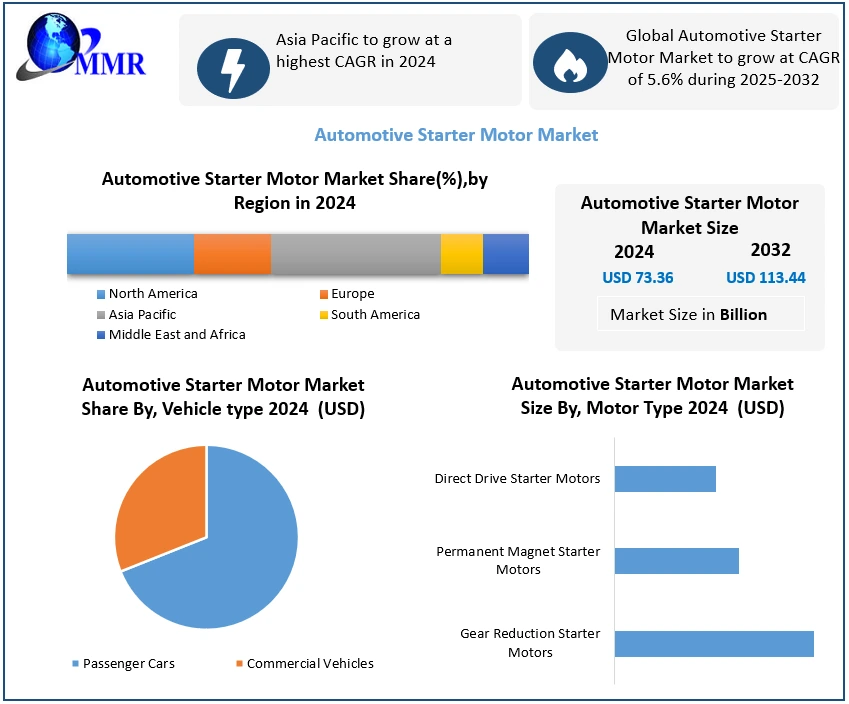
Market Valuation: The global automotive starter motor market was valued at USD 73.36 billion in 2024.
Growth Forecast: The market is projected to reach USD 113.44 billion by 2032, expanding at a CAGR of 5.6%.
Dominant Segment: Passenger cars represent the largest vehicle segment, supported by high production volumes in Asia-Pacific.
Dominant Technology: Gear reduction starter motors lead the market due to their superior torque-to-weight ratio and compact dimensions.
Regional Hub: The Asia-Pacific region commands approximately 75% of the global market share, serving as the primary manufacturing and consumption engine.
Why This Matters Now
The automotive industry is facing a critical inflection point where the necessity of maintaining high-performance internal combustion engine (ICE) fleets clashes with the aggressive push for electrification. For Tier-1 suppliers and OEMs, the starter motor—a legacy component—has been revitalized by the rise of micro-hybrid and start-stop systems, turning a standard ignition device into a critical pillar of modern fuel-efficiency strategy.
Market Overview
Valued at USD 73.36 billion in 2024, The Automotive Starter Motor Market is far from a stagnant legacy sector. While the long-term industry trend points toward full electric vehicle (EV) adoption, the current global fleet remains heavily dependent on ICE and hybrid powertrains. Starter motors now serve a dual purpose: they act as the initial ignition source for conventional engines and as integral components in start-stop systems that cut engine idling to slash emissions in congested urban environments. This functional evolution ensures that even as the industry pivots, the demand for sophisticated, high-torque starting technology remains robust.
Key Trends Driving Growth
The Rise of Start-Stop Systems: Stricter global emission regulations are mandating the integration of automatic start-stop technology across passenger car fleets. By shutting down the engine at stoplights and instantly restarting it, these systems require starter motors that are significantly more durable and cycle-efficient than traditional models. This shift directly benefits manufacturers capable of producing high-cycle-life solenoids and robust gear-reduction assemblies.
Hybrid Powertrain Integration: The transition toward hybrid and mild-hybrid architectures is expanding the definition of a “starter.” Modern systems are increasingly moving toward integrated starter-generators (ISG), which blend the ignition function with power regeneration. This move toward integration allows manufacturers to capture higher value per unit while meeting the automotive industry’s requirements for compact, high-efficiency powertrain components.
Segment Insights
Dominant Segment (Vehicle Type): Passenger Cars. Accounting for the majority of global production, this segment benefits from massive demand in emerging economies and the continuous integration of advanced ignition features in consumer vehicles.
Fastest-Growing Segment: Commercial Vehicles. Driven by the rapid expansion of logistics networks and the transition to smarter, IT-enabled fleet management systems, commercial vehicle demand is outstripping traditional passenger car growth rates in several major markets.
Regional Growth Story
The Asia-Pacific region holds an overwhelming 75% market share. This dominance is not accidental; it is the result of a deliberate concentration of manufacturing facilities and a massive, growing consumer base in countries like China, India, and Japan. While Western markets are focusing heavily on pure-play EV platforms, Asia-Pacific remains the world’s primary hub for both ICE and hybrid vehicle production, ensuring that regional demand for starter motors remains the strongest in the world.
Competitive Landscape
The competitive landscape is dominated by heavyweights including BorgWarner, Bosch, Denso, Valeo, and Mitsubishi Electric. These players are moving away from commodity-based pricing models toward “technological partnerships” with OEMs. By securing long-term contracts that integrate their ignition technology into specific vehicle platforms, these firms protect their margins against the rising costs of raw materials and the looming threat of long-term EV displacement. The current market rivalry is signaling a shift toward vertical integration; the manufacturers that survive the transition will be those that can supply not just the motor, but the power electronics and software necessary to manage complex start-stop/regenerative cycles.
Recent Developments
Technological Standardization: Manufacturers are heavily investing in gear reduction technology to maximize power output while reducing the total mass of the motor, supporting broader trends toward vehicle lightweighting.
Predictive Maintenance: The integration of sensors and connectivity into starter units allows for real-time health monitoring, providing fleet operators with the capability to anticipate failures before they occur.
Capacity Additions: Major suppliers are scaling production facilities in emerging economies to support the localized assembly requirements of global OEMs.
Strategic Implications
The strategic imperative for industry stakeholders is to balance the “sunset” of traditional ICE components with the “sunrise” of hybrid-integrated solutions. For suppliers, this means the end of purely mechanical engineering. The future of the starter motor lies in electronics and control logic, as the lines between “starting” the engine and “powering” the electrical architecture of a hybrid vehicle continue to blur.
Future Outlook
The global automotive starter motor market will reach USD 113.44 billion by 2032, yet the competitive chasm between participants will widen significantly. Market leaders will be those who transition their portfolios to support hybrid and micro-hybrid architectures, effectively embedding themselves into the new generation of powertrain systems, while laggards that remain tethered to the low-margin, high-volume production of simple ignition motors will find themselves unable to compete as the ICE fleet eventually enters its terminal decline.
Analyst Perspective
“The starter motor has undergone a quiet renaissance,” says Tejaswini Kakade, Analyst at Maximize Market Research. “By adapting to the demands of start-stop functionality and hybrid power management, these components have secured a vital role in the transition to more efficient transportation. The manufacturers who innovate in high-cycle durability and system integration will lead the market through 2032 and beyond.”
About Maximize Market Research
Maximize Market Research Pvt. Ltd. (MMR) is a global market research and consulting company that provides reliable, data-focused, and practical business insights. The firm serves a wide range of industries, including healthcare, pharmaceuticals, technology, automotive, electronics, chemicals, personal care, and consumer goods. Through market forecasts, competitive analysis, strategic consulting, and industry impact assessments, MMR helps organizations understand changing market conditions, identify growth opportunities, and make informed business decisions for long-term success.
2nd Floor, Navale IT Park Phase 3
Pune Banglore Highway, Narhe
Pune, Maharashtra 411041, India
+91 9607365656
sales@maximizemarketresearch.com
