Key Highlights
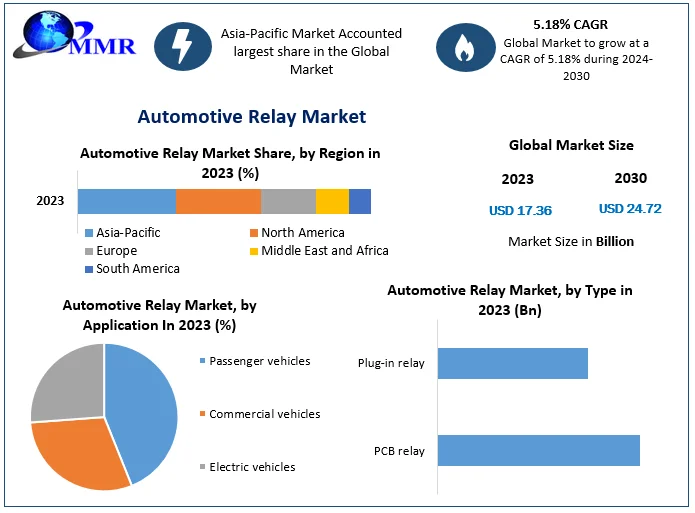
Automotive Relay Market size was valued at USD 17.36 billion in 2023, indicating that relays remain essential components in the electrical architecture of modern vehicles despite the shift toward semiconductors.
Total revenue is expected to grow by 5.18% from 2024 to 2030, reaching nearly USD 24.72 billion, which signals steady, structural demand tied to rising electronic content per vehicle rather than speculative spikes.
Automotive relays are widely used in electrical systems for vehicles, trucks, industrial machinery, and heavy equipment, showing that the market spans both light and heavy transportation applications.
Growth parallels increased preference for advanced features in automobiles, including comfort, safety, and connectivity systems that all require reliable power switching.
The market’s expansion implies continued opportunities for manufacturers that can deliver robust, miniaturized, and application‑specific relays for both ICE and EV platforms.
Why This Matters Now
The auto industry is deep into electrification and software‑defined vehicle rollouts, but every digital feature still depends on physical power control. Relays quietly decide which circuits energize and when, making them critical to safety systems, powertrains, and comfort electronics.
A market growing from USD 17.36 billion in 2023 to about USD 24.72 billion by 2030 at just over 5% CAGR shows an important reality: while high‑profile components like batteries and chips get headlines, stable, reliable relay demand reflects the persistent need for safe switching in increasingly complex electrical systems. The companies that manage this layer well will avoid costly failures and recalls as vehicles add more loads.
Market Overview
The automotive relay market covers electromechanical and solid‑state devices that open and close circuits controlling motors, lights, pumps, fans, heating elements, and a broad array of electronics in vehicles. They are used in passenger cars, commercial trucks, buses, and heavy machinery.
Relays enable low‑current control signals from ECUs to switch higher‑current loads, protecting control electronics and simplifying wiring. As vehicles add more features—such as power windows, seat controls, ADAS modules, and thermal systems—the number and diversity of relays tends to rise, even when some functions migrate to solid‑state devices.
MMR’s revenue forecast underscores a stable demand trend across global production. For executives and investors, this means relays sit in the “essential component” category: not high‑flying growth, but reliably tied to vehicle volumes and content. OEMs that redesign architectures for EVs and SDVs must still plan relay strategies to manage legacy loads and new high‑power functions.
Key Trends Driving Growth
1. Rising Vehicle Electronics Content – What Changed?
Industry analyses highlight growing preference for advanced features in automobiles—comfort systems, safety electronics, lighting, infotainment, and convenience functions—as a key factor augmenting relay demand. Each added load often needs controlled switching, either directly via relays or through subsystems that still incorporate relays internally.
This reflects a broader trend: electrical complexity is rising even as OEMs move to domain controllers and centralized architectures. Relays help bridge between centralized control and distributed loads, preserving safety and reliability while allowing modular design.
2. Electrification and Powertrain Evolution – Why Now?
EVs introduce high‑voltage battery packs, inverters, on‑board chargers, and thermal management circuits. While some high‑power switching uses contactors and solid‑state solutions, many auxiliary systems—pumps, fans, auxiliary heaters, DC‑DC converters—still rely on relays for control.
The shift to EVs therefore changes the mix of relay applications but does not eliminate demand. Instead, it drives the need for relays that can handle different voltage levels, higher thermal loads, and stricter safety requirements, presenting design and material innovation opportunities for suppliers.
3. Miniaturization and PCB Relays – Who Benefits?
Reports mention developments in miniaturization as a driver of market expansion, with PCB relays gaining share due to tighter packaging and integration into electronics modules. These components help reduce weight, save space, and simplify harnesses, which is attractive for OEMs chasing efficiency and assembly simplification.
Manufacturers that master miniaturized, high‑performance relays can offer more value per unit and win slots in densely packed ECUs and module designs. This improves pricing power and strategic relevance, especially as architectures converge on fewer, more capable control units.
4. Reliability and Safety Expectations – What Happens Next?
Growing expectations for safety, durability, and uptime—particularly in ADAS‑equipped and increasingly automated vehicles—push higher reliability standards on every electrical component. Relays controlling critical loads (lights, brakes, steering assistance, sensors) must perform under harsh conditions, with predictable failure modes.
As regulatory regimes favor active safety and autonomy, OEMs and Tier‑1s will treat relay selection as part of functional safety strategies. This elevates qualification requirements and favors suppliers with strong testing, quality systems, and proven performance across millions of cycles.
Request a Free Sample Copy or View Report Summary: https://www.maximizemarketresearch.com/request-sample/3037/
Segment Insights
Dominant Segment: Plug‑in relays are a major product type in traditional and heavy‑duty applications, while PCB relays gain prominence in module‑based electronics. From the MMR value and usage description, automotive relays broadly—used in vehicles, trucks, industrial machinery, and heavy equipment—form the dominant demand base, anchored in passenger and commercial vehicles.
Fastest‑Growing Segment: PCB relays associated with miniaturization and electronics integration are described across industry sources as a strong growth area; however, the specific fastest‑growing product segment is not explicitly named in the MMR summary and cannot be quantified without the full report detail.
Application segments typically include heating, lamps and filter capacitors, solenoids, motors and pumps, and control of various accessories, underpinning the breadth of relay use across vehicle systems.
Relays also cluster into automotive body electronics, powertrain, chassis, and safety domains, each with different performance and qualification needs that influence supplier specialization.
For OEM engineers and sourcing teams, this segmentation highlights where optimization brings the most impact: standardizing relay platforms across high‑volume applications while tailoring specialized designs for safety‑critical and EV‑specific loads.
Regional Growth Story
Global market estimates show demand spread across major manufacturing regions, with Asia Pacific, Europe, and North America as key contributors. Vehicle production growth in China, India, and other Asian markets supports volume demand for relays in both passenger and commercial segments.
Europe, particularly Germany, features strong adoption of advanced features and safety systems, which increases relay content per vehicle in premium and high‑spec models. Regulatory pressure on emissions and safety accelerates electrification and ADAS inclusion, indirectly driving relay demand for associated subsystems.
In North America, the mix of trucks, SUVs, and heavy equipment sustains significant relay usage across high‑load and utility applications. As OEMs update platforms for more electronics and electrified variants, relay suppliers serving these segments see stable and incremental opportunities.
Competitive Landscape
Global industry research identifies major relay producers such as TE Connectivity, Omron, Panasonic, and others as key players, with competition centered on reliability, cost, and design integration. While the MMR summary highlights volume and growth, the strategic message is that differentiation comes from performance, miniaturization, and application‑specific designs rather than commodity pricing alone.
Suppliers with strong automotive track records, robust quality systems, and the ability to support global OEM platforms win design‑in positions that last years. Their relays become embedded in platform electrical architectures, raising switching costs and giving these suppliers leverage on pricing and future content discussions.
For OEMs, relay supplier choices affect not just cost, but also warranty exposure and safety risk. Those who partner closely with leading relay manufacturers can co‑engineer solutions tuned for EV environments, ADAS loads, and SDV architectures, gaining resilience as electrical complexity rises.
Recent Developments
Industry commentary points to the rising preference for advanced features—such as powered accessories and sophisticated lighting—as a key driver of incremental relay applications in modern vehicles.
Miniaturization efforts in relay design are highlighted as expanding use in compact ECUs and modules, improving packaging efficiency and reducing wiring complexity.
Global demand projections through 2030 show steady, mid‑single‑digit CAGR for automotive relays, aligned with vehicle production and electronic content growth trends.
Across research, suppliers continue to invest in improved contact materials, coil designs, and housing to extend relay life and handle higher loads, especially for EV and high‑feature platforms.
Strategic Implications
For OEM executives, relays may look like commodity hardware, but they are strategic to electrical reliability and safety. Decisions around relay architectures, standardization, and supplier partnerships should be made alongside electrification and SDV plans to avoid bottlenecks in power distribution and functional safety.
Tier‑1 electrical system suppliers can use relay innovation—miniaturization, higher current handling, integrated diagnostics—to differentiate their modules and harnesses. By offering smarter or more integrated relay solutions, they can capture more value and secure long‑term positions in next‑generation platforms.
Fleet operators and mobility providers, while not buying relays directly, stand to benefit when vehicles use high‑quality, well‑designed relay systems; fewer electrical failures mean better uptime, lower maintenance costs, and more stable service delivery in electrified and connected fleets.
Future Outlook
With the Automotive Relay Market projected to grow from USD 17.36 billion in 2023 to nearly USD 24.72 billion by 2030 at about 5.18% CAGR, relays will remain critical hardware in an era of electrification and software‑defined vehicles. As EV, ADAS, and connectivity expand, the relay’s role will evolve toward more compact, robust, and specialized designs that quietly keep increasingly complex electrical ecosystems under control.
The decisive split ahead is clear: future market leaders will treat relay strategy as a foundational element of their electrical and EV architectures—partnering on miniaturized, high‑reliability designs—while laggards will treat relays as interchangeable commodities and face higher failure rates, warranty costs, and integration challenges in the next generation of electrified, software‑heavy vehicles.
Related Reports
Automotive Exhaust Sensor Market https://www.maximizemarketresearch.com/market-report/automotive-exhaust-sensor-market/11198/
Aerial Refuelling System Market https://www.maximizemarketresearch.com/market-report/aerial-refuelling-system-market/12095/
Global Automotive Starter and Alternator Market https://www.maximizemarketresearch.com/market-report/global-automotive-starter-and-alternator-market/36010/
Analyst Perspective
“Automotive relays may be small, but they sit at the heart of every vehicle’s electrical system, and as electrification and advanced features grow, their reliability and design increasingly shape overall platform performance and risk,” said Tejaswini Kakade, Analyst.
About Maximize Market Research
Maximize Market Research Pvt. Ltd. (MMR) is a global market research and consulting company that provides reliable, data-focused, and practical business insights. The firm serves a wide range of industries, including healthcare, pharmaceuticals, technology, automotive, electronics, chemicals, personal care, and consumer goods. Through market forecasts, competitive analysis, strategic consulting, and industry impact assessments, MMR helps organizations understand changing market conditions, identify growth opportunities, and make informed business decisions for long-term success.
2nd Floor, Navale IT Park Phase 3
Pune Banglore Highway, Narhe
Pune, Maharashtra 411041, India
+91 9607365656
sales@maximizemarketresearch.com
