Key Highlights
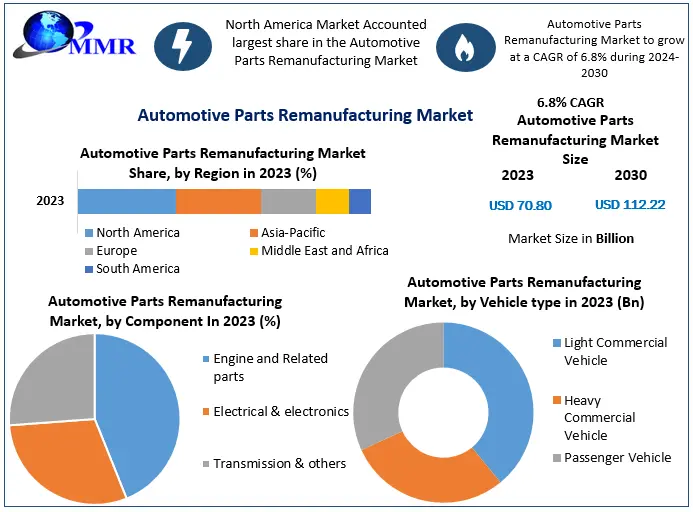
- Market valued at USD 70.80 billion in 2023.
- Expected to reach USD 112.22 billion by 2030.
- Forecast CAGR stands at 6.8% between 2024 and 2030.
- Asia Pacific accounted for the largest market share in 2023.
- Electrical & electronics components dominated the component segment.
- Passenger vehicles generated the highest demand for remanufactured parts.
- Recoating worn parts remained the leading remanufacturing process.
- Circular economy initiatives continue expanding market opportunities.
- Rising raw material costs strengthen the business case for remanufacturing.
Why This Matters Now
The Automotive Parts Remanufacturing Market is shifting from a linear manufacturing model toward resource-efficient production. Rising raw material costs, stricter environmental regulations, and growing demand for affordable vehicle maintenance are making remanufacturing a strategic priority for OEMs, aftermarket suppliers, and fleet operators. Companies capable of restoring components to original performance standards while lowering manufacturing costs are gaining a competitive advantage in the evolving automotive value chain.
Market Overview
The Automotive Parts Remanufacturing Market focuses on restoring used automotive components to original equipment performance through dismantling, inspection, cleaning, repair, replacement of worn components, reassembly, and comprehensive testing. Unlike conventional recycling, remanufacturing preserves much of the original product value while delivering performance comparable to new parts.
Growing demand for cost-effective vehicle repairs is a major growth driver. Consumers and commercial fleet operators increasingly choose remanufactured components because they provide reliable performance, warranty coverage, and significant cost savings compared to new replacement parts.
The market is also benefiting from sustainability initiatives. Governments worldwide continue implementing stricter waste management regulations and promoting circular economy practices that encourage product reuse and resource conservation. Remanufacturing significantly reduces energy consumption, lowers carbon emissions, and minimizes dependence on newly mined raw materials.
On the supply side, manufacturers continue investing in advanced restoration technologies that improve product quality and operational efficiency. However, the industry faces ongoing challenges related to skilled labor shortages, high technology investment requirements, and supply chain disruptions affecting core component availability.
Key Trends Driving Growth
Circular Economy Becomes an Industry Standard
Automotive manufacturers and aftermarket suppliers increasingly integrate remanufacturing into their business strategies to extend product lifecycles and reduce environmental impact. Circular manufacturing models create recurring revenue while lowering production costs.
Rising Raw Material Costs Improve Market Economics
Increasing prices for steel, aluminum, copper, and other industrial materials strengthen the financial benefits of remanufacturing. Recovering existing components reduces dependence on volatile raw material markets while improving manufacturing efficiency.
Environmental Regulations Accelerate Adoption
Governments continue introducing waste reduction policies and sustainability regulations that encourage reuse instead of disposal. These policies support broader adoption of remanufactured automotive components across both passenger and commercial vehicle segments.
Electrical Components Generate Higher Demand
Starters, alternators, and other electrical systems experience relatively frequent replacement cycles, making them well suited for remanufacturing. Increasing vehicle electrification is expected to expand long-term opportunities within this category.
Technology Improves Product Reliability
Advancements in inspection systems, precision machining, coating technologies, and component testing continue improving remanufactured product quality. Enhanced reliability strengthens customer confidence and supports broader market acceptance.
Explore detailed analysis, insights, and growth opportunities
Segment Insights
Dominant Segment: Electrical & Electronics Components
Electrical and electronics represented the largest component segment in 2023.
Growing replacement demand for starters, alternators, and related electrical systems continues supporting remanufacturing activity. These components experience predictable wear patterns and can often be restored efficiently while maintaining original performance standards.
Business impact: Suppliers specializing in electrical component remanufacturing benefit from recurring aftermarket demand and attractive profit margins driven by relatively high replacement frequency.
Fastest-Growing Segment: Passenger Vehicles
Passenger vehicles are expected to record the highest growth during the forecast period.
Rising urbanization, expanding vehicle ownership, and increasing consumer demand for affordable maintenance solutions continue driving demand for remanufactured automotive parts. Cost-conscious vehicle owners increasingly choose certified remanufactured components without compromising reliability.
Business impact: Aftermarket distributors and remanufacturing companies focused on passenger vehicle applications are well positioned to benefit from expanding global vehicle fleets.
Additional Key Sub-segments
Remanufacturing by Recoating Worn Parts
Recoating worn parts remains the leading remanufacturing process because it extends component life while restoring performance without requiring complete replacement.
Engine and Related Parts
Engine remanufacturing continues generating stable demand as commercial fleets seek cost-effective alternatives to purchasing entirely new powertrain components.
Commercial Vehicles
Both light and heavy commercial vehicles continue supporting steady remanufacturing demand due to high operating hours and fleet operators’ emphasis on minimizing maintenance costs.
Regional Growth Story
Asia Pacific
Asia Pacific accounted for the largest market share in 2023 and continues offering the strongest long-term growth potential.
Rapid vehicle ownership growth, expanding automotive production, increasing purchasing power, and rising awareness of sustainable manufacturing practices continue supporting market expansion across China, India, Japan, and other regional economies.
The region’s large vehicle population also creates substantial opportunities within the automotive aftermarket.
North America
North America remains one of the most mature remanufacturing markets due to widespread adoption of advanced manufacturing technologies, strong automotive sales, and growing consumer awareness of environmentally responsible repair solutions.
Established aftermarket networks and technological expertise continue supporting market leadership.
Europe
Europe benefits from stringent environmental regulations and well-established circular economy policies. Automotive manufacturers increasingly integrate remanufacturing into sustainability strategies while reducing production waste and material consumption.
Middle East, Africa and South America
Growing vehicle ownership and expanding aftermarket service networks continue creating new opportunities for remanufactured automotive components as consumers seek affordable maintenance alternatives.
Competitive Landscape
The Automotive Parts Remanufacturing Market is highly competitive, with global automotive suppliers, aftermarket specialists, and component remanufacturers competing through product quality, technical expertise, and extensive distribution networks.
Competitive differentiation increasingly depends on advanced remanufacturing technologies, warranty support, quality assurance, and efficient recovery of used components. Companies with broad product portfolios covering engines, transmissions, electrical systems, and drivetrain components are strengthening their market positions.
Industry participants are also investing in process automation, precision restoration technologies, and environmentally sustainable manufacturing practices to improve operational efficiency while meeting evolving regulatory requirements.
Key players include:
- Caterpillar Inc.
- Valeo SA
- ZF Friedrichshafen AG
- ZF TRW
- Carwood Group
- Robert Bosch GmbH
- Meritor Inc.
- Detroit Diesel Corporation
- Monark Automotive GmbH
- Budweg Caliper A/S
- Genuine Parts Company
- ATC Drivetrain Inc.
- Maval Manufacturing Inc.
- Teamec BVBA
- Motorcar Parts of America, Inc.
- Jasper Engines and Transmissions
- Standard Motor Products Inc.
Recent Developments
- Manufacturers expanded remanufacturing capabilities to improve resource efficiency and reduce production costs.
- Growing adoption of recoating technologies strengthened component restoration quality.
- Companies increased focus on electrical and electronic component remanufacturing to address rising replacement demand.
- Automotive manufacturers continued supporting circular economy initiatives through greater use of remanufactured components.
- Industry participants invested in advanced inspection, testing, and restoration technologies to improve product reliability.
Analyst Perspective — Tejaswini Kakade
Automotive remanufacturing is evolving into a strategic manufacturing discipline rather than simply an aftermarket repair activity. Companies that combine advanced restoration technologies, circular economy expertise, and rigorous quality assurance will be best positioned to capitalize on growing demand for cost-efficient, sustainable automotive components.
Future Outlook
The strongest market leaders will be those that integrate high-quality remanufacturing technologies with scalable circular supply chains as automakers and consumers increasingly prioritize sustainability, affordability, and resource efficiency.
About Maximize Market Research
Maximize Market Research Pvt. Ltd. (MMR) is a global market research and consulting company that provides reliable, data-focused, and practical business insights. The firm serves a wide range of industries, including healthcare, pharmaceuticals, technology, automotive, electronics, chemicals, personal care, and consumer goods. Through market forecasts, competitive analysis, strategic consulting, and industry impact assessments, MMR helps organizations understand changing market conditions, identify growth opportunities, and make informed business decisions for long-term success.
Contact Us :
2nd Floor, Navale IT Park Phase 3
Pune Banglore Highway, Narhe
Pune, Maharashtra 411041, India
+91 9607365656
sales@maximizemarketresearch.com
