Key Highlights
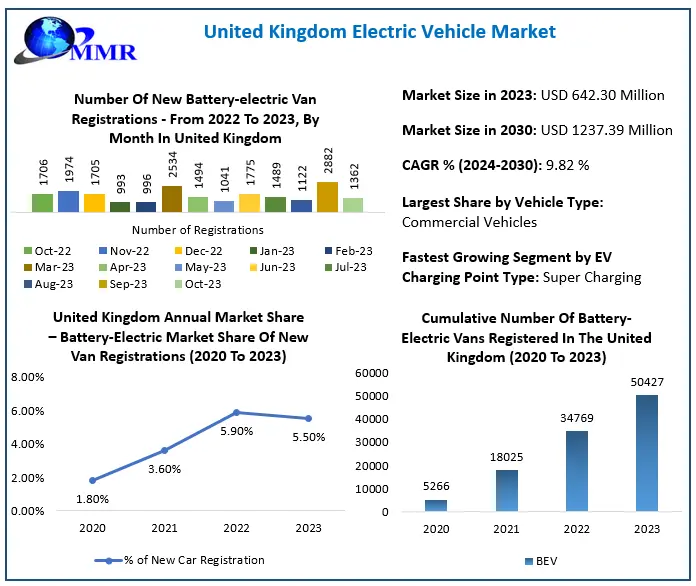
Market Growth: The UK electric vehicle (EV) market is on a high-growth trajectory, with valuations projected to soar from USD 37.74 billion in 2023 to USD 245.67 billion by 2033.
Strong CAGR: The market is expanding at a significant CAGR of 20.60% during the 2023–2033 forecast period.
Dominant Segment: Battery electric vehicles (BEVs) currently lead the market, capturing the largest revenue share due to their alignment with national sustainability mandates.
Key Drivers: Government-led policy mandates, rising climate change awareness, and continuous improvements in battery technology are the primary engines of adoption.
Sector Focus: The passenger vehicle segment remains the dominant force, reflecting strong consumer demand for individual electrified transportation.
Why This Matters Now
The United Kingdom stands at a critical juncture in its industrial history, as the automotive sector pivots decisively away from internal combustion engines. This transition is not merely a policy preference but an urgent economic necessity, as manufacturers and fleet operators race to align with legally binding carbon-reduction targets and the imminent phase-out of fossil-fuel vehicles.
Market Overview
The UK Electric Vehicle Market has evolved from a niche category into a pillar of the national economy. Driven by a combination of stringent emission regulations, government-backed incentives, and a growing consumer preference for sustainable transport, the market is scaling rapidly. As the industry matures, the focus has shifted from simple vehicle availability to the creation of a comprehensive, smart energy ecosystem that integrates charging infrastructure, grid management, and high-performance battery technology.
Key Trends Driving Growth
Policy-Driven Adoption: The UK government’s commitment to achieving net-zero emissions serves as the bedrock of market confidence. Regulatory frameworks requiring a high percentage of new car sales to be electric or hydrogen-powered by 2030 are forcing OEMs to accelerate their electrification roadmaps. These mandates, combined with low-emission zones in major urban centers, provide a stable and predictable environment for both manufacturers and investors.
Charging Infrastructure Expansion: The reliability and density of the charging network are now recognized as the definitive factors for sustained growth. Significant capital investment is currently flowing into both ultra-fast public charging stations and residential-friendly home-charging solutions. The industry focus has shifted from raw volume to “utilization efficiency,” ensuring that the network can support the rapid growth of the EV parc while maintaining grid stability.
Segment Insights
Dominant Segment: Battery Electric Vehicles (BEVs). BEVs have captured the largest market share, consistently outperforming other propulsion types due to their lower maintenance costs, absence of tailpipe emissions, and improving driving ranges.
Fastest-Growing Segment: Commercial and Fleet Electrification. While passenger vehicles hold the largest current share, the commercial segment—specifically for last-mile delivery and urban taxi services—is seeing an accelerated transition as operators seek to reduce operational costs and comply with city-center emission penalties.
Regional Growth Story
The electrification of the UK transport network is particularly pronounced in metropolitan hubs like London, Birmingham, and Manchester. These cities are leading the charge, utilizing low-emission zones to incentivize the shift to electric fleets. Meanwhile, regional infrastructure programs are ensuring that the benefits of EV adoption are distributed nationwide, providing the backbone for a truly interconnected national electric transport system.
Competitive Landscape
The competitive environment in the UK is characterized by a mix of legacy automotive giants and nimble, EV-native manufacturers. Traditional players are re-tooling their historical manufacturing hubs to accommodate modular electric architectures, while new entrants are leveraging software-defined vehicle models to challenge market share. This shift signals a major transition: success is no longer defined by engine output, but by the ability to manage battery supply chains, integrate advanced driver-assistance systems (ADAS), and provide seamless connectivity via over-the-air (OTA) updates. Manufacturers are increasingly moving toward localized battery sourcing to stabilize costs and ensure long-term production resilience.
Recent Developments
Manufacturing Transformations: Significant capital investments are revitalizing UK-based production facilities, with billions committed to re-tooling for next-generation electric vehicle assembly.
Vehicle-to-Grid (V2G) Pilots: Early-stage trials are exploring how electric vehicles can act as mobile power units for the national grid, potentially transforming the vehicle from a cost center into a value-added energy asset.
Battery Chemistry Evolution: A shift toward lithium iron phosphate (LFP) chemistries for mass-market vehicles is optimizing costs, while high-nickel chemistries continue to dominate the premium segment for range-critical applications.
Strategic Implications
For investors and OEMs, the UK market offers a blueprint for the managed transition to zero-emission mobility. The competitive advantage in this market belongs to those who view the vehicle as part of a larger energy ecosystem rather than an isolated hardware product. Strategic partnerships between automotive companies and energy providers will define the next phase of the UK market, as grid-integrated charging becomes the standard.
Future Outlook
The UK electric vehicle market is not just preparing for a future of electrification; it is actively constructing the infrastructure, policy, and manufacturing base to lead it. Future market leaders will be those who master the delicate balance between battery efficiency, grid compatibility, and consumer-centric software experiences—separating themselves from laggards who fail to pivot from the traditional “car-as-product” model to the modern, integrated “mobility-as-a-service” ecosystem.
Analyst Perspective
“The UK’s transition to electric vehicles has moved beyond the early-adopter phase and is now firmly embedded in the national industrial strategy,” says Tejaswini Kakade, Analyst at Maximize Market Research. “As battery costs stabilize and infrastructure becomes more reliable, the focus will increasingly shift toward how these vehicles integrate with the broader energy grid, turning every electric car into a node in a much larger, cleaner, and smarter energy network.”
About Maximize Market Research
Maximize Market Research Pvt. Ltd. (MMR) is a global market research and consulting company that provides reliable, data-focused, and practical business insights. The firm serves a wide range of industries, including healthcare, pharmaceuticals, technology, automotive, electronics, chemicals, personal care, and consumer goods. Through market forecasts, competitive analysis, strategic consulting, and industry impact assessments, MMR helps organizations understand changing market conditions, identify growth opportunities, and make informed business decisions for long-term success.
2nd Floor, Navale IT Park Phase 3
Pune Banglore Highway, Narhe
Pune, Maharashtra 411041, India
+91 9607365656
sales@maximizemarketresearch.com
