Key Highlights
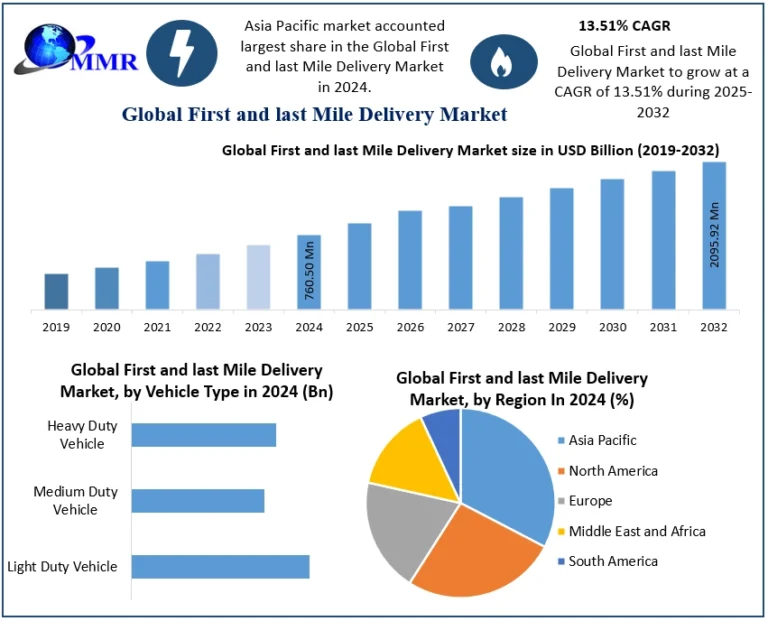
- Market valued at USD 760.50 million in 2024.
- Forecast to reach USD 2,095.92 million by 2032.
- Expected CAGR of 13.51% during 2025–2032.
- E-commerce growth continues to reshape logistics networks.
- Ground delivery vehicles remain central to operational efficiency.
- Asia Pacific leads the global market through expanding online retail.
- Technology investments improve delivery speed and customer satisfaction.
- Logistics providers increasingly compete through service quality and network optimization.
Why This Matters Now
Consumer expectations have fundamentally changed logistics operations. Same-day delivery, flexible shipping options, and real-time tracking have become competitive necessities rather than premium services. Logistics providers capable of optimizing first- and last-mile operations can reduce delivery costs, improve customer retention, and strengthen supply chain resilience. As online retail expands globally, efficient delivery networks are becoming a strategic differentiator across industries.
Market Overview
The First and Last Mile Delivery Market encompasses logistics services responsible for moving products from manufacturers to distribution networks and ultimately to end customers. First-mile operations focus on transporting goods from production facilities into logistics systems, while last-mile delivery completes the journey by delivering products directly to consumers.
Rapid expansion of e-commerce remains the market’s strongest growth catalyst. Increasing online shopping volumes require logistics providers to build faster, more flexible, and cost-efficient delivery networks capable of handling higher parcel volumes while maintaining delivery accuracy.
Ground transportation continues to dominate delivery operations because of its flexibility, lower operating costs, and ability to serve both urban and suburban markets. Companies continue investing in fleet modernization to improve operational efficiency and reduce delivery times.
However, market participants face operational challenges including regulatory compliance, infrastructure limitations, and vehicle performance in complex delivery environments. These factors require continuous investment in technology, route optimization, and intelligent logistics management.
Key Trends Driving Growth
E-commerce Expansion Accelerates Logistics Demand
Growing online retail sales continue increasing parcel volumes worldwide. Retailers increasingly depend on logistics partners capable of providing rapid, reliable, and flexible delivery services.
Digital Fleet Management
Logistics companies are adopting advanced routing software, GPS tracking, predictive analytics, and fleet monitoring technologies to improve vehicle utilization while reducing delivery costs.
Investment in Ground Delivery Vehicles
Manufacturers continue developing more efficient delivery vehicles with improved fuel economy and lower operating costs. Fleet modernization supports faster deliveries and greater operational flexibility.
Regulatory Focus on Transportation Operations
Governments continue strengthening transportation regulations affecting vehicle safety, emissions, and logistics operations. Compliance encourages investment in newer delivery fleets and advanced fleet management technologies.
Customer Experience as a Competitive Strategy
Delivery speed, real-time tracking, flexible scheduling, and reliable service have become essential competitive advantages for logistics providers serving the growing e-commerce ecosystem.
Explore detailed analysis, insights, and growth opportunities
Segment Insights
Dominant Segment: Light Duty Vehicles
Light-duty vehicles continue dominating first- and last-mile delivery operations due to their operational flexibility in urban environments. Their ability to navigate congested cities while supporting high delivery frequencies makes them essential for parcel distribution.
Business impact: Logistics companies benefit from lower operating costs, improved route flexibility, and higher delivery efficiency, particularly in densely populated urban markets.
Fastest-Growing Segment: Food & Beverage End Users
Food and beverage deliveries continue expanding rapidly as consumers increasingly adopt online grocery shopping and food delivery services. Delivery speed and product freshness remain critical operational priorities.
Business impact: Logistics providers specializing in temperature-sensitive deliveries gain opportunities to expand premium delivery services and long-term retail partnerships.
Additional Key Sub-Segments
Pharmaceutical and Healthcare
Healthcare deliveries require secure, timely, and temperature-controlled transportation, increasing demand for specialized logistics services.
FMCG
Fast-moving consumer goods generate consistent delivery volumes because of frequent consumer purchases and expanding digital retail channels.
Dry Goods
Dry goods remain the largest shipment category due to broad application across consumer products, industrial goods, and retail merchandise.
Postal Services
Postal delivery continues evolving through digital logistics integration, improving delivery visibility and operational efficiency.
Regional Growth Story
Asia Pacific
Asia Pacific leads the global market, supported by large consumer populations, rapid digital commerce expansion, and increasing investments in logistics infrastructure. Countries including China, India, Japan, and ASEAN economies continue strengthening regional distribution networks to support growing online retail demand.
North America
North America remains a mature logistics market driven by advanced supply chain technologies, established delivery networks, and widespread adoption of same-day delivery services. Continued investment in automation strengthens operational productivity.
Europe
European logistics providers increasingly focus on delivery efficiency while complying with stricter transportation regulations. Investments in sustainable delivery fleets and intelligent logistics systems continue modernizing regional operations.
Middle East & Africa and South America
Emerging markets are expanding logistics infrastructure to support growing e-commerce penetration and urbanization. Improvements in transportation networks are creating new opportunities for regional delivery providers.
Competitive Landscape
The market remains highly competitive, with global logistics companies leveraging integrated transportation networks, digital technologies, and diversified service portfolios to strengthen market positions.
UPS Supply Chain Solutions, DHL Supply Chain & Global Forwarding, and FedEx maintain leadership through extensive global distribution networks, advanced logistics technologies, and comprehensive supply chain capabilities.
Companies including Kuehne + Nagel, DB Schenker Logistics, CEVA Logistics, DSV, and GEODIS continue expanding integrated logistics solutions that combine transportation, warehousing, and digital supply chain management.
Regional leaders such as SF Express, China POST, YTO Express, and Nippon Express strengthen competitive intensity by expanding domestic delivery capabilities while increasing international logistics operations.
Competitive differentiation increasingly depends on technology adoption, network coverage, delivery reliability, and customer experience rather than transportation capacity alone.
Recent Developments
- Logistics providers continue investing in advanced ground delivery vehicle technologies.
- E-commerce companies are expanding delivery options to improve customer satisfaction.
- Fleet modernization initiatives are improving operational efficiency and reducing delivery costs.
- Technology adoption is increasing across route optimization, shipment visibility, and delivery management systems.
- Asia Pacific continues attracting logistics investments driven by sustained online retail growth.
Future Outlook
Logistics providers that combine intelligent automation, scalable delivery networks, and technology-driven customer experience will capture the strongest growth opportunities as global e-commerce continues transforming supply chain operations.
Analyst Perspective — Tejaswini Kakade
The competitive landscape of first- and last-mile delivery is shifting from transportation capacity toward technology-enabled execution. Logistics providers that integrate AI-powered route optimization, real-time shipment visibility, automated fleet management, and customer-centric delivery models will gain significant competitive advantages. As e-commerce volumes continue expanding globally, operational efficiency and delivery reliability will become the primary factors determining long-term market leadership.
About Maximize Market Research
Maximize Market Research Pvt. Ltd. (MMR) is a global market research and consulting company that provides reliable, data-focused, and practical business insights. The firm serves a wide range of industries, including healthcare, pharmaceuticals, technology, automotive, electronics, chemicals, personal care, and consumer goods. Through market forecasts, competitive analysis, strategic consulting, and industry impact assessments, MMR helps organizations understand changing market conditions, identify growth opportunities, and make informed business decisions for long-term success.
Contact Us :
2nd Floor, Navale IT Park Phase 3
Pune Banglore Highway, Narhe
Pune, Maharashtra 411041, India
+91 9607365656
sales@maximizemarketresearch.com
