Key Highlights
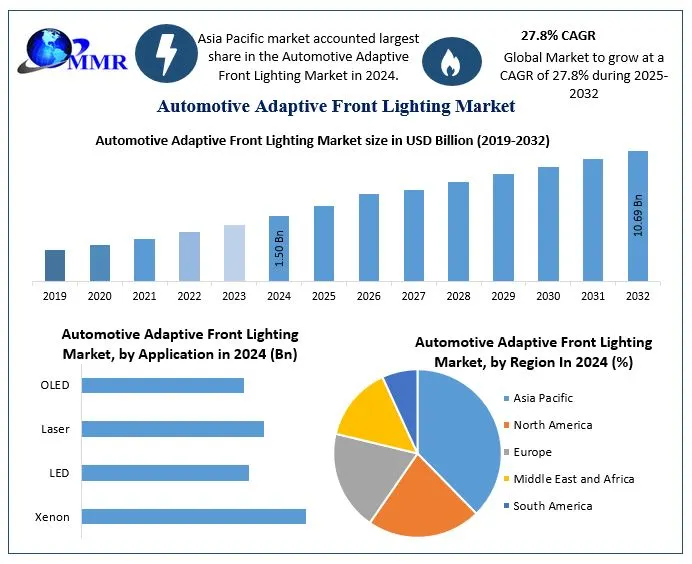
Dominant Segment: Xenon-based adaptive lighting maintains significant penetration in existing premium fleets, though it is steadily yielding market share to LED and Laser innovations.
Fastest-Growing Segment: LED-based adaptive front lighting (AFL) systems are accelerating at the highest rate, fueled by the integration of matrix-beam technology and energy-efficient architecture essential for EV range optimization.
Autonomous Integration: Lighting is transitioning from simple visibility tools into active sensor-fusion components, essential for LiDAR and camera-based ADAS arrays to function in low-visibility environments.
Regulatory Shift: Global legislative bodies are increasingly mandating high-performance, non-glare high-beam systems, creating an immediate upgrade cycle for lighting OEMs.
Software-Defined Evolution: Modern AFL systems now rely on over-the-air (OTA) updates to refine beam patterns and integrate with vehicle connectivity ecosystems.
Why This Matters Now
The automotive industry is no longer designing cars; it is building mobile sensor platforms that require high-precision illumination to perceive and interact with their surroundings. Adaptive Front Lighting (AFL) systems have moved from the periphery of luxury features to the core of the autonomous and ADAS safety stack, forcing a radical reconfiguration of vehicle electrical architectures. For Tier-1 suppliers and OEMs, the ability to integrate lighting into the broader vehicle connectivity ecosystem—rather than treating it as a static hardware component—has become a primary differentiator in safety, branding, and autonomous performance.
Market Overview
The Automotive Adaptive Front Lighting Market is currently undergoing a structural transformation as the demand for passive visibility is eclipsed by the necessity for active safety. As autonomous driving initiatives move from R&D to commercial deployment, the lighting system’s role is expanding to include data signaling and environment illumination for external perception sensors. This shift is reshaping the competitive landscape, pushing traditional lighting manufacturers to evolve into high-tech software and sensor integration firms.
Key Trends Driving Growth
The ADAS and Autonomous Imperative: Autonomous systems rely heavily on visual perception, making advanced lighting crucial for vehicle-to-everything (V2X) communication and low-light operation. By providing precise, high-contrast illumination that adapts to vehicle speed, steering angle, and traffic flow, AFL systems reduce driver fatigue and improve safety for human drivers while providing essential environmental data for autonomous algorithms.
Energy Efficiency and Powertrain Dynamics: With the industry-wide transition to battery electric vehicles (BEVs), energy-efficient illumination is a tactical necessity. LED and micro-LED technologies consume significantly less power than traditional halogen or xenon systems, directly impacting the vehicle’s electrical load and overall driving range. Manufacturers are optimizing these systems to be lighter and more aerodynamically efficient, aligning with the broader industry drive toward material weight reduction and power conservation.
Segment Insights
Dominant Segment (Xenon): While facing decline, Xenon technology still holds a strong position in the established automotive parc. Its established reliability in long-range illumination keeps it relevant, though its power consumption profile limits its utility in next-gen EV architectures.
Fastest-Growing Segment (LED/Laser): LED and Laser-based adaptive lighting represent the future of the segment. The rise of Matrix LED technology, which allows for individual pixel control to create “non-glare” high beams, is driving record adoption rates among global OEMs looking to maximize safety without compromising the comfort of oncoming traffic.
Regional Growth Story
The Asia-Pacific region dominates the market due to the concentration of vehicle manufacturing in China, Japan, and South Korea, where the demand for premium, tech-integrated vehicles remains high. Japan, in particular, is pioneering the integration of advanced lighting into autonomous mobility platforms. Meanwhile, Europe is the regulatory bellwether; stringent safety and environmental mandates there have forced the rapid adoption of intelligent lighting solutions, setting the standard for global OEMs. In North America, the market is catching up as regulatory hurdles for adaptive-beam technology are cleared, opening a massive demand pipeline for the next generation of intelligent lighting systems.
Competitive Landscape
The competitive arena is shifting from volume-based manufacturing to intellectual property and software leadership. Tier-1 suppliers are consolidating their market position through massive investment in electronics and software-defined lighting (SDL) platforms. Successful companies are moving beyond providing glass-and-bulb assemblies to delivering end-to-end illumination solutions that include sensors, control modules, and the software to manage them. This trend signals an inflection point where pricing power is shifting to suppliers who can guarantee deep integration with the vehicle’s ECU and safety-critical software. The winners will be those who control the “light-as-a-sensor” ecosystem, effectively making themselves indispensable to the autonomous vehicle software stack.
Recent Developments
Matrix LED Expansion: Tier-1 leaders have launched next-generation Matrix LED systems capable of selectively shading specific areas to avoid glare, a technology now becoming a standard requirement for premium vehicles.
Sensor Integration: New product rollouts now feature integrated LiDAR and camera cleaning systems within the headlamp module, reducing physical space requirements while optimizing sensor performance.
Software-Defined Lighting (SDL): Manufacturers are partnering with chip-makers to introduce high-speed communication buses that allow for real-time beam adjustment via OTA updates, a key milestone for software-defined vehicles.
Strategic Implications
The strategy for OEMs must focus on vertical integration and modular design. Relying on legacy suppliers for siloed lighting components creates a competitive disadvantage in an era of connectivity. OEMs should prioritize suppliers that provide modular lighting platforms capable of integrating into their specific software ecosystems. For investors, the focus must shift toward companies that possess not just manufacturing capacity, but the capability to build, test, and update safety-critical lighting software. The traditional manufacturing moat has been replaced by the software moat.
Future Outlook
The path forward is defined by the absolute integration of lighting into the autonomous vehicle sensory suite. We are witnessing the final phase of the transition where illumination becomes a data-driven function, and the “headlight” as a passive component is rendered obsolete. Future market leaders will be defined by their ability to treat light as an active sensor, while laggards will be those who fail to recognize that the value of an illumination system now rests entirely in its software, its energy efficiency, and its role as a core safety component in the autonomous software-defined vehicle.
Analyst Perspective
“The adaptive front lighting market is no longer just about visibility; it is about providing the high-contrast data environment required for the next generation of autonomous safety systems,” states Tejaswini Kakade, Market Analyst at Maximize Market Research. “OEMs that treat the lighting system as an integrated, software-driven sensor platform will set the safety standards for the next decade of mobility.”
About Maximize Market Research
Maximize Market Research Pvt. Ltd. (MMR) is a global market research and consulting company that provides reliable, data-focused, and practical business insights. The firm serves a wide range of industries, including healthcare, pharmaceuticals, technology, automotive, electronics, chemicals, personal care, and consumer goods. Through market forecasts, competitive analysis, strategic consulting, and industry impact assessments, MMR helps organizations understand changing market conditions, identify growth opportunities, and make informed business decisions for long-term success.
2nd Floor, Navale IT Park Phase 3
Pune Banglore Highway, Narhe
Pune, Maharashtra 411041, India
+91 9607365656
sales@maximizemarketresearch.com
