Key Highlights
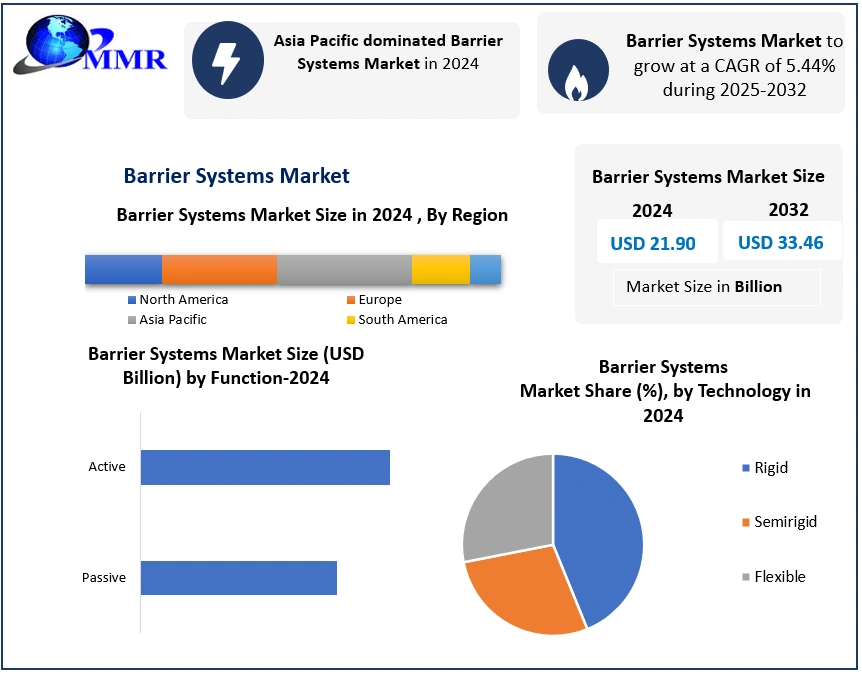
Market Valuation: The global barrier systems market reached USD 19.12 billion in 2023 and is projected to scale to USD 26.24 billion by 2030, compounding at a CAGR of 4.61% over the forecast period.
Vehicle Weight Disruption: The rapid adoption of heavier electric vehicles (EVs) is forcing a complete redesign of roadside containment barriers to withstand higher kinetic energy impacts.
Infrastructure Digitalization: Integration of sensors, IoT connectivity, and LED warning lights is transforming traditional passive steel guardrails into active, intelligent crash systems.
Urban Access Demands: Rising geopolitical threats and municipal security mandates are driving double-digit growth in automatic bollards and crash-rated drop arms for public transit hubs.
Regulatory Pressures: Strict compliance with European MASH (Manual for Assessing Safety Hardware) and EN 1317 standards is driving civil contractors to phase out legacy concrete systems in favor of advanced energy-absorbing steel and composite barriers.
Why This Matters Now
Global transportation networks are undergoing a structural shift that renders legacy safety infrastructure obsolete. The immediate commercial challenge lies in the changing physical profile of the global vehicle fleet. The average weight of passenger vehicles has risen sharply due to heavy battery packs in electric vehicles. Consequently, traditional highway guardrails designed for lighter internal combustion engine (ICE) vehicles are failing to contain modern EVs during high-speed run-off-road (ROR) events.
This mismatch creates an immediate liability and engineering challenge for municipal authorities and highway operators. Additionally, as autonomous driving systems move from test tracks to public roads, physical barriers must double as digital markers. Future barrier systems must incorporate radar-reflective materials and embedded sensors to communicate directly with vehicle-to-infrastructure (V2I) safety systems. Municipalities, civil developers, and automotive OEMs must synchronize their road safety and vehicle design standards immediately to prevent a spike in highway fatalities.
Market Overview
The global Barrier systems market is on a steady trajectory to reach USD 26.24 billion by 2030, growing at a 4.61% CAGR. This expansion represents a fundamental transition from passive perimeter protection to highly engineered, energy-absorbing crash systems. Historically, highway departments viewed barriers as static commodities purchased solely on low-cost bidding models. Today, the focus has shifted toward life-cycle cost analysis (LCCA), where durability, ease of post-impact repair, and modular designs dictate procurement decisions.
The market’s expansion is closely linked to the global push for smart cities and automated transport corridors. Governments are pouring trillions of dollars into highway expansion programs, particularly in developing economies where rapid urbanization has outpaced roadway safety frameworks. In mature markets, funding is pivoting toward retrofitting existing highways with high-containment, flexible steel systems that reduce occupant injury risk during secondary collisions. This systemic transition ensures a steady demand for next-generation safety infrastructure.
Key Trends Driving Growth
Three primary macroeconomic trends are accelerating the barrier systems market. First, the mass rollout of EV charging stations in commercial and public spaces requires robust physical protection. High-voltage charging terminals represent high-value, high-risk infrastructure that must be shielded from parking lot collisions. Consequently, commercial operators are investing heavily in crash-rated bollards and heavy-duty perimeter barriers to secure charging plazas and electrical substations.
Second, the rising complexity of urban traffic ecosystems has triggered a wave of smart city initiatives. Modern active barriers are no longer simple mechanical structures. They are integrated with automated access control, license plate recognition (LPR), and remote monitoring software. This integration allows municipal operators to manage traffic flows in real-time, redirecting vehicles dynamically during peak congestion or emergencies.
Third, structural shifts in materials science are driving product innovation. Traditional rigid concrete barriers, while effective at preventing crossover accidents, transfer the entirety of impact forces back to the vehicle occupants. Manufacturers are rapidly shifting production lines to high-strength, low-alloy (HSLA) steel and engineered polymer composites. These advanced materials deform progressively upon impact, absorbing kinetic energy and redirecting the errant vehicle safely along the barrier line.
Segment Insights
Dominant Segment: Crash Barrier Systems
Crash barrier systems remain the dominant product segment, commanding over 65% of total market revenue. This dominance is driven by mandatory government safety installations along state highways, bridges, and high-speed rail corridors. The segment is shifting rapidly from rigid concrete structures toward semi-rigid steel guardrails and flexible cable barriers that minimize vehicle damage and occupant trauma during high-speed impacts.
Fastest-Growing Segment: Smart/Active Barrier Systems (Bollards & Drop Arms)
Active barrier systems, including automated bollards, wedge barriers, and drop-arm gates, represent the fastest-growing segment. This growth is fueled by commercial real estate development, data center security requirements, and the expansion of smart toll plazas. These systems utilize hydraulic or electromechanical drives integrated with building management networks to provide instantaneous security screening.
By Material: Metal/Steel Barriers
Metal barriers hold the largest share of the material segment, prized for their predictable deformation characteristics, high tensile strength, and ease of recycling. Galvanized steel systems dominate outdoor applications due to their superior resistance to environmental corrosion.
By Application: Roadways and Highways
The roadways and highways segment dominates end-user demand. Rising infrastructure spending in emerging nations, alongside extensive repair and widening initiatives in North America and Western Europe, ensures a continuous pipeline of highway containment contracts.
Regional Growth Story
North America represents a highly mature, high-value segment of the barrier systems market, supported by the Federal Highway Administration’s strict enforcement of MASH guidelines. US and Canadian transportation agencies are systematically replacing older NCHRP 350-compliant hardware with MASH-tested barriers capable of handling modern utility vehicles and light trucks. This regulatory push guarantees a highly lucrative aftermarket for Tier-1 highway hardware suppliers.
In the Asia-Pacific region, rapid infrastructure development in China and India is fueling unprecedented volume demand. China’s extensive national highway network expansion and India’s aggressive national corridor development projects have made the region the largest consumer of steel crash barriers by volume. Additionally, rapid urbanization in South Korea and Japan is driving local governments to install intelligent pedestrian-protection barriers at busy city intersections and school zones.
Europe remains the global leader in design standards and material innovation. Compliance with EN 1317 standards has forced European manufacturers to focus heavily on the “Severity Index” of crashes, leading to the development of highly advanced, soft-impact motorcycle protection barriers. European nations are also leading the charge in integrating solar-powered LED warning systems directly into highway guardrails to improve night-time visibility.
Competitive Landscape
The global barrier systems market is characterized by consolidation among a few dominant players, alongside a fragmented tier of regional fabricators. Industry leaders include Lindsay Corporation, Trinity Industries, Valmont Industries, and Hill & Smith Holdings. These companies are shifting away from low-margin steel fabrication to position themselves as comprehensive safety solution providers, leveraging proprietary engineering software and advanced crash-testing facilities.
This consolidation signals a critical shift: pure-play steel fabricators are losing pricing power. The value in the market is migrating toward companies that hold proprietary intellectual property for energy-absorbing crash cushions and end-treatments. Furthermore, these players are locking in long-term municipal maintenance contracts, turning a traditional transactional product business into a highly predictable, service-oriented revenue stream.
Recent Developments
High-Capacity EV Barrier Testing: Leading manufacturers have initiated crash testing of guardrails using 5,000-pound electric SUVs to validate containment capabilities under extreme weight conditions.
IoT Guardrail Monitoring: Deployment of wireless impact-detection sensors on highway barriers, allowing road maintenance crews to receive instant alerts when a guardrail has been compromised.
Eco-Friendly Galvanization: Implementation of zinc-aluminum-magnesium alloy coatings to reduce the environmental footprint of barrier manufacturing while doubling corrosion resistance in coastal zones.
Modular Work Zone Barriers: Launch of highly lightweight, rapid-deployment steel barriers designed to protect construction workers in high-traffic highway maintenance zones.
Strategic Implications
For civil engineering firms and highway planners, the rapid evolution of the barrier systems market demands a revision of procurement models. Bidding processes that prioritize lowest initial cost over long-term durability are leading to ballooning maintenance budgets. Highly rigid barrier designs require frequent and expensive replacement of concrete blocks and vehicle components after low-speed impacts. Investing in modern self-healing or modular steel systems drastically reduces secondary maintenance costs and lanes closures.
Furthermore, commercial developers must integrate barrier selection into the early design phases of retail and industrial projects. As cities implement vehicle-free zones and pedestrianized corridors, perimeter security must blend seamlessly into the urban architecture. Developers who utilize passive landscaping, engineered stone planters, and high-security automatic bollards will successfully protect high-traffic public zones without creating a fortress-like aesthetic that drives away retail traffic.
Future Outlook
The next decade will see the integration of physical road barriers with the digital vehicle ecosystem. As autonomous vehicles occupy dedicated lanes on major freight corridors, barrier systems will evolve from passive impact attenuators into active guiding tracks. These systems will house V2I transmitters, continuous LED lane guidance lights, and integrated fiber-optic cables that monitor structural integrity and local weather conditions in real time.
The industry is moving toward a highly polarized future: commoditized, low-containment barriers will face extreme price pressure and low margins, while smart, highly engineered, energy-absorbing containment systems will capture premium pricing and dominate public-sector infrastructure budgets.Industry Inflection Point: The market will inevitably divide between innovative manufacturers offering intelligent, MASH-compliant, energy-absorbing crash infrastructure integrated with smart sensor networks, and legacy metal fabricators struggling to survive on shrinking margins for basic, non-rated steel guardrails.
Analyst Perspective
“The barrier systems market is no longer a simple discussion of steel and concrete; it is a critical component of the broader smart infrastructure and vehicle electrification puzzle. As passenger vehicles grow heavier and autonomous driving networks expand, safety barriers must evolve to become both physically stronger and digitally communicative to prevent catastrophic containment failures.”— Tejaswini Kakade, Principal Analyst, Maximize Market Research
About Maximize Market Research
Maximize Market Research Pvt. Ltd. (MMR) is a global market research and consulting company that provides reliable, data-focused, and practical business insights. The firm serves a wide range of industries, including healthcare, pharmaceuticals, technology, automotive, electronics, chemicals, personal care, and consumer goods. Through market forecasts, competitive analysis, strategic consulting, and industry impact assessments, MMR helps organizations understand changing market conditions, identify growth opportunities, and make informed business decisions for long-term success.
2nd Floor, Navale IT Park Phase 3
Pune Banglore Highway, Narhe
Pune, Maharashtra 411041, India
+91 9607365656
sales@maximizemarketresearch.com
