Key Highlights
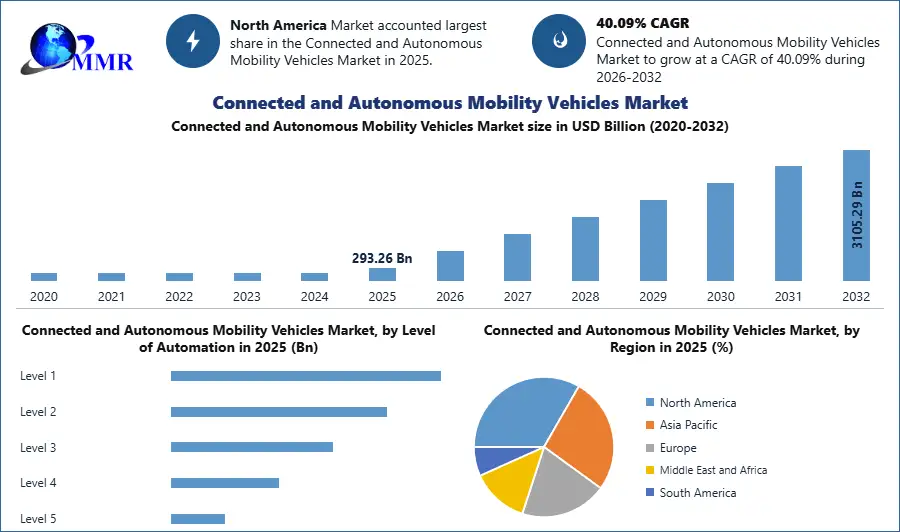
The global connected and autonomous mobility vehicles market reached a valuation of USD 293.26 billion in 2025.
Market scale is projected to expand to USD 3105.29 billion by 2032, advancing at a compound annual growth rate (CAGR) of 40.09% across the forecast period.
Passenger vehicles maintained the dominant market position in 2023, anchored by rising consumer safety expectations and advanced driver assistance systems (ADAS) penetration.
Commercial vehicle fleets represent the fastest-growing application landscape, driven by logistics operators targeting reduced driver labor expenses and optimized long-haul freight scheduling.
North America and the United States maintain frontrunner status in operational testing and deployment, driven by aggressive R&D investments from tech incumbents and supportive state-level regulatory policies.
Primary technical and operational bottlenecks limiting global deployment scale include high initial fail-safe system engineering costs, regional variations in vehicle certification standards, and data cybersecurity liabilities.
Why This Matters Now
The global automotive sector faces an unprecedented convergence of mechanical, electrical, and computational re-engineering. Traditional internal combustion platforms are systematically giving way to high-voltage electric architectures, while distributed electronic control unit (ECU) setups are being consolidated into centralized high-performance computing zones. This structural evolution demands massive capital outlays for software-defined vehicle (SDV) engineering, validation of complex machine learning stacks, and specialized production capabilities. For automotive executives, component suppliers, and institutional investors, understanding the exact vector of this capital transition is no longer just a long-term planning exercise—it is an immediate prerequisite for corporate survival.
Market Overview
The global Connected and autonomous mobility vehicles market stood at USD 293.26 billion in 2025. According to comprehensive market intelligence compiled by Maximize Market Research analyst Tejaswini Kakade, the sector is experiencing an intense phase of technological compounding. It is projected to achieve a valuation of USD 3105.29 billion by 2032, sustaining a CAGR of 40.09% from 2026 to 2032.
This rapid scaling reflects the structural consolidation of vehicle-to-everything (V2X) communication networks, artificial intelligence algorithms, and heavy vehicle electrification. The integration of real-time data streaming architectures allows today’s production platforms to shift from static mechanical devices into continuously updating nodes within a broader urban transportation network. By linking automated sensor suites directly with electric powertrains, OEMs are establishing the baseline requirements needed to support modern fleet optimization models and data-driven revenue streams.
Key Trends Driving Growth
What Changed?
The architectural focus of vehicle engineering has decisively migrated from standalone hardware platforms to highly connected, cloud-integrated digital systems. Historically, vehicle safety depended almost entirely on passive mechanical structures and localized electronic controls. Today, real-world validation of advanced vision sensors, LiDAR arrays, and edge-computing processors has transformed how vehicles sense and react to their environments. This shift reduces reliance on human driver reactions, opening new pathways to mitigate road accidents caused by driver fatigue or error.
Why Now?
The simultaneous pressure to meet strict municipal decarbonization targets and address urban traffic congestion has forced a transformation in vehicle operations. Cities are facing rising infrastructure constraints and strict emissions mandates, making the transition to connected electric vehicle architectures highly urgent. High-speed cellular networks and centralized computing layers are now mature enough to handle complex data routing smoothly. This allows municipal traffic infrastructure and smart grids to communicate directly with incoming fleets, maximizing traffic flow and improving real-time energy efficiency.
Who Benefits?
Automotive manufacturers that have aggressively invested in proprietary software stacks and central computer architectures stand to gain significant market advantages. Similarly, Tier-1 electronics suppliers capable of delivering advanced sensor assemblies and high-compute domain controllers are capturing a larger share of the vehicle bill of materials (BOM). On the operational side, logistics networks, ride-hailing providers, and micro-mobility platforms benefit from lower total cost of ownership (TCO) profiles through optimized preventative maintenance schedules and reduced driver dependencies.
What Happens Next?
The market is shifting toward deeper collaboration models that bring together technology companies, legacy vehicle manufacturers, and regional government bodies. Municipalities are actively modifying their local governance frameworks to support the integration of autonomous networks within public transit systems. This ecosystem expansion requires substantial investments in digital twin mapping, smart traffic signaling, and grid-tied charging hubs. As these systems scale, they will unlock new business opportunities focused on vehicle data monetization, localized logistics routing, and fully integrated Mobility-as-a-Service (MaaS) subscription networks.
Segment Insights
Dominant Segment: Passenger Vehicles
Passenger platforms represent the largest market share by volume and value within the global landscape. This leadership position is sustained by intense regulatory focus on active safety features and growing consumer demand for advanced driver assistance systems (ADAS). The continuous rollout of Level 2 and Level 2+ features by major auto brands has established a baseline consumer expectation for automated lane-keeping, adaptive cruise control, and automated parking systems. To offset the high initial engineering costs of these packages, OEMs are combining advanced driver monitoring with subscription-based over-the-air (OTA) feature upgrades to build predictable aftermarket revenue models.
Fastest-Growing Segment: Commercial Vehicles & Fleet Logistics
Commercial transportation platforms, covering long-haul freight trucks and automated urban delivery vans, show the highest growth trajectory through 2032. Fleet operators face severe macroeconomic challenges, including driver retention issues, strict hours-of-service rules, and volatile fuel costs. Implementing autonomous driving tech directly addresses these pain points by maximizing long-haul vehicle uptime and optimizing highway fuel efficiency. The deployment of autonomous yard trucks and automated hub-to-hub freight line-hauls offers a highly structured route to commercial viability, justifying the higher upfront hardware acquisition costs.
Regional Growth Story
North America remains the leading region for connected and autonomous vehicle innovation and testing. The United States and Canada benefit from a mature technology ecosystem that brings together top-tier AI engineering talent, software providers, and well-funded R&D centers. Flexible regional testing regulations, particularly in states like California, Arizona, and Texas, have allowed developers like Waymo, Tesla, and Cruise to run large-scale pilot projects and accumulate millions of real-world autonomous testing miles.
Concurrently, European manufacturing centers—led by Germany—are prioritizing highly disciplined functional safety validation and harmonizing cross-border vehicle communication standards. In the Asia-Pacific region, led by China, Japan, and South Korea, growth is accelerated by massive industrial investments in lithium-ion battery manufacturing and rapid smart-city infrastructure rollouts. These public-private partnerships provide a strong foundation for launching highly integrated, large-scale connected vehicle projects.
Competitive Landscape
The competitive dynamics within the connected and autonomous mobility vehicles market are shifting away from standalone product engineering toward full-stack technology and manufacturing partnerships. Major automotive corporations are recognizing that developing complete autonomous software platforms, high-performance computing clusters, and specialized solid-state sensors requires highly diversified engineering skills. As a result, the industry is seeing deep strategic alliances that pair legacy manufacturing capabilities with advanced software expertise.
These collaborative agreements allow partners to share the high financial risks and capital costs associated with long-term technology development. Furthermore, these joint efforts are accelerating the rollout of standardized vehicle architectures capable of processing massive volumes of edge-computed sensor data. Dominant positions in the market are increasingly held by companies that control their own operating software stacks, maintain secure semiconductor supply chains, and have access to the large-scale cloud infrastructure needed to process fleet-wide data analytics.
Recent Developments
Autonomous vehicle platforms have significantly expanded their urban robotaxi test zones, moving from low-density suburbs into highly complex, dense metropolitan centers.
Automotive electronics providers have introduced next-generation domain controllers designed to handle multi-sensor data fusion, merging camera, radar, and LiDAR feeds onto a single processing chip.
Leading software developers have successfully rolled out end-to-end neural network architectures for path planning, replacing manual heuristic coding with deep-learning models.
Public transport agencies across several major cities have launched commercial pilot programs using automated low-speed shuttles to solve first-mile and last-mile transit gaps.
Global standards bodies have updated cybersecurity protocols for vehicle-to-everything (V2X) communications, introducing advanced cryptographic layers to protect against external network vulnerabilities.
Strategic Implications
For automotive decision-makers, the scaling of the connected and autonomous mobility vehicle market requires an immediate overhaul of core corporate strategies:
Software-Centric Capital Allocation: Capital expenditure must pivot away from traditional mechanical validation toward software engineering, cloud data operations, and continuous integration/continuous deployment (CI/CD) pipelines.
Supply Chain Verticalization: OEMs must form direct strategic partnerships with semiconductor foundries and Tier-1 electronics suppliers to guarantee long-term access to specialized high-compute chips.
Redesigning Aftermarket Models: Revenue generation must look beyond the initial vehicle sale to prioritize lifetime value monetization, enabled by over-the-air feature releases, predictive maintenance diagnostics, and on-demand functional upgrades.
Active Regulatory Alignment: Product teams must work closely with regional regulators to build transparent safety cases, clear operational design domains (ODDs), and standardized liability frameworks.
Future Outlook
As the market advances toward 2032, the gap between forward-looking companies and slow-moving market participants will widen dramatically. The market will reward organizations that move quickly to secure their component supply chains, build flexible software-defined vehicle architectures, and participate in broader urban smart-city networks. Ultimately, the industry will divide into two clear groups: agile, software-capable leaders that monetize complete digital mobility platforms, and slow-moving laggards confined to low-margin hardware assembly.
Analyst Perspective
“The scaling of the global connected and autonomous mobility vehicles market represents a fundamental rewriting of industrial transportation economics. We are observing an irreversible transition where value creation shifts from the mechanical assembly of the chassis to the computation running inside the vehicle domain controller. Companies that fail to master centralized electronic architectures, secure reliable semiconductor pipelines, and deploy highly resilient software platforms will find themselves sidelined in an increasingly automated, fleet-driven transport ecosystem.”
— Tejaswini Kakade, Lead Automotive Sector Analyst at Maximize Market Research
About Maximize Market Research
Maximize Market Research Pvt. Ltd. (MMR) is a global market research and consulting company that provides reliable, data-focused, and practical business insights. The firm serves a wide range of industries, including healthcare, pharmaceuticals, technology, automotive, electronics, chemicals, personal care, and consumer goods. Through market forecasts, competitive analysis, strategic consulting, and industry impact assessments, MMR helps organizations understand changing market conditions, identify growth opportunities, and make informed business decisions for long-term success.
2nd Floor, Navale IT Park Phase 3
Pune Banglore Highway, Narhe
Pune, Maharashtra 411041, India
+91 9607365656
sales@maximizemarketresearch.com
