Key Highlights
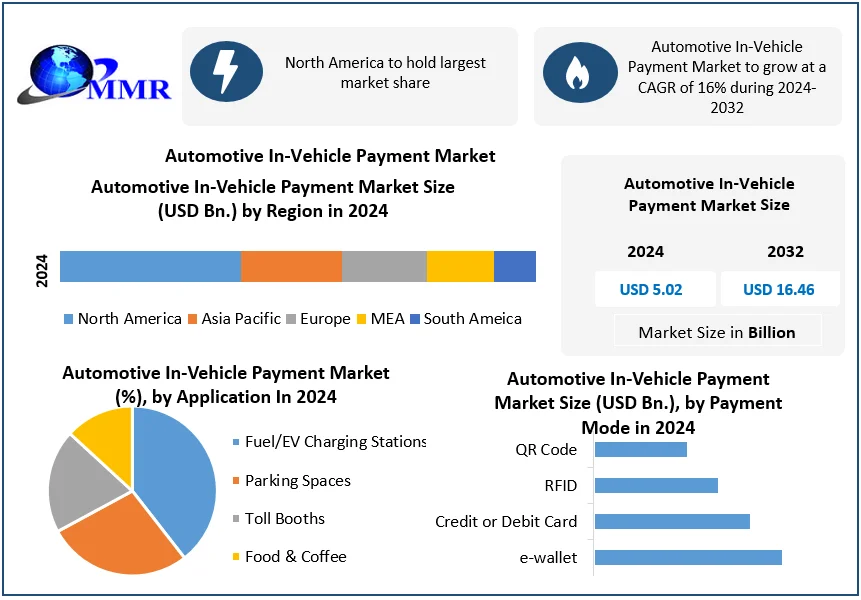
Global Automotive In‑Vehicle Payment Market was valued at USD 5.02 billion in 2024, showing that monetizable car‑based transactions have already moved beyond pilots into a meaningful commercial base.
The market is projected to reach USD 16.46 billion by 2032 at 16% CAGR, signaling a multi‑year shift in how drivers pay for fuel, charging, parking, tolls, and services from inside the vehicle.
Growth is driven by rising connected vehicle penetration and software‑defined vehicles, which make the dashboard and infotainment stack a secure interface for payments.
OEMs, payment networks, and mobility platforms are integrating in‑vehicle payments to capture new recurring revenue streams and strengthen customer lock‑in.
The United States and Europe are early leaders, but Asia Pacific is emerging rapidly as connected and electric vehicles scale.
Why This Matters Now
Automakers are shifting from selling hardware to selling mobility services, data, and digital experiences. In‑vehicle payment systems sit at the center of this shift by turning every refueling, charging, parking, and drive‑through interaction into a seamless, embedded transaction.
For OEMs, that means new recurring revenue and stronger brand engagement; for payment providers and mobility platforms, it means gaining direct access to drivers at the moment of intent. A market expected to more than triple by 2032 at 16% CAGR shows that this is not a side feature but a strategic pillar of the connected‑car business model.
Market Overview
The Automotive In‑Vehicle Payment Market covers hardware, software, and services that enable drivers to initiate and complete payments from inside the vehicle, typically through the infotainment screen, voice commands, or smartphone‑linked interfaces. Core use cases include fuel and EV charging payments, parking, tolls, quick‑service food, and subscription services.
The jump from USD 5.02 billion in 2024 to USD 16.46 billion by 2032 means in‑vehicle payments are tracking closely with connected car and SDV adoption. As more vehicles ship with embedded connectivity, OEM app stores, and integrated navigation, payments move from the driver’s phone into the vehicle itself, tightening control over the transaction journey.
Executives reading this number should see a commerce platform, not a widget. The vehicle is becoming a point‑of‑sale terminal with sensors, location, and identity already built in. That allows OEMs and partners to design offers, loyalty, and dynamic pricing tied directly to driving behavior and vehicle status.
Key Trends Driving Growth
1. Software‑Defined Vehicles and Connected Ecosystems – What Changed?
The rise of software‑defined vehicles means features are increasingly delivered through code and over‑the‑air updates, turning cars into connected devices with continuous services. In‑vehicle payment functionality can be added, updated, and expanded via software, enabling faster innovation cycles and new services without hardware changes.
Connected car penetration also brings always‑on data links and secure channels needed for payments. As more OEMs standardize connectivity and app platforms, payments become a natural extension of navigation (pay‑for‑parking), route planning (reserve and pay for charging), and infotainment (subscriptions, content, food orders).
2. EV Charging and Mobility Services – Why Now?
EV adoption is pushing drivers to interact with charging networks frequently and often across different operators. In‑vehicle payments simplify that process by allowing drivers to start and pay for charging directly through the vehicle, without juggling multiple apps or cards.
As fleet electrification rises, operators need consolidated billing, fraud control, and driver convenience. Embedded payments at the vehicle level reduce friction and administrative overhead by tying transactions to VINs, driver IDs, and fleet accounts, increasing the appeal of integrated payment platforms.
3. Contactless, Tokenized, and Biometric Payments – Who Benefits?
Payment networks and fintech providers are pushing tokenization, contactless methods, and biometrics for security and convenience. In‑vehicle payment systems can embed these technologies into steering wheel buttons, voice authentication, and head‑unit interfaces.
Drivers benefit from frictionless, secure transactions; OEMs and merchants benefit from higher conversion rates and data flows; payment providers gain new volumes through a differentiated channel. The result is a value chain where integration and user experience drive share.
4. Mobility Platform Economics – What Happens Next?
Mobility platforms—ride‑hail, car sharing, subscription services—are increasingly integrating payments into their apps and vehicles. As in‑vehicle payments mature, these platforms can link trip, vehicle, and spending data to optimize pricing, offers, and routes.
This creates a feedback loop: better payment integration drives better service economics and customer satisfaction, which drives more usage and more transactions, reinforcing the business case for investment in in‑vehicle payment tech.
Request a Free Sample Copy or View Report Summary: https://www.maximizemarketresearch.com/request-sample/81174/
Segment Insights
Dominant Segment: Passenger vehicles are the dominant segment, as most in‑vehicle payment deployments focus on private cars and SUVs where drivers frequently use parking, tolls, fuel, charging, and retail services. This concentration means OEMs targeting retail customers shape the bulk of current market revenue.
Fastest‑Growing Segment: Services linked to EV charging and connected commerce—like parking, tolling, and food services bundled with navigation—are highlighted across industry reports as fast‑growing, driven by EV penetration and connected ecosystem maturity, though the exact fastest‑growing segment is not formally named in the cited MMR figure and therefore cannot be quantified.
On the technology side, cloud‑based payment platforms and app‑integrated wallets are scaling faster than legacy embedded card systems, as SDV architectures favor flexible, API‑driven integration.
Fleet and commercial vehicle payment solutions are an emerging segment, especially in logistics and corporate fleets, where consolidated billing and driver authorization from the cab improve control.
For OEM strategists, this segmentation shows where to focus first: mainstream passenger cars and crossovers with strong connected feature uptake, plus EV models where charging payments solve clear pain points.
Regional Growth Story
North America and Europe are early leaders in in‑vehicle payments, driven by high connected car penetration, mature payment infrastructure, and strong partnerships between automakers, fuel chains, and payment networks. The United States, in particular, combines large highway networks, tolling, and a strong QSR culture, making in‑vehicle payment a natural extension of daily driving.
Europe’s focus on EVs, digital tolling, and urban parking systems creates fertile ground for vehicle‑based payments tied to smart city infrastructure. For OEMs in Germany and broader Europe, this aligns with their push into SDVs and advanced infotainment stacks.
Asia Pacific is flagged across market analyses as the fastest‑growing region for in‑vehicle payment services, fueled by rapid uptake of connected and electric vehicles and strong smartphone‑led digital payment habits in markets like China, South Korea, and India. As local OEMs embed payments into connected car platforms, regional growth will accelerate beyond today’s base.
For stakeholders, this spread means in‑vehicle payment strategies must be tailored: North America and Europe focus on integrating existing payment ecosystems and services; Asia Pacific focuses on scaling new, app‑driven commerce behaviors into the car.
Competitive Landscape
The competitive field includes OEMs, payment networks, card schemes, banks, fintechs, fuel retailers, EV charging operators, parking platforms, and technology providers powering in‑vehicle payment middleware. Each group is vying to control user identity, transaction routing, and data.
OEMs that build their own payment platforms or co‑brand wallets inside the vehicle gain leverage over data and customer relationships. Payment networks and fintechs push white‑label or co‑developed solutions to stay embedded in the transaction flow, aiming to prevent disintermediation.
Technology providers that supply secure payment modules, tokenization, and integration APIs gain pricing power because their software becomes hardwired into vehicle operating systems. Over time, those players can shape standards and interoperability, influencing which OEM ecosystems attract merchants and services.
Recent Developments
Market reports highlight rapid integration of in‑vehicle payments with EV charging networks, allowing drivers to authenticate and pay directly from the car at compatible charging stations.
Industry analysis points to partnerships between automakers and fuel or parking operators to enable seamless pay‑by‑car experiences at pumps, garages, and toll plazas.
Connected vehicle reports spotlight growing use of biometric and tokenized payment methods inside vehicles, aiming to balance convenience with fraud protection.
Studies highlight Asia Pacific’s strong growth projections, reflecting the region’s aggressive deployment of connected and electric vehicles and its digital payment culture.
Strategic Implications
For OEMs, in‑vehicle payments are now a strategic feature of connected‑car roadmaps, not a marketing add‑on. They enable monetization of the driver’s journey through commissions, subscription services, and differentiated experiences, while also anchoring loyalty programs and usage‑based offerings.
Tier‑1 suppliers and software partners must align their infotainment, connectivity, and HMI solutions with secure, flexible payment architectures. Those that provide turnkey payment modules and proven integrations with major ecosystems will be more attractive to OEMs juggling complexity and compliance.
Fleet operators and mobility providers can use in‑vehicle payments to centralize, audit, and control spend, linking expenses to route, driver, and vehicle. This improves fleet economics and supports integrations with mobility‑as‑a‑service platforms, especially when tied to EV charging, tolling, and parking.
Future Outlook
With the Automotive In‑Vehicle Payment Market expected to grow from USD 5.02 billion in 2024 to USD 16.46 billion by 2032 at 16% CAGR, the car is set to become a mainstream commerce endpoint, connecting drivers, merchants, and mobility services through embedded, secure payments. As SDVs mature and EVs spread, transaction flows will increasingly originate from vehicle OS and apps rather than phones or physical cards.
The decisive split ahead is clear: future market leaders will treat in‑vehicle payment as a core pillar of their connected‑car and mobility platform strategies, building secure, data‑rich ecosystems around the dashboard, while laggards will bolt on basic payment features and watch higher‑margin services, customer data, and everyday driver touchpoints flow to more integrated competitors.
Related Reports
Global Automotive Flooring Market https://www.maximizemarketresearch.com/market-report/global-automotive-flooring-market/113225/
Global Curtain Airbags Market https://www.maximizemarketresearch.com/market-report/global-curtain-airbags-market/98343/
Global Automotive Hill Descent Control Market https://www.maximizemarketresearch.com/market-report/global-automotive-hill-descent-control-market/82527/
Analyst Perspective
“In‑vehicle payments are transforming connected cars into transaction hubs, creating new revenue and loyalty levers for OEMs and mobility providers while redefining how drivers pay for energy, access, and services on the move,” said Tejaswini Kakade, Analyst.
About Maximize Market Research
Maximize Market Research Pvt. Ltd. (MMR) is a global market research and consulting company that provides reliable, data-focused, and practical business insights. The firm serves a wide range of industries, including healthcare, pharmaceuticals, technology, automotive, electronics, chemicals, personal care, and consumer goods. Through market forecasts, competitive analysis, strategic consulting, and industry impact assessments, MMR helps organizations understand changing market conditions, identify growth opportunities, and make informed business decisions for long-term success.
2nd Floor, Navale IT Park Phase 3
Pune Banglore Highway, Narhe
Pune, Maharashtra 411041, India
+91 9607365656
sales@maximizemarketresearch.com
