Key Highlights
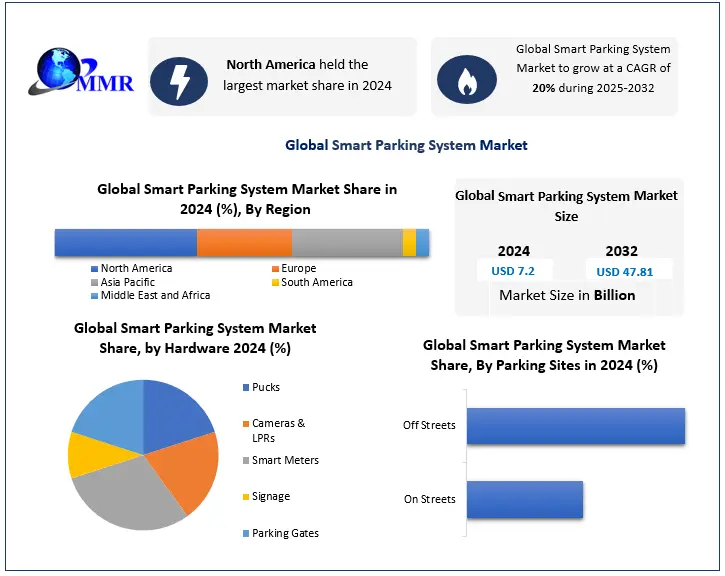
Market Valuation: The global market reached USD 7.2 Bn in 2024, projected to grow at a 20% CAGR to reach USD 47.81 Bn by 2032.
Dominant Hardware: Smart Meters hold the largest share (39.23% in 2024).
Dominant Application: The Commercial segment leads the market with a 42% share.
Regional Leadership: North America remains the primary market (46.03% share in 2023), while Asia-Pacific emerges as the fastest-growing region.
Strategic Disruption: Automotive OEMs and Tier-1 suppliers are increasingly integrating vehicle sensors with infrastructure to enable automated valet parking.
Why This Matters Now
Urban density and the relentless surge in vehicle ownership have turned parking from a logistical necessity into a critical urban crisis. As cities face dwindling space and rising traffic congestion, traditional parking models are failing, creating an immediate, high-stakes opening for AI-driven, IoT-connected smart systems that slash idle times and boost asset utilization.
Market Overview
The global Smart parking system market is undergoing a fundamental shift, moving beyond simple space monitoring toward comprehensive, data-driven ecosystems. These systems—comprising ground sensors, high-resolution cameras, and real-time data analytics—are no longer just tools for operators; they are core components of the “Smart City” mandate. By reducing the time vehicles spend circling for spots, these systems directly address environmental emission mandates, positioning parking technology as a key enabler for sustainable urban mobility.
Key Trends Driving Growth
The convergence of the Internet of Things (IoT), big data analytics, and cloud computing is the primary engine of this market. Real-time data collection allows for dynamic pricing strategies, enabling municipalities and private operators to regulate traffic flow more effectively. Simultaneously, consumer demand for contactless payments and mobile reservation apps is forcing a shift away from legacy cash-based payment infrastructure. The market is evolving into a holistic management platform where traffic control, environmental monitoring, and parking availability converge into a single, seamless digital experience.
Segment Insights
Dominant Hardware Segment: The Smart Meter segment holds the largest market share (39.23% in 2024). These devices, integrated with sensors and mobile applications, have rendered traditional cash-collecting meters obsolete, significantly lowering operating expenses for municipalities.
Fastest-Growing Region: Asia-Pacific is the fastest-growing market. Rapid urbanization in India, China, and Japan is accelerating demand as rising vehicle affordability puts unprecedented pressure on existing infrastructure.
Dominant Application Segment: The Commercial segment commands the largest share (42% in 2024), driven by large-scale adoption in corporate campuses, sports complexes, and shopping malls to maximize asset throughput and data-driven resource allocation.
Regional Growth Story
North America maintains its lead, accounting for 46.03% of the market share in 2023, bolstered by aggressive investment in smart city infrastructure and high consumer demand for tech-integrated convenience. Europe is carving a significant niche (31.6% share) by leveraging its robust automotive manufacturing base to integrate ultrasonic and camera-based sensors directly into passenger vehicle architectures. The Middle East, Africa, and South America represent the next frontier, where nascent smart city projects are expected to create untapped opportunities for international technology providers.
Competitive Landscape
The competitive environment is shifting from hardware-centric sales to integrated, software-defined ecosystems. Tier-1 suppliers and major OEMs are prioritizing R&D to bridge the gap between in-vehicle hardware and external parking infrastructure. Companies are no longer selling isolated sensors; they are offering end-to-end platforms that optimize the entire vehicle-to-infrastructure (V2I) loop. This transition signals that the next competitive battlefield is not just vehicle performance, but the ability to offer a “frictionless” mobility experience that starts the moment a vehicle leaves the garage.
Recent Developments
Bosch and APCOA: In January 2023, the partners launched automated valet parking technology across German parking garages, turning physical spaces into software-enabled hubs.
Continental AG’s Expansion: The 2021 acquisition of Kopernikus Automotive reflects a strategic focus on infrastructure-based automated parking and logistics center maneuvering.
IPS Group’s Innovation: The July 2022 launch of a stereoscopic detection sensor signifies a push for more precise vehicle occupancy detection within integrated smart ecosystems.
Westphalia Parking: The 2021 app launch enables remote vehicle summoning, highlighting the industry’s push toward complete contactless, autonomous-ready parking solutions.
Strategic Implications
For OEMs, the message is clear: parking is now a software feature, not an afterthought. Integrating parking management into the vehicle’s operating system creates high-margin, recurring revenue opportunities via mobility-as-a-service (MaaS) platforms. Fleet operators, meanwhile, must view smart parking integration as a cost-saving necessity to mitigate the idling and downtime costs inherent in urban delivery and shared mobility services. Investors should monitor companies that own the data loop between infrastructure and vehicle, as these firms hold the highest long-term leverage in the urban mobility chain.
Future Outlook
The future of the parking industry belongs to firms capable of seamless integration between vehicle-side autonomy and infrastructure-side intelligence. While early movers are currently focused on basic space availability, the next phase of competition will be won by those who deliver fully automated valet and traffic-integrated maneuvering. The chasm between future market leaders and laggards will be defined by one factor: the ability to scale IoT-led, AI-optimized systems that turn stagnant parking assets into dynamic, high-revenue digital nodes in the global transportation network.
Analyst Perspective
“The global smart parking system market is moving from a utility-focused sector to a critical pillar of intelligent transportation,” says Tejaswini Kakade, Analyst at Maximize Market Research. “As urbanization accelerates, the winners will be those who bridge the gap between vehicle-to-infrastructure connectivity and sustainable, data-driven urban planning.”
About Maximize Market Research
Maximize Market Research Pvt. Ltd. (MMR) is a global market research and consulting company that provides reliable, data-focused, and practical business insights. The firm serves a wide range of industries, including healthcare, pharmaceuticals, technology, automotive, electronics, chemicals, personal care, and consumer goods. Through market forecasts, competitive analysis, strategic consulting, and industry impact assessments, MMR helps organizations understand changing market conditions, identify growth opportunities, and make informed business decisions for long-term success.
2nd Floor, Navale IT Park Phase 3
Pune Banglore Highway, Narhe
Pune, Maharashtra 411041, India
+91 9607365656
sales@maximizemarketresearch.com
