Key Highlights
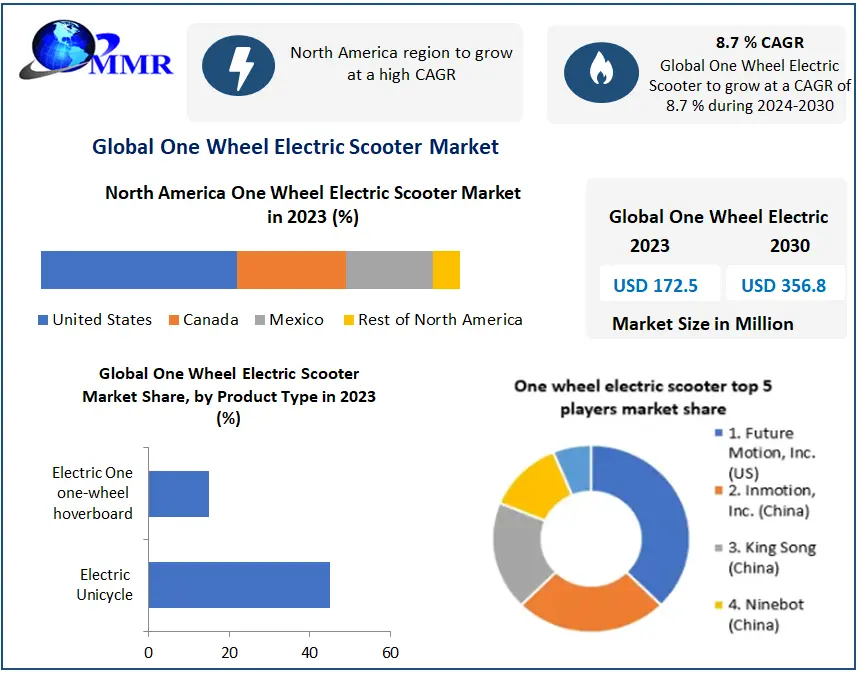
The Global One Wheel Electric Scooter Market size is valued at USD 172.5 million in 2023, confirming a niche but commercially meaningful segment within personal EV micromobility.
Market revenue is expected to grow to USD 356.8 million by 2030 at a compound annual growth rate of 8.7%, indicating steady expansion rather than speculative hype.
Parallel industry reports show similar orders of magnitude and mid‑single to high‑single digit CAGRs, reinforcing that one wheel scooters are on a stable growth path.
The category is driven largely by millennials and Gen Z users attracted to distinctive form factors, self‑balancing tech and compact urban mobility.
Offline sales remain significant, as many buyers prefer in‑person product testing and safety reassurance before purchasing novel balance‑based devices.
Why This Matters Now
Urban transport is shifting toward smaller, cleaner, software‑enabled vehicles. One wheel electric scooters sit on the frontier of that shift, blending electrification, compact design and digital controls into a single device that challenges traditional views of scooters and bikes.
At the same time, OEMs and investors search for testbeds where battery technology, in‑wheel motors and balance control software can be trialed quickly at consumer scale. A market moving from USD 172.5 million to USD 356.8 million by 2030 at 8.7% CAGR gives them a living laboratory for EV component innovation and user‑experience design without the cost and risk of full‑size vehicles.
Market Overview
MMR positions the Global One Wheel Electric Scooter Market around single‑wheel, electrically powered devices used for personal commuting, recreation and urban mobility. These scooters typically use self‑balancing technology and electric drivetrains to deliver compact EV transport in dense environments.
The market value of USD 172.5 million in 2023, rising to USD 356.8 million by 2030 at 8.7% CAGR, suggests one wheel scooters occupy a distinct niche between traditional e‑scooters, electric skateboards and bikes. Consumers buy them for their portability, distinctive riding experience and lifestyle appeal, rather than pure utilitarian commuting alone.
For decision‑makers, this means one wheel electric scooters function both as a business opportunity in their own right and as a strategic platform for EV technology experimentation, brand positioning and urban mobility pilots.
Key Trends Driving Growth
1. Urban Micromobility and Lifestyle EV Adoption – What Changed?
Recent analyses highlight one wheel electric scooters as part of a broader micromobility wave, where users seek compact, low‑emission vehicles for short trips. Unlike shared scooters, these products skew toward personal ownership and lifestyle usage.
This shift changes demand drivers. Buyers focus on experience, design and performance, not just price and range. Brands that deliver distinctive styling, smooth self‑balancing control and credible safety features can command premium pricing and build strong communities, turning hardware into recurring accessory and upgrade businesses.
2. Battery and In‑Wheel Motor Innovation – Why Now?
One wheel scooters rely heavily on battery and in‑wheel motor performance. Industry reports describe in‑wheel motor developments that improve low‑speed and high‑speed torque by double‑digit percentages, aimed at electric two‑wheelers. Similar advances feed into single‑wheel platforms.
Improved torque, efficiency and thermal performance expand what riders can do—steeper climbs, longer rides, higher speeds—while controlling size and weight. OEMs experimenting with new in‑wheel motor designs and battery packs in this category gain valuable data before applying those technologies to e‑bikes or motorcycles, lowering R&D risk.
3. Offline Retail Dominance – Who Benefits?
Market commentary points out that offline sales channels hold the largest share because customers prefer to test devices in person. Balance‑based vehicles require trust; consumers want to feel stability, check build quality and receive training or demonstration before buying.
This benefits brands that invest in retail experiences and demo programs. Store staff become part of the product proposition, guiding riders and building comfort with safety and performance. It also gives manufacturers stronger direct feedback loops and opportunities for upselling protective gear and accessories.
4. EV Ecosystem and Youth Demand – What Happens Next?
One wheel electric scooters attract younger demographics—millennials and Gen Z—who value novelty, eco‑credentials and digital integration. As cities add bike lanes and micro‑EV infrastructure, these devices find more safe operating spaces, extending their viable use cases.
Over time, integration with apps, connectivity and software updates will deepen. Devices that log rides, adjust performance modes, and integrate with mobile ecosystems will stand out. That creates room for subscription models, performance unlocks and safety features, turning hardware sales into recurring digital revenue.
Request a Free Sample Copy or View Report Summary: https://www.maximizemarketresearch.com/request-sample/189235/
Segment Insights
Dominant Segment: Industry commentary identifies the electric unicycle segment—single‑wheel, self‑balancing devices—as the most significant contributor to market growth, suggesting it is the dominant product segment within one wheel electric scooters.
Fastest‑Growing Segment: The same electric unicycle segment is projected to expand at a notable CAGR (e.g., cited at 5.3% in one report), described as the most significant growth contributor in some external analyses; however, the MMR summary itself does not break out segment‑specific growth figures, so we recognize electric unicycles qualitatively as the fastest‑moving category in product mix rather than formally quantifying it from the MMR text.
By sales channel, offline retail holds the largest share due to customer preference for in‑person evaluation and safety reassurance, while online channels grow as brand awareness and trust increase.
By application, segments include commuting, recreation and lifestyle use cases, with recreational and lifestyle usage forming much of the initial demand due to novelty and community clusters around brands.
These segments suggest that manufacturers should prioritize performance and brand community in electric unicycles, support strong offline retail experiences, and then layer in online and connected services as trust builds.
Regional Growth Story
Reports highlight North America as a prevailing force in electric mobility and a strong market for one wheel electric scooters, with prominent players and robust adoption. The region’s high disposable incomes, urban commuting needs and active outdoor culture support early uptake.
Asia‑Pacific, particularly China and Japan, emerges as a rapid‑growth hub for electric mobility. Strong manufacturing bases, tech‑savvy consumers and expanding EV acceptance create fertile ground for one wheel devices, both as local products and exports.
European markets show growing interest aligned with urban cycling and micromobility policies. As cities encourage low‑emission transport and experiment with shared micromobility, consumer awareness of compact EV options increases, opening opportunities for niche devices like one wheel scooters.
For India and other emerging markets, growth will depend on urban infrastructure, price points and safety regulation. As EVs spread and local manufacturers experiment with compact electrics, one wheel platforms may appear in specific urban segments, but mainstream adoption will hinge on affordability and regulation.
Competitive Landscape
Industry coverage names Future Motion (Onewheel), Inmotion Technologies, Ninebot/Segway, Airwheel, IPS Electric Unicycle, F‑Wheel and other brands as key players in one wheel electric scooters and electric unicycles. Many of these companies come from broader micromobility or self‑balancing device backgrounds.
Competition focuses on motor performance, battery range, build quality and software experience. Brands that deliver smooth self‑balancing, reliable hardware and compelling design build strong communities and word‑of‑mouth, which are crucial in a niche lifestyle market.
Strategically, companies leveraging their wider EV portfolios—like large scooter or bike makers—bring manufacturing scale and distribution networks, gaining cost and reach advantages. Smaller innovators compete on design, niche focus and early adoption by enthusiasts, often influencing the category’s direction before larger brands follow.
Recent Developments
MMR reports the Global One Wheel Electric Scooter Market at USD 172.5 million in 2023 with a forecast to USD 356.8 million by 2030 at 8.7% CAGR.
External studies show similar trajectories, with 2022–2030 projections around USD 323–351 million and CAGRs in the 8–9% range, reinforcing steady, not speculative, growth.
Analysts describe one wheel scooters as attracting millennials and Gen Z, driven by safety, convenience and independence from traditional fuels.
Commentary highlights electric unicycles as the most significant growth contributor, with notable CAGR, reflecting strong consumer interest in single‑wheel balance platforms.
Strategic Implications
For OEMs, one wheel electric scooters offer a low‑volume but high‑signal segment. Investing in this niche can generate insights into battery integration, in‑wheel motor design and balance control algorithms that can later scale to larger micromobility products. It also provides a brand halo among younger, tech‑savvy users.
Tier‑1 suppliers of motors, batteries and control electronics can use single‑wheel platforms to showcase new technologies. Demonstrating improved torque and efficiency in a high‑visibility consumer product helps win future OEM contracts across broader EV lines.
Mobility strategists and fleet operators will see limited direct fleet use for one wheel scooters but significant indirect effects: these devices influence how cities think about lanes, safety laws and EV micro‑infrastructure. Understanding their trajectory helps anticipate how regulations might affect other small EVs and shared micromobility offerings.
Future Outlook
With the Global One Wheel Electric Scooter Market expected to grow from USD 172.5 million in 2023 to USD 356.8 million by 2030 at 8.7% CAGR, the segment will remain a compact but strategic niche in urban micromobility. Its long‑term impact will come less from sheer volume and more from its role as a testbed for EV components, software and user‑centric design.
The high‑stakes divide ahead is clear: future market leaders will treat one wheel electric scooters as strategic innovation platforms—refining batteries, motors, software and experiential branding for a new generation of urban EV users—while laggards will dismiss them as novelty gadgets and miss a valuable window into the technologies, customers and regulatory frameworks that will define the next wave of compact electric mobility.
Related Reports
Global Monorail System Market https://www.maximizemarketresearch.com/market-report/global-monorail-system-market/23256/
Global Automotive E tailing Market https://www.maximizemarketresearch.com/market-report/global-automotive-e-tailing-market/22842/
Global Automotive Optoelectronics Market https://www.maximizemarketresearch.com/market-report/automotive-optoelectronics-market/12988/
Analyst Perspective
“One wheel electric scooters sit at the edge of urban EV innovation, and as their market steadily grows, they give manufacturers and investors a focused way to test technologies, design approaches and business models that can later scale across the wider micromobility landscape,” said Tejaswini Kakade, Analyst.
About Maximize Market Research
Maximize Market Research Pvt. Ltd. (MMR) is a global market research and consulting company that provides reliable, data-focused, and practical business insights. The firm serves a wide range of industries, including healthcare, pharmaceuticals, technology, automotive, electronics, chemicals, personal care, and consumer goods. Through market forecasts, competitive analysis, strategic consulting, and industry impact assessments, MMR helps organizations understand changing market conditions, identify growth opportunities, and make informed business decisions for long-term success.
2nd Floor, Navale IT Park Phase 3
Pune Banglore Highway, Narhe
Pune, Maharashtra 411041, India
+91 9607365656
sales@maximizemarketresearch.com
