Key Highlights
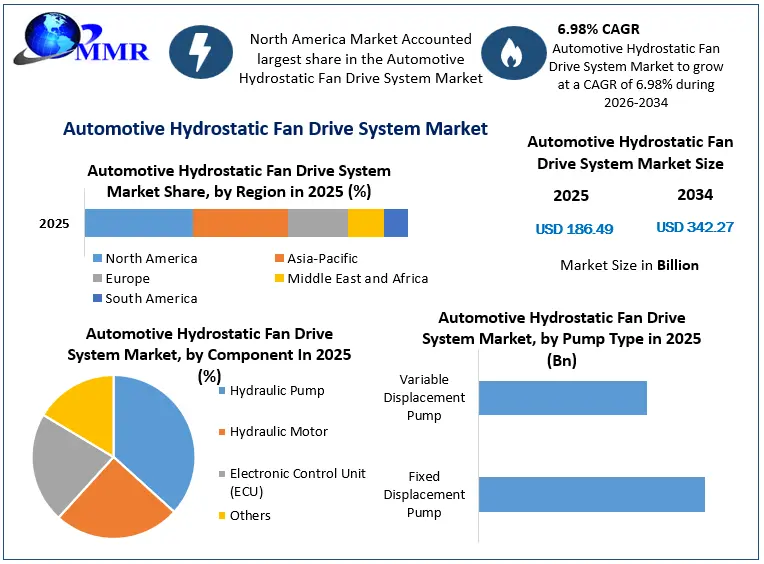
- The Global Automotive Hydrostatic Fan Drive System Market Size was valued at USD 186.49 Billion in 2025, reflecting the growing importance of intelligent thermal management across modern vehicle platforms.
- The market is projected to reach nearly USD 342.27 Billion by 2034, creating significant opportunities for OEMs, Tier-1 suppliers, hydraulic system manufacturers, and commercial vehicle producers.
- The industry is expected to grow at a CAGR of 6.98% from 2026 to 2034, highlighting sustained investment in advanced cooling technologies.
- Increasing commercial vehicle production and stricter efficiency requirements continue driving adoption of hydrostatic fan drive systems.
- Intelligent cooling solutions are becoming essential for optimizing engine performance, reducing fuel consumption, and supporting next-generation vehicle architectures.
Why This Matters Now
Vehicle efficiency is increasingly determined by intelligent thermal management rather than engine performance alone. As commercial vehicles become more connected, electrified, and digitally controlled, advanced cooling systems are emerging as strategic technologies supporting reliability, emissions compliance, and operational efficiency.
The Automotive Hydrostatic Fan Drive System Market Size, valued at USD 186.49 Billion in 2025, illustrates this transformation. Its projected growth to nearly USD 342.27 Billion by 2034, expanding at a 6.98% CAGR, signals long-term opportunities for manufacturers developing advanced thermal management solutions for modern transportation.
Market Overview
Hydrostatic fan drive systems regulate cooling performance by adjusting fan speed according to vehicle operating conditions rather than maintaining constant mechanical operation.
This intelligent cooling approach improves energy efficiency while reducing unnecessary engine load, fuel consumption, and component wear. As vehicle manufacturers pursue greater operational efficiency and emissions compliance, demand for advanced thermal management technologies continues expanding.
The market also reflects broader automotive transformation. Modern commercial vehicles increasingly integrate digital control systems, predictive diagnostics, telematics, and intelligent power management, making thermal efficiency an essential engineering priority.
Hydrostatic cooling technologies support not only traditional internal combustion engines but also increasingly complex hybrid and electrified commercial vehicle platforms requiring precise temperature management.
Key Trends Driving Growth
Commercial vehicle modernization remains one of the strongest market drivers. Heavy-duty trucks, buses, construction equipment, and agricultural machinery increasingly require intelligent cooling systems capable of operating efficiently under varying workloads.
Fleet electrification is also reshaping thermal management requirements. Although battery-electric vehicles employ different cooling architectures, hybrid commercial vehicles continue benefiting from advanced hydrostatic fan technologies supporting multiple powertrain components.
Powertrain innovation continues increasing demand for efficient temperature control. Higher-performance engines, emissions systems, and auxiliary equipment require intelligent cooling solutions that optimize energy consumption.
Software-defined vehicles are expanding opportunities for digitally controlled thermal management. Electronic control units increasingly optimize cooling performance using real-time operating data.
Connected vehicle technologies enable predictive maintenance by continuously monitoring cooling system performance, improving fleet reliability while reducing maintenance costs.
Regulatory pressure continues encouraging manufacturers to improve fuel efficiency and reduce emissions. Intelligent cooling systems contribute directly by minimizing unnecessary energy losses associated with conventional mechanical fan operation.
Segment Insights
- Dominant Segment: Information available in the Maximize Market Research report.
- Fastest-Growing Segment: Information available in the Maximize Market Research report.
- Commercial vehicle applications remain a major source of demand for hydrostatic fan drive systems.
- Advanced thermal management technologies continue supporting next-generation vehicle efficiency objectives.
Regional Growth Story
The United States remains a significant market due to large commercial vehicle fleets, infrastructure development, and ongoing investment in advanced transportation technologies. Fleet operators increasingly prioritize operational efficiency through intelligent thermal management systems.
Germany continues leading commercial vehicle engineering and automotive innovation. Manufacturers focus on efficient cooling technologies supporting premium heavy-duty vehicle platforms and stringent emissions regulations.
China remains one of the world’s largest commercial vehicle manufacturing centers. Expanding production capacity and transportation modernization continue strengthening demand for advanced cooling technologies.
Japan continues emphasizing engineering precision, fuel efficiency, and reliability across commercial transportation, supporting continued investment in intelligent vehicle cooling systems.
South Korea benefits from globally competitive automotive manufacturing and advanced industrial technologies that encourage development of next-generation thermal management solutions.
India continues expanding commercial transportation, logistics infrastructure, and heavy vehicle manufacturing. Rising freight activity and fleet modernization create significant opportunities for advanced cooling system suppliers.
Across global transportation markets, thermal efficiency is becoming increasingly important as vehicle performance expectations continue rising.
Competitive Landscape
Competition within the Automotive Hydrostatic Fan Drive System industry increasingly centers on system efficiency, digital integration, and long-term operating performance.
OEMs increasingly evaluate suppliers based on cooling precision, energy efficiency, durability, and compatibility with electronically controlled vehicle architectures. Companies capable of delivering intelligent thermal management solutions strengthen strategic relationships with commercial vehicle manufacturers.
Technology investment reflects broader automotive transformation. Hydraulic engineering increasingly combines with electronic controls, sensors, software algorithms, and predictive diagnostics to optimize cooling performance.
Manufacturing capability remains another competitive differentiator. Suppliers capable of supporting large-scale commercial vehicle production while maintaining consistent quality improve long-term market positioning.
The competitive landscape increasingly rewards organizations combining hydraulic engineering expertise, intelligent electronics, software integration, and global manufacturing capability.
Recent Developments
- Commercial vehicle manufacturers continue integrating intelligent thermal management technologies.
- Digital vehicle control systems increasingly optimize cooling performance in real time.
- Fleet modernization initiatives continue supporting demand for energy-efficient cooling solutions.
- Connected diagnostics are improving predictive maintenance across commercial transportation.
- OEMs continue investing in advanced cooling technologies supporting future vehicle platforms.
Strategic Implications
For OEMs, hydrostatic fan drive systems improve vehicle efficiency while supporting increasingly sophisticated thermal management requirements.
Tier-1 suppliers benefit from growing demand for intelligent hydraulic systems integrated with electronic vehicle controls. Companies combining mechanical engineering and digital technologies strengthen long-term competitiveness.
Fleet operators gain operational advantages through improved fuel efficiency, lower maintenance requirements, enhanced reliability, and longer component life.
Investors should recognize that thermal management remains a strategic growth area within commercial transportation. As vehicles become more connected, electrified, and electronically controlled, advanced cooling technologies become increasingly valuable across multiple vehicle categories.
The aftermarket also benefits as fleet operators seek replacement systems and upgraded cooling solutions that improve long-term operating efficiency.
Future Outlook
The Automotive Hydrostatic Fan Drive System Market Size is projected to expand from USD 186.49 Billion in 2025 to nearly USD 342.27 Billion by 2034, growing at a 6.98% CAGR. That trajectory reflects the rising importance of intelligent thermal management within modern transportation systems.
Future competition will increasingly focus on digitally controlled cooling technologies capable of integrating seamlessly with connected vehicles, predictive maintenance platforms, and advanced powertrain architectures. Thermal efficiency will become an increasingly important factor in vehicle performance, operating cost, and sustainability.
As commercial transportation evolves toward connected, electrified, and software-defined mobility, companies capable of transforming cooling systems into intelligent thermal management platforms will emerge as industry leaders, while manufacturers relying solely on conventional mechanical solutions risk losing competitiveness in the next generation of automotive engineering.
Analyst Perspective
“Thermal management is becoming a strategic differentiator across modern commercial vehicles. Manufacturers investing in intelligent hydrostatic fan drive systems, digital control technologies, and integrated cooling architectures will be best positioned to support the next phase of transportation modernization,” says Tejaswini Kakade, Analyst, Maximize Market Research.
About Maximize Market Research
Maximize Market Research Pvt. Ltd. (MMR) is a global market research and consulting company that provides reliable, data-focused, and practical business insights. The firm serves a wide range of industries, including healthcare, pharmaceuticals, technology, automotive, electronics, chemicals, personal care, and consumer goods. Through market forecasts, competitive analysis, strategic consulting, and industry impact assessments, MMR helps organizations understand changing market conditions, identify growth opportunities, and make informed business decisions for long-term success.
2nd Floor, Navale IT Park Phase 3
Pune Banglore Highway, Narhe
Pune, Maharashtra 411041, India
+91 9607365656
sales@maximizemarketresearch.com
