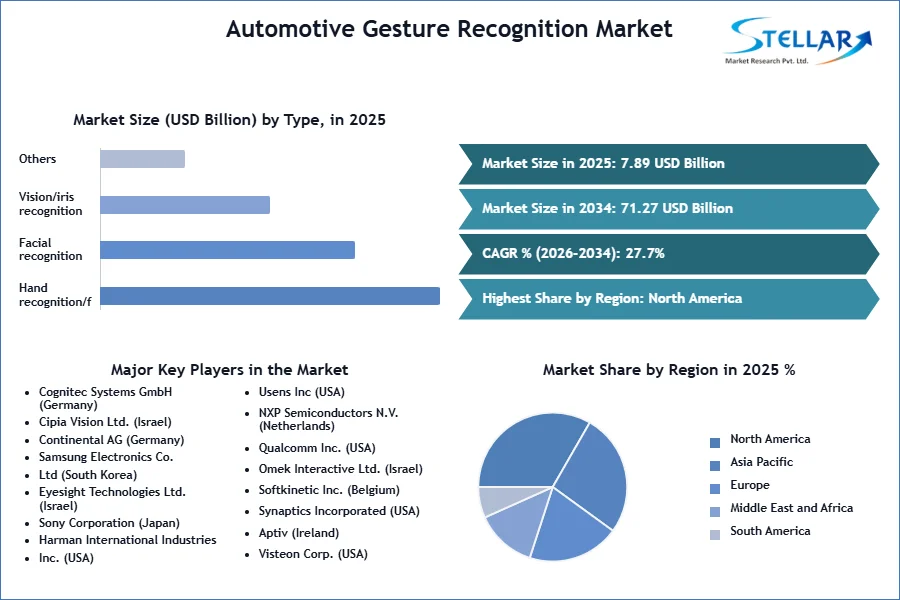
The Automotive Gesture Recognition Market is rapidly evolving as automakers integrate advanced human-machine interface (HMI) technologies into modern vehicles. Gesture recognition systems enable drivers and passengers to control infotainment, navigation, climate settings, and other functions through simple hand movements, reducing the need for physical touch.
Automotive Gesture Recognition Market is expected to grow at a CAGR of 27.70% during the forecast period. Automotive Gesture Recognition Market is expected to reach USD 71.27 Bn. in 2034 from USD 7.89 Bn in 2025.
Driven by the rise of connected cars, autonomous driving, and enhanced in-vehicle experiences, gesture recognition is becoming a key component of next-generation automotive design.
A Market Driven by Smart Cockpits and Touchless Technology
A defining trend in the automotive gesture recognition market is the shift toward touchless and intuitive vehicle control systems. Gesture-based interfaces enhance convenience, improve safety by minimizing driver distraction, and offer a futuristic user experience.
Automakers are increasingly incorporating gesture recognition into smart cockpit systems alongside voice control and touchscreens.
Key Market Insights
- Gesture recognition enables touchless control of vehicle functions.
- Used in infotainment, navigation, and climate systems.
- AI and computer vision technologies power these systems.
- Premium vehicles lead adoption, followed by mid-range segments.
- Integration with voice and touch interfaces is increasing.
- Demand is driven by safety and user experience improvements.
- Sensors and cameras are core components of the technology.
Market Drivers Accelerating Growth
1. Increasing Focus on Driver Safety
Touchless controls reduce distraction and enhance road safety.
2. Growth of Connected and Autonomous Vehicles
Advanced HMIs are essential for next-generation vehicles.
3. Rising Demand for Enhanced User Experience
Consumers expect seamless and intuitive in-car interactions.
Market Challenges and Restraints
1. High System Costs
Advanced sensors and AI technologies can increase vehicle costs.
2. Accuracy and Reliability Issues
Environmental factors and gesture recognition errors can affect performance.
Technology and Innovation Trends
Technology is at the core of the automotive gesture recognition market, with advancements in AI, computer vision, 3D sensing, and machine learning driving innovation.
Modern systems use cameras, infrared sensors, and radar-based technologies to detect and interpret hand movements accurately. AI algorithms continuously improve recognition accuracy by learning user behavior and adapting to different conditions.
Integration with augmented reality (AR) displays and digital dashboards is enhancing user interaction, while multi-modal systems combining gesture, voice, and touch are becoming more common.
Edge computing is enabling faster processing within the vehicle, reducing latency and improving responsiveness. Additionally, improvements in sensor miniaturization are making systems more cost-effective and scalable.
Visual Snapshot: Gesture Recognition in Vehicles
Regional Insights: Global Adoption Expands
The automotive gesture recognition market is gaining traction globally, with Europe and North America leading adoption due to the presence of premium automotive manufacturers and advanced technology integration.
Asia-Pacific is emerging as a high-growth region, driven by increasing vehicle production, rising consumer demand for smart features, and rapid technological advancements.
Recent Industry Developments
- BMW (2025): Expanded gesture control features in premium models.
- Mercedes-Benz (2024): Integrated advanced HMI technologies.
- Continental AG (2025): Developed AI-based gesture recognition systems.
- Valeo (2024): Enhanced sensor and camera technologies.
- NVIDIA (2025): Advanced AI platforms for automotive applications.
Competitive Landscape
The automotive gesture recognition market is highly competitive, with automotive OEMs, technology providers, and component manufacturers collaborating to develop integrated solutions.
Companies are focusing on innovation, system accuracy, cost optimization, and user experience to differentiate themselves. Partnerships between automakers and AI technology firms are a key trend.
Analyst Perspective
A senior market analyst notes:
“The automotive gesture recognition market is transforming in-car interaction. AI-driven systems and smart cockpit integration will drive future growth.”
Future Outlook
The Automotive Gesture Recognition Market is expected to witness strong growth, driven by increasing adoption of smart vehicle technologies, advancements in AI, and demand for safer and more intuitive interfaces.
As autonomous and connected vehicles become more prevalent, gesture recognition will play a crucial role in enhancing user interaction and driving experience. Continued innovation and cost reduction will enable broader adoption across vehicle segments.
Overall, the market presents significant opportunities for automakers, technology companies, and suppliers aiming to shape the future of intelligent mobility.
