Market Estimation and Definition
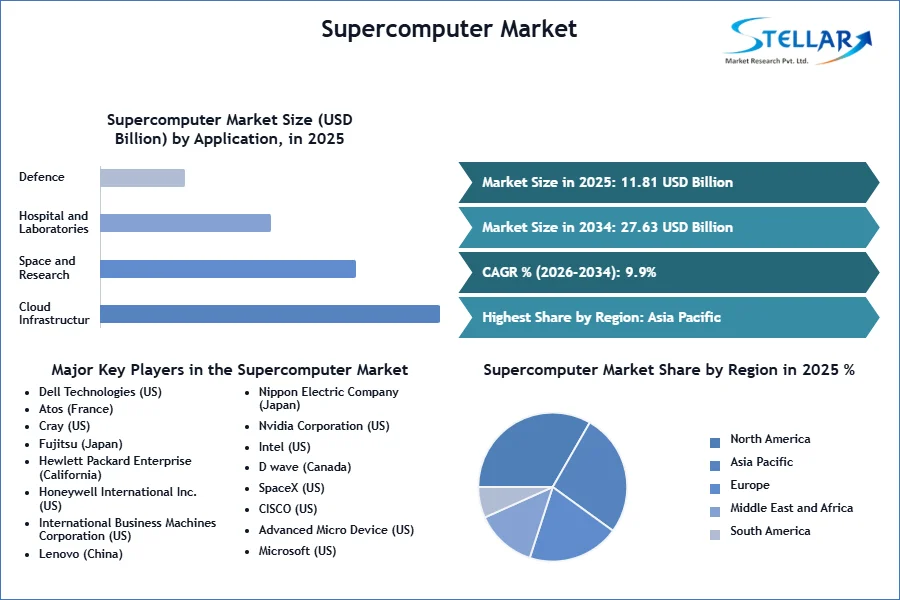
Supercomputer Market was valued at USD 11.81 billion in 2025, and overall Supercomputer Market revenue is predicted to expand at a CAGR of 9.9 % between 2026 and 2034, reaching approximately USD 27.63 billion.
The Supercomputer Market is experiencing remarkable growth as governments, research institutions, and enterprises invest heavily in high-performance computing (HPC) to solve increasingly complex computational challenges. Supercomputers are advanced computing systems capable of processing massive volumes of data at exceptionally high speeds, enabling applications ranging from climate modeling and drug discovery to artificial intelligence (AI), aerospace engineering, financial risk analysis, and national defense.
Unlike conventional computing systems, supercomputers utilize thousands of interconnected processors working in parallel to execute complex calculations within seconds. Their ability to support exascale computing, machine learning, big data analytics, and advanced simulations has made them indispensable for scientific research and industrial innovation.
𝐃𝐨𝐰𝐧𝐥𝐨𝐚𝐝 𝐅𝐫𝐞𝐞 𝐏𝐃𝐅 𝐁𝐫𝐨𝐜𝐡𝐮𝐫𝐞: https://www.stellarmr.com/report/req_sample/supercomputer-market/2647
Market Growth Drivers and Opportunities
Rising Adoption of Artificial Intelligence and Machine Learning
Artificial intelligence has become one of the most significant growth drivers for the Supercomputer Market. Training large language models, deep learning algorithms, and generative AI applications requires enormous computational power that only high-performance computing systems can efficiently deliver.
Technology companies, universities, and government laboratories are increasingly deploying supercomputers to accelerate AI research, optimize model training, and improve data processing capabilities. As AI applications expand across healthcare, finance, manufacturing, and transportation, demand for advanced computing infrastructure is expected to increase substantially.
Growing Investment in Scientific Research
Governments worldwide continue investing in supercomputing facilities to strengthen scientific research and technological leadership. Supercomputers support critical applications including weather forecasting, climate change modeling, genomic sequencing, pharmaceutical research, materials science, nuclear simulations, and space exploration.
The increasing complexity of scientific challenges requires computing platforms capable of processing petabytes of data with exceptional speed and accuracy. National research laboratories and academic institutions remain among the largest adopters of advanced HPC systems.
Expansion of Cloud-Based High-Performance Computing
Cloud computing has transformed access to supercomputing resources. Organizations that previously lacked the financial resources to build dedicated HPC infrastructure can now utilize cloud-based supercomputing services on demand.
Cloud HPC enables businesses to scale computational workloads efficiently while reducing infrastructure investment and maintenance costs. This trend is encouraging wider adoption of high-performance computing among small and medium-sized enterprises, engineering firms, pharmaceutical companies, and financial institutions.
Emerging Trends Shaping the Supercomputer Market
Development of Exascale Computing
The transition toward exascale computing represents one of the most significant technological advancements in the industry. Exascale supercomputers can perform more than one quintillion calculations per second, enabling unprecedented computational performance.
These systems are expected to accelerate breakthroughs in artificial intelligence, precision medicine, advanced manufacturing, quantum research, and climate science by dramatically reducing simulation times and improving analytical accuracy.
Energy-Efficient Computing Architectures
As computational power increases, energy efficiency has become a critical design consideration. Modern supercomputers increasingly utilize advanced processors, liquid cooling technologies, optimized power management systems, and energy-efficient architectures to reduce electricity consumption.
Manufacturers are investing in sustainable data center technologies that improve performance while minimizing environmental impact, helping organizations achieve operational efficiency and sustainability objectives.
Integration of Quantum Computing and Hybrid Systems
Although quantum computing remains an emerging technology, hybrid computing environments combining traditional supercomputers with quantum processors are gaining attention. These integrated systems have the potential to solve highly complex optimization, cryptography, and molecular simulation problems beyond the capabilities of classical computing alone.
Continued investment in quantum research is expected to complement future developments in high-performance computing infrastructure.
Regional Analysis
North America remains the largest market for supercomputers due to strong investments in research, defense, artificial intelligence, and cloud computing. The United States continues to lead global supercomputing development through significant government funding, advanced technology companies, and world-class research institutions.
Europe represents another important market, supported by collaborative research initiatives, digital sovereignty programs, and investments in exascale computing. Countries such as Germany, France, Italy, and the United Kingdom continue expanding high-performance computing infrastructure to strengthen scientific and industrial competitiveness.
The Asia-Pacific region is expected to witness the fastest growth during the forecast period. China, Japan, South Korea, and India are making substantial investments in supercomputing capabilities to support artificial intelligence, semiconductor research, weather forecasting, healthcare innovation, and national security.
China has emerged as one of the world’s leading supercomputing nations through extensive government support and domestic technology development. Meanwhile, Japan continues advancing exascale computing technologies for scientific and industrial applications.
Latin America and the Middle East & Africa are gradually increasing investments in research infrastructure and digital transformation, creating long-term growth opportunities for the Supercomputer Market.
Competitive Landscape
The global Supercomputer Market is highly competitive, with leading technology companies focusing on innovation, strategic partnerships, and next-generation computing architectures. Manufacturers are continuously developing systems with higher processing capabilities, improved energy efficiency, and greater scalability.
Major companies operating in the market include Hewlett Packard Enterprise (HPE), IBM Corporation, Dell Technologies, Lenovo Group, Fujitsu Limited, NEC Corporation, Atos, NVIDIA Corporation, Intel Corporation, and Advanced Micro Devices (AMD).
Strategic collaborations between hardware manufacturers, semiconductor companies, cloud service providers, and research organizations are accelerating innovation across the industry. Investments in GPU-accelerated computing, AI optimization, advanced networking technologies, and liquid cooling systems continue strengthening competitive positioning.
𝐃𝐨𝐰𝐧𝐥𝐨𝐚𝐝 𝐅𝐫𝐞𝐞 𝐏𝐃𝐅 𝐁𝐫𝐨𝐜𝐡𝐮𝐫𝐞: https://www.stellarmr.com/report/req_sample/supercomputer-market/2647
Future Outlook
The future of the Supercomputer Market appears exceptionally promising as demand for artificial intelligence, advanced analytics, scientific research, and digital transformation continues to expand across industries. Organizations increasingly require high-performance computing platforms capable of processing massive datasets, supporting real-time decision-making, and accelerating innovation.
The continued evolution of exascale computing, AI accelerators, cloud HPC, and hybrid quantum-classical systems will redefine computational capabilities over the coming decade. Governments and enterprises are expected to increase investments in next-generation computing infrastructure to maintain technological competitiveness and support strategic research initiatives.
However, the industry must address challenges including high deployment costs, significant energy consumption, cybersecurity risks, and the shortage of specialized HPC professionals. Manufacturers that prioritize energy-efficient system design, scalable architectures, and AI-driven performance optimization will be well positioned for long-term success.
As industries continue embracing digital transformation and data-intensive applications, the Supercomputer Market will remain a cornerstone of technological advancement. Ongoing innovation in processing technologies, cloud integration, and sustainable computing will create substantial opportunities for vendors, research institutions, and enterprises seeking to unlock the full potential of high-performance computing through 2032.
Media Contact
Stellar Market Research
Website: Stellar Market Research – Global Research Reports & Consulting
Email: sales@stellarmr.com
