Market Estimation and Definition
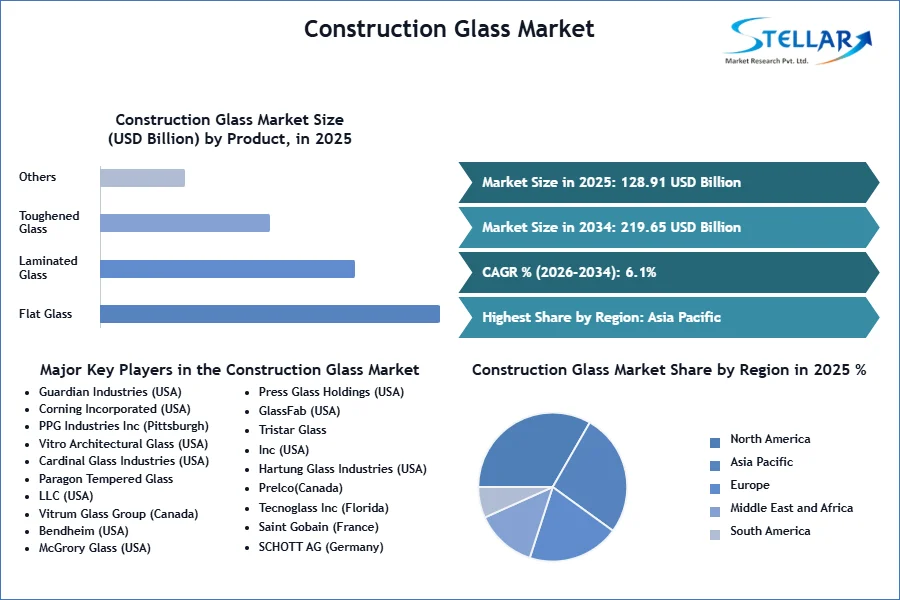
Construction Glass Market size was valued at USD 128.91 billion in 2025. The market is expected to reach USD 219.65 billion by 2034, exhibiting a compound annual growth rate (CAGR) of 6.1% from 2026 to 2034.
The Construction Glass Market is witnessing significant growth as the global construction industry increasingly adopts energy-efficient, aesthetically appealing, and sustainable building materials. Construction glass is widely used in residential, commercial, and industrial buildings for windows, doors, façades, skylights, partitions, curtain walls, and interior applications. Beyond its traditional role of providing transparency and natural lighting, modern construction glass offers advanced functionalities such as thermal insulation, soundproofing, UV protection, fire resistance, and enhanced safety.
Technological advancements have transformed construction glass into a high-performance building material capable of improving energy efficiency and supporting green building initiatives. Products such as tempered glass, laminated glass, insulated glass, low-emissivity (Low-E) glass, solar control glass, and smart glass are becoming increasingly popular in modern architectural designs.
𝐃𝐨𝐰𝐧𝐥𝐨𝐚𝐝 𝐅𝐫𝐞𝐞 𝐏𝐃𝐅 𝐁𝐫𝐨𝐜𝐡𝐮𝐫𝐞: https://www.stellarmr.com/report/req_sample/construction-glass-market/2649
Market Growth Drivers and Opportunities
Rapid Urbanization and Infrastructure Development
One of the primary drivers of the Construction Glass Market is the rapid pace of urbanization across both developed and developing economies. Governments are investing heavily in residential housing, commercial complexes, airports, healthcare facilities, educational institutions, and transportation infrastructure to accommodate growing urban populations.
Modern architectural designs increasingly incorporate large glass façades and curtain wall systems that improve natural lighting, enhance aesthetics, and reduce energy consumption. As smart city projects expand globally, demand for high-performance construction glass continues to rise.
Increasing Focus on Energy-Efficient Buildings
Growing awareness of climate change and rising energy costs have encouraged builders and property developers to adopt energy-efficient construction materials. Construction glass plays a critical role in improving building performance by reducing heat transfer, minimizing air conditioning requirements, and maximizing daylight utilization.
Low-emissivity (Low-E) glass and insulated glazing units help maintain comfortable indoor temperatures while lowering overall energy consumption. These benefits make advanced construction glass an important component of green buildings and sustainable infrastructure projects.
Rising Demand for Smart Buildings
The increasing adoption of intelligent building technologies is creating new opportunities for construction glass manufacturers. Smart glass solutions, including electrochromic and switchable glass, enable occupants to control light transmission, glare, and privacy electronically.
These advanced products improve occupant comfort, reduce energy usage, and support modern building automation systems. Growing demand for premium office spaces, luxury residential developments, and healthcare facilities is accelerating the adoption of smart glazing technologies.
Emerging Trends Shaping the Construction Glass Market
Growth of Green Building Certifications
Green building certification programs such as LEED, BREEAM, and other sustainable construction standards are encouraging developers to use environmentally responsible materials. High-performance construction glass contributes significantly to achieving energy efficiency, indoor environmental quality, and sustainability targets.
Manufacturers are developing recyclable glass products and adopting low-carbon manufacturing processes to reduce environmental impact while supporting global sustainability initiatives.
Innovation in Smart Glass Technologies
Technological innovation continues to reshape the construction glass industry. Smart glass technologies that automatically adjust transparency based on sunlight intensity or user preferences are becoming increasingly popular in commercial buildings, hotels, airports, and luxury residences.
Integration with building management systems allows smart glass to optimize daylight usage, improve occupant comfort, and reduce energy costs without compromising architectural design.
Digital Manufacturing and Automation
Glass manufacturers are investing in advanced production technologies, robotics, and automated quality control systems to improve manufacturing efficiency and product consistency. Digital inspection systems enhance precision while reducing production defects and operational costs.
Automation also enables manufacturers to produce customized glass products for complex architectural applications while maintaining high quality standards.
Regional Analysis
Asia-Pacific dominates the Construction Glass Market due to rapid urbanization, large-scale infrastructure projects, and strong growth in residential and commercial construction. China remains the world’s largest construction market, supported by continuous investments in urban development, transportation infrastructure, and industrial facilities.
India is emerging as another major growth market due to government initiatives promoting affordable housing, smart cities, commercial real estate development, and infrastructure modernization. Increasing foreign investment in the construction sector further supports market expansion.
North America represents a significant market driven by renovation activities, commercial construction, and increasing demand for energy-efficient buildings. The United States continues investing in sustainable building technologies and modern office infrastructure that incorporate advanced glazing systems.
Europe remains an important market due to stringent energy efficiency regulations and widespread adoption of green building standards. Countries including Germany, France, Italy, and the United Kingdom continue emphasizing sustainable construction practices and high-performance building materials.
The Middle East is witnessing substantial demand for premium architectural glass as governments invest in iconic skyscrapers, hospitality projects, airports, and smart city developments. Latin America and Africa are also experiencing gradual market growth through expanding urban infrastructure and residential construction.
Competitive Landscape
The Construction Glass Market is highly competitive, with global manufacturers focusing on technological innovation, sustainability, and product diversification. Companies are investing heavily in research and development to produce glass solutions that offer improved thermal insulation, enhanced durability, superior safety, and aesthetic appeal.
Leading companies operating in the market include AGC Inc., Saint-Gobain, NSG Group, Guardian Glass, Sisecam, Vitro, Central Glass Co., Ltd., Fuyao Glass Industry Group, SCHOTT AG, and Xinyi Glass Holdings Limited.
Strategic initiatives such as capacity expansion, acquisitions, partnerships, and investments in advanced manufacturing technologies remain central to competitive growth. Manufacturers are also expanding their presence in emerging economies to capitalize on increasing infrastructure investments.
𝐃𝐨𝐰𝐧𝐥𝐨𝐚𝐝 𝐅𝐫𝐞𝐞 𝐏𝐃𝐅 𝐁𝐫𝐨𝐜𝐡𝐮𝐫𝐞: https://www.stellarmr.com/report/req_sample/construction-glass-market/2649
Future Outlook
The future of the Construction Glass Market appears highly promising as governments, developers, and architects continue prioritizing sustainable and energy-efficient construction practices. Increasing investments in smart cities, commercial infrastructure, residential housing, and green building projects will continue driving demand for advanced glazing solutions.
Technological advancements in smart glass, solar control coatings, self-cleaning surfaces, and energy-efficient glazing systems are expected to further expand application opportunities across multiple building segments. Integration with digital building management systems will enhance operational efficiency while supporting environmental sustainability goals.
Despite challenges such as fluctuating raw material prices, energy-intensive manufacturing processes, and supply chain disruptions, long-term market fundamentals remain strong. Companies that invest in innovation, automation, environmentally responsible manufacturing, and premium product development will be well positioned to capture emerging opportunities.
As the global construction industry continues transitioning toward sustainable, intelligent, and resilient infrastructure, construction glass will remain a fundamental building material supporting modern architectural design and energy-efficient buildings. Continuous innovation, regulatory support, and increasing consumer demand for high-performance structures are expected to ensure steady growth for the Construction Glass Market through 2032.
Media Contact
Stellar Market Research
Website: Stellar Market Research – Global Research Reports & Consulting
Email: sales@stellarmr.com
