Market Estimation and Definition
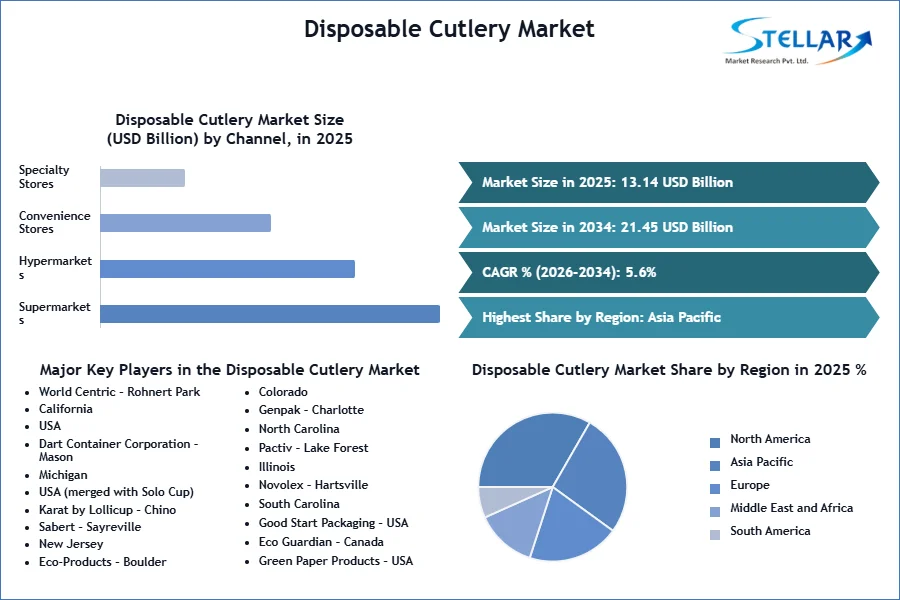
Disposable Cutlery market size was valued at over USD 13.14 Billion in 2025 and is expected to grow at USD 21.45 billion in 2034 at a CAGR of 5.6%.
The Disposable Cutlery Market is experiencing steady growth as changing consumer lifestyles, expanding food delivery services, and increasing hygiene awareness continue to drive demand for convenient single-use dining solutions. Disposable cutlery includes spoons, forks, knives, and specialty utensils manufactured from materials such as plastic, wood, bamboo, paper, and biodegradable bioplastics. These products are widely used across restaurants, quick-service restaurants (QSRs), catering services, institutional food providers, airlines, and online food delivery platforms.
The market is undergoing a significant transformation as governments implement regulations to reduce single-use plastic waste and consumers increasingly prefer environmentally friendly alternatives. Manufacturers are responding by investing in sustainable materials, recyclable packaging, and compostable product innovations.
𝐃𝐨𝐰𝐧𝐥𝐨𝐚𝐝 𝐅𝐫𝐞𝐞 𝐏𝐃𝐅 𝐁𝐫𝐨𝐜𝐡𝐮𝐫𝐞: https://www.stellarmr.com/report/req_sample/disposable-cutlery-market/2651
Market Growth Drivers and Opportunities
Expanding Food Delivery and Quick-Service Restaurant Industry
One of the strongest growth drivers for the Disposable Cutlery Market is the continued expansion of food delivery platforms and quick-service restaurants. The growing popularity of takeaway meals, online ordering applications, cloud kitchens, and meal delivery services has significantly increased the demand for disposable utensils.
Consumers increasingly expect hygienic, ready-to-use cutlery with delivered meals, encouraging restaurants and foodservice providers to purchase disposable products in large quantities. The growth of urban populations and busy lifestyles further supports this trend.
Rising Consumer Preference for Sustainable Alternatives
Environmental concerns have reshaped purchasing behavior across the foodservice industry. Consumers now actively seek disposable cutlery made from renewable materials such as bamboo, wood, paper, bagasse, and plant-based bioplastics.
Manufacturers are expanding their portfolios with compostable and biodegradable products that comply with evolving environmental regulations while maintaining product durability and functionality. This shift presents significant opportunities for companies investing in sustainable product innovation.
Increasing Hygiene Awareness
Heightened awareness regarding food safety and personal hygiene continues to support demand for disposable cutlery across hospitals, educational institutions, corporate cafeterias, catering businesses, and hospitality services.
Disposable utensils reduce the risk of cross-contamination associated with reusable products, making them particularly valuable in healthcare facilities, travel services, and large public events.
Emerging Trends Shaping the Disposable Cutlery Market
Transition Toward Biodegradable Materials
One of the most significant trends influencing the market is the rapid replacement of conventional plastic products with environmentally friendly alternatives. Bamboo, wooden, paper-based, and compostable bioplastic cutlery are gaining popularity among consumers, restaurants, and institutional buyers.
Government restrictions on single-use plastics are encouraging manufacturers to accelerate research into renewable raw materials that offer comparable strength while minimizing environmental impact.
Product Innovation and Premium Designs
Manufacturers are introducing premium disposable cutlery featuring improved ergonomics, enhanced durability, and attractive designs suitable for upscale catering events and premium foodservice applications.
Customized branding, printed packaging, and premium wooden or bamboo utensils are increasingly used by restaurants seeking to enhance customer experience while supporting sustainable business practices.
Automation and Sustainable Manufacturing
Production facilities are increasingly adopting automated manufacturing systems to improve efficiency, reduce production costs, and maintain consistent product quality.
Companies are also investing in environmentally responsible manufacturing processes that reduce energy consumption, optimize raw material utilization, and minimize production waste, helping meet corporate sustainability objectives.
Regional Analysis
North America remains an important market due to the strong presence of food delivery services, fast-food chains, institutional catering, and growing demand for eco-friendly products. Consumer awareness regarding sustainability continues encouraging adoption of biodegradable cutlery solutions.
Europe is witnessing substantial growth as governments implement strict regulations limiting single-use plastic products. Countries including Germany, France, the United Kingdom, Italy, and the Nordic nations are increasingly adopting compostable and recyclable disposable cutlery to meet environmental targets.
Asia-Pacific dominates the global market due to rapid urbanization, expanding foodservice industries, increasing online food delivery, and rising disposable incomes. China, India, Japan, South Korea, and Southeast Asian countries continue experiencing strong demand supported by growing restaurant chains and takeaway culture.
Emerging economies in Latin America and the Middle East & Africa are also creating new opportunities as modern retail infrastructure expands and consumers increasingly prioritize hygienic food packaging solutions.
Competitive Landscape
The Disposable Cutlery Market is highly competitive, with both global and regional manufacturers focusing on sustainable product development, capacity expansion, and strategic collaborations. Companies are investing in research and development to improve biodegradable materials, enhance product durability, and reduce manufacturing costs.
Leading companies operating in the market include World Centric, Dart Container Corporation, Huhtamaki, Vegware, Sabert, Karat by Lollicup, Pactiv, Georgia-Pacific, Novolex, Eco-Products, BioPak, and Hotpack Packaging Industries. These companies are expanding portfolios featuring bamboo, wooden, paper, and plant-based cutlery while strengthening partnerships with restaurants, retailers, and food delivery companies.
Strategic initiatives such as production expansion, customized branding solutions, and sustainable packaging innovations continue strengthening competitive positioning across global markets.
𝐃𝐨𝐰𝐧𝐥𝐨𝐚𝐝 𝐅𝐫𝐞𝐞 𝐏𝐃𝐅 𝐁𝐫𝐨𝐜𝐡𝐮𝐫𝐞: https://www.stellarmr.com/report/req_sample/disposable-cutlery-market/2651
Future Outlook
The future of the Disposable Cutlery Market remains promising as convenience, hygiene, and sustainability continue shaping consumer purchasing decisions. The rapid expansion of food delivery platforms, quick-service restaurants, catering businesses, and institutional food services will maintain strong demand for disposable dining products.
Environmental regulations will continue accelerating the transition from conventional plastics toward biodegradable, compostable, and renewable materials. Manufacturers investing in innovative product development, sustainable sourcing, and advanced manufacturing technologies are expected to benefit from evolving market dynamics.
Digital procurement platforms and direct partnerships with restaurant chains will further streamline distribution while enabling manufacturers to respond more effectively to changing customer preferences.
Although challenges such as fluctuating raw material prices, evolving environmental regulations, and competition among sustainable material suppliers remain, the long-term growth outlook is positive. Companies that successfully balance affordability, product performance, environmental responsibility, and regulatory compliance will strengthen their market positions.
As consumers and businesses increasingly embrace sustainable dining solutions, the Disposable Cutlery Market is expected to remain an important segment of the global food packaging industry. Continuous innovation in biodegradable materials, expanding foodservice demand, and stronger environmental commitments will drive steady market growth through 2032 while creating new opportunities for manufacturers, investors, and supply chain partners.
Media Contact
Stellar Market Research
Website: Stellar Market Research – Global Research Reports & Consulting
Email: sales@stellarmr.com
