Market Estimation and Definition
The Software Defined Vehicle (SDV) Market is transforming the automotive industry by shifting vehicle functionality from hardware-centric systems to software-driven platforms. In a software-defined vehicle, core functions—including powertrain management, infotainment, advanced driver assistance systems (ADAS), connectivity, and vehicle diagnostics—are controlled and continuously enhanced through software updates rather than hardware modifications.
Unlike conventional vehicles, SDVs receive over-the-air (OTA) software updates that enable manufacturers to introduce new features, improve performance, enhance cybersecurity, and fix software issues remotely throughout the vehicle’s lifecycle. This approach allows vehicles to evolve much like smartphones, delivering a more personalized and connected driving experience.
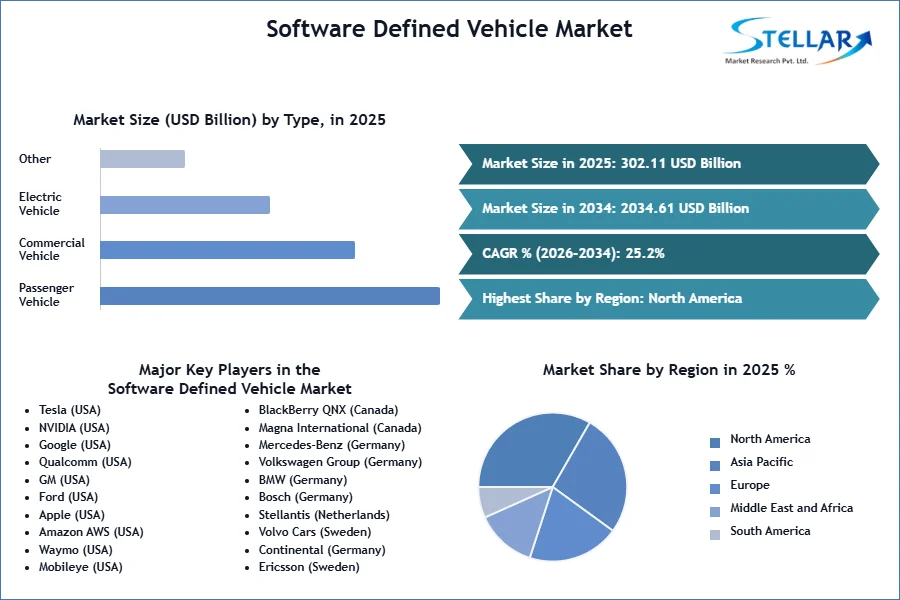
According to Stellar Market Research, the Software Defined Vehicle Market was valued at USD 302.11 billion in 2025 and is expected to reach nearly USD 2,034.61 billion by 2034, expanding at a CAGR of 25.2% during the forecast period from 2026 to 2034. Rapid growth in electric vehicles (EVs), autonomous driving technologies, and AI-powered mobility solutions is driving this remarkable expansion.
𝐃𝐨𝐰𝐧𝐥𝐨𝐚𝐝 𝐅𝐫𝐞𝐞 𝐏𝐃𝐅 𝐁𝐫𝐨𝐜𝐡𝐮𝐫𝐞: https://www.stellarmr.com/report/req_sample/software-defined-vehicle-market/2655
Market Growth Drivers and Opportunities
Growing Adoption of Electric and Connected Vehicles
The increasing popularity of electric vehicles is one of the primary drivers of the Software Defined Vehicle Market. Modern EVs rely heavily on software to manage battery performance, energy optimization, charging systems, and intelligent driving capabilities.
Consumers now expect vehicles to receive regular software improvements that enhance functionality, improve efficiency, and introduce new digital services. As automotive manufacturers transition toward connected mobility ecosystems, software has become a major competitive differentiator.
Rising Demand for Over-the-Air Updates
OTA software updates are revolutionizing vehicle maintenance by allowing manufacturers to deliver security patches, feature enhancements, infotainment upgrades, and performance improvements without requiring dealership visits.
This capability reduces maintenance costs while improving customer satisfaction and extending vehicle functionality throughout ownership. Automakers are increasingly using OTA platforms to introduce subscription-based premium features, creating recurring revenue opportunities beyond vehicle sales.
Artificial Intelligence Enhances Vehicle Intelligence
Artificial intelligence is becoming a core technology within software-defined vehicles. AI supports advanced driver assistance systems, predictive maintenance, voice recognition, intelligent navigation, driver monitoring, and autonomous driving functions.
Machine learning algorithms continuously analyze vehicle data to optimize performance, improve safety, and deliver personalized user experiences. As AI capabilities continue advancing, software-defined vehicles will become increasingly autonomous and connected.
Emerging Trends Shaping the Software Defined Vehicle Market
Transition to Centralized Vehicle Computing
Traditional vehicles rely on dozens of independent electronic control units (ECUs). Software-defined vehicles are moving toward centralized and zonal computing architectures that simplify vehicle electronics while improving software management.
Centralized computing reduces system complexity, improves processing performance, enables faster software deployment, and supports future autonomous driving applications. This architectural shift is expected to become the industry standard for next-generation vehicles.
Subscription-Based Automotive Services
Automakers are increasingly adopting subscription business models that allow customers to activate premium vehicle features through software. Functions such as advanced navigation, enhanced acceleration, driver assistance capabilities, and luxury infotainment services can be enabled through digital subscriptions.
This transition creates new recurring revenue streams while allowing manufacturers to continuously improve customer experiences through software innovation.
Cybersecurity Becomes a Strategic Priority
As vehicles become increasingly connected, cybersecurity has become essential. Software-defined vehicles exchange large volumes of data with cloud platforms, mobile applications, charging infrastructure, and intelligent transportation systems.
Manufacturers are investing heavily in secure operating systems, encryption technologies, intrusion detection systems, and continuous security monitoring to protect vehicles from cyber threats while complying with international automotive safety standards.
Regional Analysis
North America remains one of the leading markets for software-defined vehicles due to strong investments in electric mobility, autonomous driving research, and connected vehicle technologies. Major automotive manufacturers and technology companies continue collaborating to accelerate SDV development.
Europe is experiencing rapid market growth driven by stringent vehicle safety regulations, increasing EV adoption, and significant investments in automotive digitalization. Germany, France, Sweden, and the United Kingdom are leading innovation in intelligent mobility and software-centric vehicle platforms.
Asia-Pacific is expected to register the fastest growth during the forecast period. China has emerged as a global leader in electric vehicles and connected mobility, while companies such as BYD and Xiaomi are introducing highly software-centric vehicles. Japan, South Korea, and India are also investing in advanced automotive software development, semiconductor technologies, and intelligent transportation systems.
Latin America and the Middle East & Africa are gradually adopting connected vehicle technologies as digital infrastructure improves and automotive manufacturers expand their regional presence.
Competitive Landscape
The Software Defined Vehicle Market is highly competitive, with automotive manufacturers, semiconductor companies, cloud providers, and software developers collaborating to build next-generation mobility platforms.
Leading industry participants include Tesla, General Motors, Volkswagen Group, Mercedes-Benz Group, BYD, Xiaomi, NVIDIA, Qualcomm, BlackBerry QNX, Google, Intel, Bosch, Continental AG, Aptiv, and Tata Technologies. These companies are investing heavily in AI-powered vehicle operating systems, centralized computing architectures, automotive cloud platforms, and cybersecurity solutions.
Strategic partnerships between automakers and technology companies continue accelerating innovation. Collaborations involving semiconductor manufacturers, cloud service providers, and AI developers are enabling faster deployment of intelligent vehicle platforms while reducing software development complexity.
𝐃𝐨𝐰𝐧𝐥𝐨𝐚𝐝 𝐅𝐫𝐞𝐞 𝐏𝐃𝐅 𝐁𝐫𝐨𝐜𝐡𝐮𝐫𝐞: https://www.stellarmr.com/report/req_sample/software-defined-vehicle-market/2655
Future Outlook
The future of the Software Defined Vehicle Market is exceptionally promising as vehicles evolve into continuously connected digital platforms. Future automobiles will rely on centralized software architectures capable of supporting autonomous driving, predictive maintenance, intelligent energy management, personalized infotainment, and seamless cloud connectivity.
Artificial intelligence, edge computing, 5G communication, digital twins, and vehicle-to-everything (V2X) connectivity will further expand software capabilities while improving road safety and operational efficiency. Automakers will increasingly generate revenue through software subscriptions, digital services, and feature-on-demand business models rather than relying solely on vehicle sales.
Despite challenges including cybersecurity risks, high software development costs, regulatory compliance, and integration complexity, long-term market fundamentals remain highly favorable. Continuous investments in EVs, autonomous mobility, AI technologies, and connected infrastructure will accelerate software-defined vehicle adoption worldwide.
As the automotive industry transitions from mechanical engineering to software-centric innovation, software-defined vehicles will redefine mobility by delivering safer, smarter, and continuously evolving transportation solutions. Companies that prioritize secure software platforms, AI integration, cloud connectivity, and customer-centric digital experiences will be best positioned to lead the next generation of automotive innovation.
Media Contact
Stellar Market Research
Website: Stellar Market Research – Global Research Reports & Consulting
Email: sales@stellarmr.com
