Market Estimation and Definition
The Co-Packaged Optics (CPO) Market is emerging as one of the fastest-growing segments within the semiconductor and optical networking industries, driven by the exponential growth of artificial intelligence (AI), hyperscale data centers, and high-performance computing (HPC). Co-packaged optics integrates optical components—including lasers, modulators, photodetectors, and optical engines—directly with switch ASICs, GPUs, or CPUs within the same package. This architecture significantly reduces electrical signal losses, lowers power consumption, minimizes latency, and enables much higher bandwidth than conventional pluggable optical transceivers.
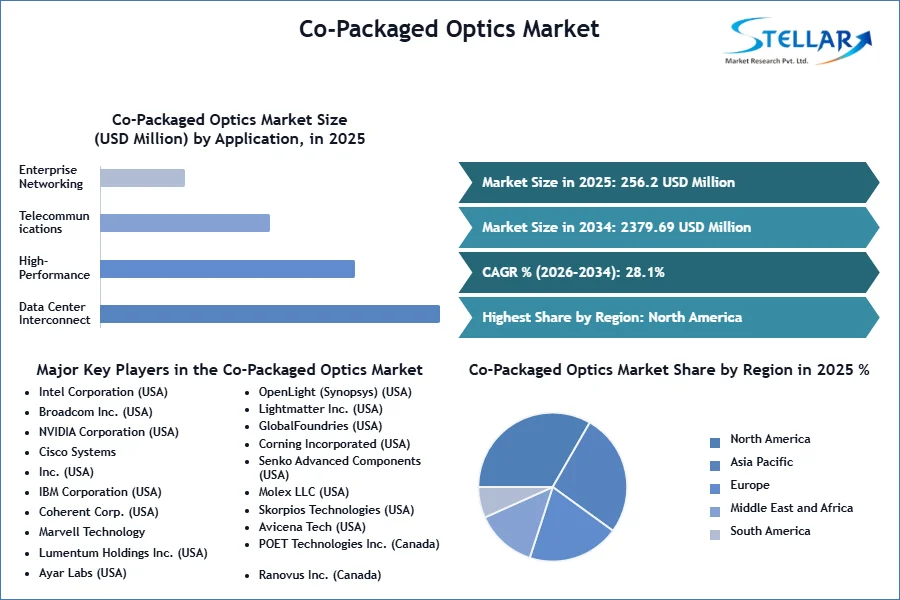
According to Stellar Market Research, the Co-Packaged Optics Market was valued at USD 256.2 million in 2025 and is projected to reach USD 2,379.69 million by 2034, expanding at a CAGR of 28.1% during the forecast period (2026–2034). The rapid deployment of AI clusters, 800G and 1.6T networking, and energy-efficient cloud infrastructure is accelerating global adoption.
𝐃𝐨𝐰𝐧𝐥𝐨𝐚𝐝 𝐅𝐫𝐞𝐞 𝐏𝐃𝐅 𝐁𝐫𝐨𝐜𝐡𝐮𝐫𝐞: https://www.stellarmr.com/report/req_sample/co-packaged-optics-market/2659
Market Growth Drivers and Opportunities
AI Workloads and Hyperscale Data Centers
Artificial intelligence has become the largest catalyst for the Co-Packaged Optics Market. Training large language models, generative AI applications, and machine learning systems requires massive data movement between GPUs and networking equipment. Traditional copper interconnects are reaching their physical limitations in bandwidth and power efficiency.
Co-packaged optics addresses these challenges by bringing optical communication directly into compute packages, enabling significantly faster data transfer while reducing energy consumption. As hyperscale cloud providers continue expanding AI infrastructure, demand for CPO solutions is expected to increase substantially.
Rising Need for Energy-Efficient Networking
Data centers account for an increasing share of global electricity consumption. Network switches operating at 800G and future 1.6T speeds generate considerable heat and require substantial power.
CPO technology reduces electrical transmission distances and minimizes power losses, helping operators lower cooling requirements and improve overall energy efficiency. This aligns with sustainability initiatives adopted by cloud service providers and enterprise data centers worldwide.
Growth in High-Performance Computing
Scientific research, financial modeling, weather forecasting, genomics, and defense simulations increasingly depend on high-performance computing systems. These workloads require ultra-fast communication between processors and storage infrastructure.
Co-packaged optics enables low-latency, high-bandwidth interconnects capable of supporting exascale computing and next-generation AI accelerators, creating significant opportunities for semiconductor and photonics manufacturers.
Emerging Trends Shaping the Co-Packaged Optics Market
Silicon Photonics Becomes the Preferred Technology
Silicon photonics has emerged as the dominant integration technology for co-packaged optics because it combines semiconductor manufacturing efficiency with high-speed optical communication. Leading technology companies are investing heavily in silicon photonics to improve scalability while reducing manufacturing costs.
Continuous advances in photonic integration, chiplet architectures, and advanced semiconductor packaging are expected to accelerate commercial deployment.
Transition to 800G and 1.6T Networks
Global data traffic continues growing at an unprecedented pace, driven by AI, cloud computing, streaming services, and enterprise digital transformation.
Network operators are rapidly transitioning toward 800G Ethernet while preparing for future 1.6T deployments. Co-packaged optics provides the bandwidth density and power efficiency necessary to support these next-generation networking standards, making it an essential technology for future data center architectures.
Advanced Semiconductor Packaging
Innovations in 2.5D, 3D chip integration, heterogeneous packaging, and advanced interposers are enabling tighter integration between optical engines and computing chips. These packaging technologies improve signal integrity while reducing physical footprint and thermal challenges.
As semiconductor manufacturers continue investing in advanced packaging capabilities, commercial adoption of co-packaged optics is expected to accelerate.
Regional Analysis
North America currently dominates the Co-Packaged Optics Market due to its concentration of hyperscale cloud providers, AI infrastructure investments, and semiconductor innovation. Major technology companies including Google, Microsoft, Amazon, Meta, and NVIDIA continue expanding AI data centers that require advanced optical interconnect technologies. Government initiatives supporting semiconductor manufacturing further strengthen regional leadership.
Asia-Pacific is expected to witness the fastest growth during the forecast period. China, Taiwan, Japan, and South Korea continue investing heavily in semiconductor fabrication, silicon photonics research, AI infrastructure, and 5G deployment. The region’s strong electronics manufacturing ecosystem supports large-scale commercialization of co-packaged optical technologies.
Europe is expanding investments in HPC infrastructure, AI research, and digital sovereignty initiatives. Countries including Germany, France, the Netherlands, and the United Kingdom are strengthening photonics research while encouraging semiconductor innovation.
Latin America and the Middle East & Africa remain emerging markets as cloud adoption, enterprise digitalization, and telecommunications infrastructure continue expanding.
Competitive Landscape
The Co-Packaged Optics Market is characterized by intense innovation among semiconductor manufacturers, optical networking companies, and cloud infrastructure providers. Companies are focusing on silicon photonics development, optical engine integration, advanced packaging technologies, and strategic partnerships to strengthen their competitive positions.
Leading companies include Intel Corporation, Broadcom Inc., NVIDIA Corporation, Cisco Systems, IBM Corporation, Coherent Corp., Marvell Technology, Ayar Labs, TSMC, and Synopsys. These organizations are investing heavily in AI networking solutions, next-generation switch architectures, silicon photonics, and high-speed optical interconnect technologies.
Collaborations between semiconductor foundries, networking equipment manufacturers, and hyperscale cloud providers continue accelerating commercialization while improving manufacturing scalability.
𝐃𝐨𝐰𝐧𝐥𝐨𝐚𝐝 𝐅𝐫𝐞𝐞 𝐏𝐃𝐅 𝐁𝐫𝐨𝐜𝐡𝐮𝐫𝐞: https://www.stellarmr.com/report/req_sample/co-packaged-optics-market/2659
Future Outlook
The future of the Co-Packaged Optics Market appears exceptionally strong as artificial intelligence, cloud computing, and high-performance networking continue reshaping digital infrastructure. The growing deployment of AI supercomputers, exascale computing systems, and hyperscale cloud facilities will significantly increase demand for high-bandwidth, energy-efficient optical interconnects.
Technological advances in silicon photonics, heterogeneous integration, quantum-dot photonics, and advanced semiconductor packaging will further improve product performance while reducing manufacturing costs. Standardization efforts across the industry are also expected to accelerate broader commercial adoption.
Despite challenges including high manufacturing complexity, thermal management requirements, integration costs, and evolving interoperability standards, long-term market fundamentals remain highly favorable. Companies investing in silicon photonics, AI networking technologies, advanced packaging, and scalable production capabilities will be well positioned to capture future growth opportunities.
As AI workloads continue expanding and data centers demand faster, more efficient communication technologies, co-packaged optics will become a foundational component of next-generation computing infrastructure. Continuous innovation in photonics, semiconductor manufacturing, and network architecture is expected to drive sustained market growth through 2034 while enabling the future of AI-powered digital ecosystems.
Media Contact
Stellar Market Research
Website: Stellar Market Research – Global Research Reports & Consulting
Email: sales@stellarmr.com
