Key Highlights
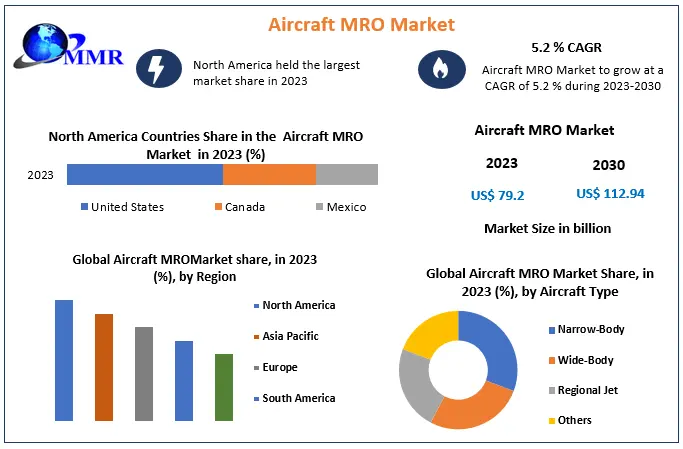
Market Valuation: The Aircraft MRO market reached USD 79.2 billion in 2023.
Growth Trajectory: Market revenue is expanding at a CAGR of 5.2% from 2023 to 2030.
Market Forecast: Projected to reach nearly USD 112.94 billion by 2030.
Dominant Segment: Engine overhaul maintains market leadership due to high criticality and cost-efficiency.
Strategic Driver: The transition toward predictive maintenance analytics and AR-integrated troubleshooting is reshaping operational efficiency.
Why This Matters Now
The aviation ecosystem is undergoing a critical transition as airlines balance aggressive fleet expansion with the uncompromising demand for operational safety and cost efficiency. For OEMs, Tier-1 suppliers, and fleet operators, the maintenance, repair, and overhaul (MRO) sector has moved from a back-office necessity to a strategic competitive lever. As global fleets grow and become more technologically complex, the ability to minimize downtime through advanced diagnostics dictates the profitability of major carriers and the market positioning of service providers.
Market Overview
In 2023, the global Aircraft MRO Market Size was valued at USD 79.2 billion. As of the latest analysis, the market is set to achieve a CAGR of 5.2% through 2030, culminating in an estimated valuation of USD 112.94 billion. This growth is underpinned by an unprecedented surge in global air travel demand and the resultant expansion of commercial airline fleets. For investors and stakeholders, this trajectory signifies a massive infrastructure opportunity, requiring the scaling of specialized facilities to support a future where over 1,500 new aircraft deliveries in specific high-growth regions like India are slated by 2031 alone.
Key Trends Driving Growth
The shift toward digital-first maintenance is the primary catalyst for market evolution. Operators are increasingly deploying predictive maintenance analytics and machine learning algorithms to forecast equipment failures before they manifest as costly operational disruptions. By transitioning from scheduled, time-based maintenance to condition-based interventions, airlines are significantly reducing grounded-aircraft time.
Concurrently, the integration of Augmented Reality (AR) in hangar operations is transforming technician efficiency. These tools provide real-time, visual data overlays for complex engine and system troubleshooting, directly reducing the human-error margin in high-stakes repairs. Furthermore, advancements in lightweight material science and component durability are extending service intervals, compelling MRO providers to shift their value proposition from high-volume, low-margin repairs to high-tech, specialized service offerings.
Segment Insights
Dominant Segment: Engine Overhaul. This segment dominates the service landscape due to the immense complexity and criticality of propulsion systems. Airlines prioritize engine longevity over total replacement, driving consistent demand for overhaul expertise.
Fastest-Growing Opportunity: Specialized MRO Services. Providers investing in proprietary OEM-certified data, state-of-the-art diagnostic infrastructure, and precision machining are capturing significant market share by offering “cradle-to-grave” support for sophisticated aircraft systems.
Regional Growth Story
India is emerging as a critical growth engine for the global MRO industry. With 713 civilian aircraft currently in service and an ambitious government initiative to invest USD 12 billion by 2025 into regional connectivity, the country is rapidly positioning itself as a top-three commercial aviation market. Currently, roughly 80% of India’s commercial aircraft MRO is conducted abroad. To capture this capital flight, the government has introduced significant policy reforms, including 100% foreign direct investment (FDI) permission and structural incentives for domestic MRO facilities, signaling an imminent shift in regional supply chain dynamics for international MRO players.
Competitive Landscape
The competitive landscape is increasingly defined by strategic partnerships between MRO service providers and Original Equipment Manufacturers (OEMs). Access to proprietary data, specialized training programs, and genuine OEM parts is now the primary differentiator between market leaders and commoditized service centers. Leading firms are not merely performing repairs; they are becoming integrated partners in fleet reliability. This shift forces Tier-1 suppliers to reconsider their roles, often moving from simple component manufacturing to providing end-to-end support ecosystems that guarantee uptime for fleet operators.
Recent Developments
Regulatory Alignment: Increased emphasis on FAA Part 145 and EASA Part-145 compliance is standardizing global operations but increasing entry barriers for smaller, non-certified players.
Policy Incentives: Domestic incentives in high-growth markets like India are accelerating the localization of MRO capabilities, disrupting traditional offshore dependency models.
Technological Integration: Significant capital infusion into precision diagnostic tools and AR-based repair training is becoming the standard for MRO infrastructure modernization.
Strategic Implications
The mandate for stakeholders is clear: MRO is no longer just a cost center; it is a critical component of fleet asset management. For fleet operators, the future lies in optimizing the “digital twin” of their assets to predict maintenance windows with pinpoint accuracy. For investors, the focus must shift toward MRO providers that hold OEM certifications and possess the technical infrastructure to service next-generation engines. The complexity of regulatory compliance, while a hurdle for some, serves as a high-moat competitive advantage for established, high-capacity facilities.
Future Outlook
The Aircraft MRO market will increasingly fracture between high-tech “smart” maintenance hubs and traditional service providers struggling with legacy workflows. The former will secure long-term, lucrative contracts by guaranteeing asset uptime through AI-driven insights, while the latter will face margin compression as their reliance on manual, high-cost maintenance processes becomes unsustainable in a high-speed, data-connected aviation ecosystem.
Analyst Perspective
“The move toward predictive maintenance and the localization of MRO hubs in emerging markets like India represent a fundamental structural shift in aviation support,” says Tejaswini Kakade, Analyst at Maximize Market Research. “Stakeholders who integrate OEM-certified technical prowess with digital diagnostic capabilities will capture the lion’s share of the projected USD 112.94 billion market.”
About Maximize Market Research
Maximize Market Research Pvt. Ltd. (MMR) is a global market research and consulting company that provides reliable, data-focused, and practical business insights. The firm serves a wide range of industries, including healthcare, pharmaceuticals, technology, automotive, electronics, chemicals, personal care, and consumer goods. Through market forecasts, competitive analysis, strategic consulting, and industry impact assessments, MMR helps organizations understand changing market conditions, identify growth opportunities, and make informed business decisions for long-term success.
2nd Floor, Navale IT Park Phase 3
Pune Banglore Highway, Narhe
Pune, Maharashtra 411041, India
+91 9607365656
sales@maximizemarketresearch.com
