Key Highlights
Market Scale: The global automotive ultracapacitor market is transitioning from its current niche stage into a high-growth phase, with projections indicating a multi-billion-dollar valuation by 2034.
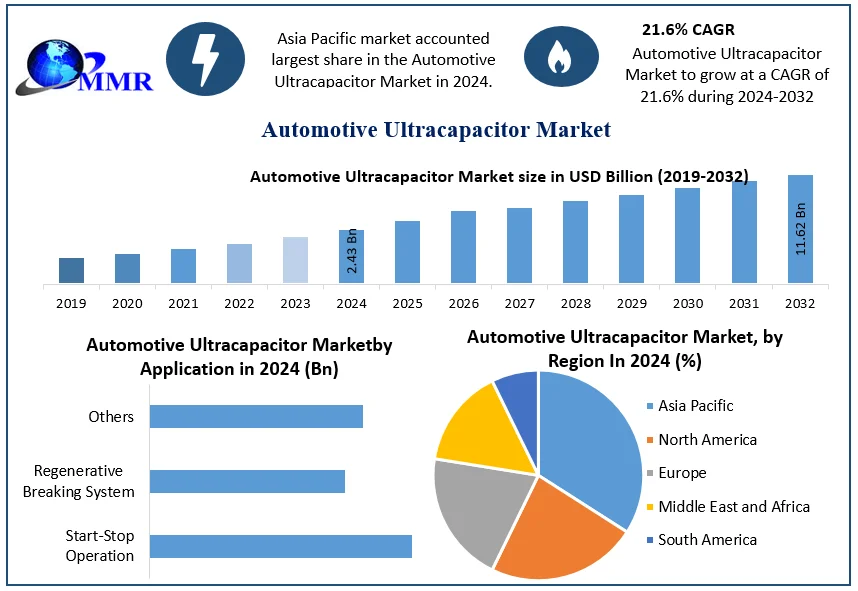
Growth Velocity: The market is expanding at a robust CAGR exceeding 20% in various forecasts, driven by the shift toward high-performance electric and hybrid powertrains.
Dominant Segment: Start-stop operations currently represent the largest application share, reflecting their widespread adoption in European and Asian micro-hybrid fleets.
Technological Bedrock: Unlike chemical batteries, ultracapacitors utilize electrostatic charge separation, allowing them to deliver and absorb energy near-instantaneously—a capability critical for regenerative braking.
Strategic Driver: OEMs are integrating ultracapacitors to mitigate the “voltage sag” of traditional batteries, effectively extending battery lifespan and enhancing vehicle efficiency.
Why This Matters Now
The automotive industry is facing a dual challenge: the increasing power demand of modern, software-defined vehicles and the physical degradation limits of conventional lithium-ion batteries. Ultracapacitors have emerged as the solution to this “power-density gap.” By handling the sudden, high-intensity energy spikes—such as regenerative braking or peak acceleration—these devices protect the main battery pack from harmful cycles, drastically reducing long-term maintenance costs and extending the effective range of both hybrid and full-electric vehicles.
Market Overview
The Automotive ultracapacitors Market are no longer just supplementary components; they are increasingly becoming foundational elements of modular power architectures. While traditional batteries excel at sustained energy storage, ultracapacitors are the “sprinters” of the powertrain, capable of millions of charge-discharge cycles without the degradation that plagues chemical storage systems. This makes them perfectly suited for the stop-start nature of urban driving and the high-performance demands of autonomous vehicle sensor arrays, which require reliable, uninterruptible power.
Key Trends Driving Growth
Electrification and autonomous driving are the twin engines of this market. As vehicles become more reliant on high-compute platforms, the need for stable, low-latency power buffers grows. Ultracapacitors are being integrated into active suspension systems, power steering, and turbocharger stabilization to ensure that these components react with the necessary precision. Furthermore, the push for faster EV charging is driving interest in ultracapacitors as a bridge technology that can handle the massive in-rush currents of ultra-fast charging stations without overheating the primary battery cells.
Segment Insights
Dominant Segment: Start-Stop Operation. This segment commands the largest share due to the near-universal adoption of micro-hybrid technology in global fleets. It is the frontline application where ultracapacitors first proved their commercial value.
Fastest-Growing Segment: Regenerative Braking Systems. As manufacturers optimize vehicles for maximum energy recovery, the role of ultracapacitors in capturing and redeploying braking kinetic energy is growing exponentially.
Regional Growth Story
Asia-Pacific leads the market, propelled by China’s aggressive new-energy vehicle (NEV) mandates and Japan’s advanced automotive R&D ecosystem. The region’s focus on high-volume production of cost-effective components is enabling rapid market penetration. Meanwhile, Europe remains a critical innovation hub, where stringent Euro-emission standards are forcing OEMs to implement ultracapacitor-based energy recovery to squeeze every possible percent of efficiency from their powertrains. North America is following suit, supported by clean-vehicle tax credits and the rapid scaling of domestic fleet electrification.
Competitive Landscape
The market is currently dominated by a mix of specialized storage-tech firms and legacy component giants, including players such as Skeleton Technologies, Maxwell Technologies, Panasonic, and Kemet Corporation. The competition is shifting from a focus on basic capacitance to the development of “hybrid” devices that blend the power density of capacitors with the energy density of batteries.
The signal here is clear: the most successful suppliers are those that work directly with OEM engineering teams to embed these modules into the initial design phase of the powertrain. We are seeing a move away from “off-the-shelf” components toward custom-designed, modular energy-management solutions. Companies that secure “design-win” status in these early stages are locking in long-term supply contracts, effectively making themselves indispensable to the electrification roadmaps of major automotive manufacturers.
Recent Developments
Material Innovation: A significant decline in electrode material costs (such as activated carbon) has improved the unit-economics of mass-market deployment.
Graphene Integration: Industry leaders like Skeleton Technologies are nearing the commercialization of graphene-hybrid electrodes, promising a 25–30% boost in energy density.
OEM Integration: Tier-1 suppliers are increasingly embedding ultracapacitor modules directly into the inverter and powertrain housings, simplifying vehicle integration and reducing overall wire-harness complexity.
Strategic Implications
For OEMs, the strategic value of ultracapacitors lies in their ability to “downsize” the main battery pack without sacrificing range or performance. By offloading peak power duties to a capacitor, manufacturers can reduce the thermal management requirements of the main battery, resulting in a lighter, more efficient, and ultimately more affordable vehicle. Investors should look toward suppliers that have mastered the integration of these devices into standard E/E (electronic/electrical) architectures, as this will be the standard for future-ready EV platforms.
Future Outlook
The automotive industry is fast approaching a tipping point where the “battery-only” model will be seen as an inefficient legacy approach. In the coming decade, we expect a bifurcation in the market: future leaders will be the OEMs that embrace multi-source power management, using ultracapacitors to create “smart-resilient” powertrains that can handle the extreme demands of the autonomous and electrified age; the laggards will be those tethered to outdated battery-only architectures that struggle to balance power, heat, and performance.
Analyst Perspective
“Ultracapacitors are the silent workhorses of the electrified vehicle,” states Tejaswini Kakade, Analyst at Maximize Market Research. “As we transition toward a future of autonomous and high-performance mobility, the ability to store and release energy in milliseconds will distinguish the top-tier, high-efficiency vehicles from the rest of the fleet.”
About Maximize Market Research
Maximize Market Research Pvt. Ltd. (MMR) is a global market research and consulting company that provides reliable, data-focused, and practical business insights. The firm serves a wide range of industries, including healthcare, pharmaceuticals, technology, automotive, electronics, chemicals, personal care, and consumer goods. Through market forecasts, competitive analysis, strategic consulting, and industry impact assessments, MMR helps organizations understand changing market conditions, identify growth opportunities, and make informed business decisions for long-term success.
2nd Floor, Navale IT Park Phase 3
Pune Banglore Highway, Narhe
Pune, Maharashtra 411041, India
+91 9607365656
sales@maximizemarketresearch.com
