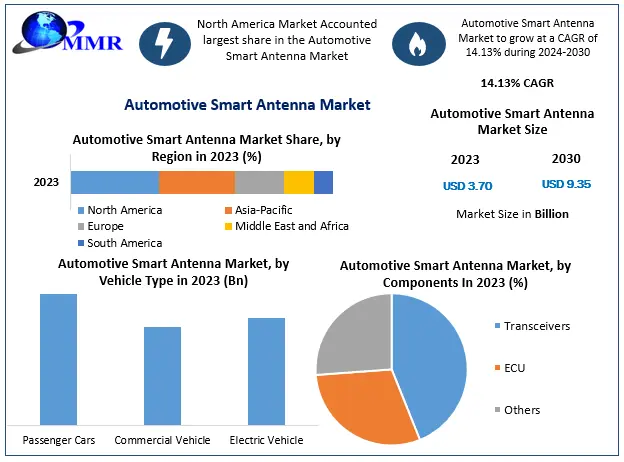
Key Highlights:
Market Valuation: Projected to reach US$ 9.35 Bn by 2030.
Growth Momentum: Registering a robust CAGR of 14.13% during the forecast period.
Core Driver: Acceleration in vehicle-to-everything (V2X) communication and autonomous driving mandates.
Technology Shift: Transitioning from passive systems to integrated, multi-functional smart antenna modules.
Why This Matters Now
The automotive industry is no longer merely manufacturing hardware; it is assembling data centers on wheels. As vehicle architectures pivot toward software-defined models, the ability to maintain high-speed, low-latency connectivity is the new competitive frontier. Smart antennas act as the critical gateway for this data flow, transforming from peripheral components into fundamental architectural pillars. For OEMs and Tier-1 suppliers, the failure to integrate advanced, multi-band antenna systems today risks technical obsolescence in a market defined by autonomous mobility and real-time over-the-air (OTA) updates.
Market Overview
The Automotive Smart Antenna Market Size is currently experiencing a profound structural expansion, fueled by the intensifying demand for seamless vehicle-to-infrastructure (V2I) and vehicle-to-vehicle (V2V) connectivity. According to the latest data, the market is poised to reach a valuation of US$ 9.35 Bn by 2030, supported by a significant CAGR of 14.13%. Unlike traditional antenna systems that rely on separate cables and mechanical mounts, modern smart antennas integrate transceivers and signal processing directly into the module. This integration reduces signal loss, minimizes cabling complexity, and provides the necessary bandwidth for 5G, GPS, Wi-Fi, and e-call services, establishing a lifeline for the modern connected vehicle.
Key Trends Driving Growth
The primary driver behind this growth is the evolution of “Intelligent Vehicles.” As autonomous driving initiatives mature, the reliance on high-accuracy location data and instant environmental awareness has skyrocketed. Smart antennas now serve as the focal point for managing the diverse spectrums required for navigation and safety protocols. Furthermore, the rising adoption of connected infotainment systems is pushing the industry to standardize antenna technology that can simultaneously handle multiple communication standards, enhancing both user experience and vehicle safety.
Segment Insights
Dominant Segment: OEM-integrated smart antenna systems. These represent the largest market share as manufacturers prioritize factory-installed, high-performance connectivity modules to ensure system reliability and warranty compliance from day one.
Fastest-Growing Segment: V2X-enabled antenna modules. As regulatory bodies and safety consortiums push for enhanced collision avoidance and traffic management, the demand for antennas capable of real-time low-latency communication is surging at a pace exceeding traditional connectivity segments.
Regional Growth Story
Asia-Pacific remains the central engine for this market, driven by its unparalleled density of automotive manufacturing and a rapid shift toward digital infrastructure. China, Japan, and India are leading the regional surge, with massive investments in 5G rollouts and domestic smart-vehicle production. Meanwhile, North America and Europe are focusing on regulatory-driven adoption. In these regions, stringent emission standards and vehicle safety mandates act as the primary catalysts, forcing OEMs to incorporate sophisticated antenna modules to comply with new connectivity-based safety regulations.
Competitive Landscape
The competitive environment is shifting from individual hardware sales to a battle for integration leadership. Leading suppliers are aggressively pursuing partnerships with silicon manufacturers to embed smarter signal-processing chips directly into antenna housings. This trend signals an inflection point: the market is consolidating around those who can provide a “one-stop” solution for connectivity—covering everything from telematics to infotainment. Companies that fail to bridge the gap between pure RF engineering and software integration are rapidly losing their pricing power as OEMs demand more intelligence per square inch of the antenna module.
Recent Developments
Strategic Consolidation: Tier-1 suppliers are increasingly acquiring niche software-defined antenna startups to gain proprietary control over frequency-hopping algorithms.
Platform Launches: Major OEMs are shifting toward unified shark-fin modules that serve as a central hub for all vehicle communications, significantly reducing assembly time and component weight.
Technology Partnerships: Collaborations between automotive suppliers and telecom infrastructure providers are becoming standard, aiming to synchronize vehicle antenna performance with external 5G edge computing networks.
Strategic Implications
For OEMs, the strategic mandate is clear: centralize connectivity management. Relying on fragmented antenna configurations across different car models is no longer cost-effective or technically viable. Suppliers must pivot their R&D toward miniaturization and high-frequency handling to accommodate the complex requirements of autonomous sensor fusion. For investors, the focus should be on firms that possess both the intellectual property for advanced V2X communication and the supply chain scale to support global OEM production lines.
Future Outlook
The next phase of the smart antenna market will be defined by the “invisible antenna”—modules so integrated and miniaturized that they disappear into the vehicle’s bodywork while increasing data throughput by orders of magnitude. The winners in this space will be the companies that treat antennas as software-defined assets rather than static hardware, creating a modular foundation for the future of mobility. Market leaders will be those who successfully commoditize current high-bandwidth standards, while laggards will be trapped in the cycle of low-margin, legacy antenna component manufacturing.
Analyst Perspective
“The move toward a US$ 9.35 Bn valuation is a direct result of the automotive sector finally treating connectivity as a safety-critical utility,” says Tejaswini Kakade, Market Analyst. “As we transition toward fully autonomous and software-defined vehicle architectures, the smart antenna is no longer just an accessory—it is the central nervous system of the modern vehicle, and the supply chain is aggressively reconfiguring to reflect this reality.”
About Maximize Market Research
Maximize Market Research Pvt. Ltd. (MMR) is a global market research and consulting company that provides reliable, data-focused, and practical business insights. The firm serves a wide range of industries, including healthcare, pharmaceuticals, technology, automotive, electronics, chemicals, personal care, and consumer goods. Through market forecasts, competitive analysis, strategic consulting, and industry impact assessments, MMR helps organizations understand changing market conditions, identify growth opportunities, and make informed business decisions for long-term success.
2nd Floor, Navale IT Park Phase 3
Pune Banglore Highway, Narhe
Pune, Maharashtra 411041, India
+91 9607365656
sales@maximizemarketresearch.com
