Key Highlights
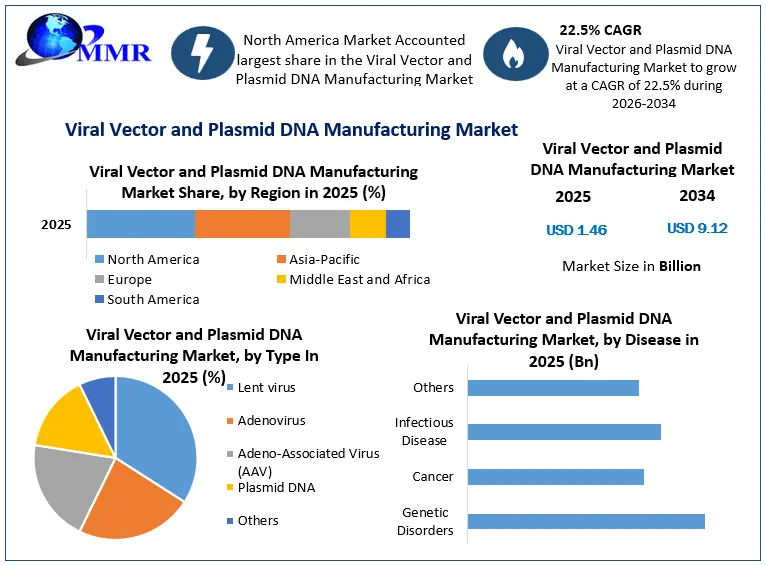
- The market is expected to grow from USD 1.46 billion in 2025 to USD 9.12 billion by 2034 at a 22.5% CAGR.
- North America remains the largest regional market due to strong gene therapy commercialization and advanced manufacturing infrastructure.
- Gene therapy applications account for the largest market share as regulatory approvals continue to increase.
- Capacity expansion and downstream purification technologies are becoming major competitive differentiators.
- CDMOs and specialized manufacturing providers are expanding GMP facilities to address rising global demand.
- Asia-Pacific is emerging as a major investment destination for viral vector production.
Why This Matters Now
Cell and gene therapies are moving rapidly from clinical research into commercial manufacturing. Viral vectors and plasmid DNA have become essential building blocks for these advanced therapies. Manufacturers capable of delivering scalable, regulatory-compliant production are becoming strategic partners for biotechnology companies seeking faster product commercialization while maintaining stringent quality standards.
Market Overview
The Viral Vector and Plasmid DNA Manufacturing Market supports the production of viral vectors and plasmid DNA used in gene therapy, cell therapy, vaccine development, and advanced biologics manufacturing.
Demand is accelerating as gene therapies gain regulatory approval for rare diseases, inherited disorders, oncology, and infectious diseases. Pharmaceutical and biotechnology companies increasingly require specialized manufacturing capabilities because viral vector production remains technically complex and highly regulated.
Manufacturing involves sophisticated upstream production, purification, analytical testing, and quality assurance. Improvements in large-scale bioprocessing, purification technologies, and GMP manufacturing are reducing production bottlenecks while improving product consistency and regulatory compliance.
Supply remains constrained compared to rising clinical demand, encouraging significant investments in manufacturing expansion, contract development and manufacturing organizations (CDMOs), and automation technologies.
Key Trends Driving Growth
Gene therapy commercialization continues expanding demand for high-quality viral vector manufacturing capacity across every stage of clinical development.
Advanced purification technologies are improving product purity, reducing contamination risk, and increasing manufacturing yields. These improvements shorten production timelines while supporting regulatory compliance.
Automation and digital bioprocessing are improving manufacturing consistency, traceability, and scalability for commercial production.
Growing investment in plasmid DNA manufacturing reflects increasing demand for starting materials supporting viral vectors, mRNA technologies, and next-generation therapeutics.
Strategic outsourcing continues to reshape the industry as biotechnology companies increasingly partner with specialized manufacturers rather than building expensive in-house production facilities.
Segment Insights
Dominant Segment: Gene Therapy
Gene therapy represents the largest application segment within the Viral Vector and Plasmid DNA Manufacturing Market.
Increasing regulatory approvals and expanding clinical pipelines continue driving demand for viral vectors and plasmid DNA used in therapeutic gene delivery. Pharmaceutical companies require reliable manufacturing partners capable of supporting clinical trials through commercial production.
Business impact is substantial because approved gene therapies require highly controlled, GMP-compliant manufacturing with recurring production demand over product lifecycles.
Fastest-Growing Segment: Vaccinology
Vaccinology is projected to register the fastest growth during the forecast period.
Research organizations continue investing in viral vector-based vaccines capable of delivering strong immune responses against infectious diseases and emerging pathogens.
This creates opportunities for manufacturers offering flexible production platforms capable of rapidly scaling vaccine development programs.
Explore detailed analysis, insights, and growth opportunities
Key Type Segments
Adeno-Associated Virus (AAV) remains one of the most widely adopted vector platforms because of its favorable safety profile and effectiveness across multiple therapeutic applications.
Lentiviral vectors continue supporting ex vivo gene-modified cell therapies, particularly in oncology and rare genetic disorders.
Plasmid DNA demand is increasing alongside expansion of gene editing technologies, mRNA therapeutics, and viral vector production, making it a foundational component across advanced biologics manufacturing.
Disease Focus
Cancer and genetic disorders continue generating the highest manufacturing demand as developers expand clinical programs targeting diseases with limited treatment options.
Infectious disease research also contributes to market expansion through viral vector vaccine development and next-generation immunotherapies.
Regional Growth Story
North America
North America maintains market leadership due to its advanced biotechnology ecosystem, strong regulatory framework, established CDMO network, and high concentration of gene therapy developers.
The United States continues leading commercial manufacturing investments while supporting rapid translation of research into approved therapies.
Europe
Europe benefits from established pharmaceutical manufacturing capabilities, strong regulatory expertise, and continued investment in advanced therapy medicinal products (ATMPs).
Growing collaborations between biotechnology firms and specialized manufacturing providers continue strengthening regional competitiveness.
Asia-Pacific
Asia-Pacific is expected to register the fastest expansion during the forecast period.
China, Japan, and India continue increasing investments in biotechnology infrastructure, clinical research, and gene therapy manufacturing capabilities. Government support and growing domestic biotechnology industries are strengthening regional production capacity.
Middle East & Africa and South America
Emerging regions are gradually expanding biotechnology infrastructure through research collaborations, healthcare investments, and increasing participation in global clinical development programs.
Competitive Landscape
Competition centers on manufacturing quality, production scalability, regulatory compliance, and technological expertise.
Merck KGaA, Lonza, FUJIFILM Diosynth Biotechnologies, Kaneka Eurogentec, Aldevron, and Novasep continue strengthening manufacturing capabilities through acquisitions, facility expansion, and technology investments.
Specialized organizations including CobraBiologics, Cell and Gene Therapy Catapult, uniQure, Creative Biogene, Addgene, MassBiologics, Brammer Bio, Spark Therapeutics, FinVector, and SIRION Biotech focus on supporting advanced therapy developers with specialized manufacturing expertise.
Market leadership increasingly depends on integrated capabilities spanning plasmid DNA production, viral vector manufacturing, analytical testing, downstream purification, and GMP regulatory compliance.
Recent Developments
- January 2025 – Aldevron launched Alchemy™ cell-free DNA technology, accelerating DNA template production for viral vector and mRNA manufacturing.
- May 2026 – Merck KGaA signed a five-year agreement to become the exclusive testing provider for Genetix Biotherapeutics’ gene therapy programs, strengthening quality assurance capabilities.
- March 2026 – Merck KGaA completed the acquisition of JSR Life Sciences’ chromatography business, enhancing downstream purification technologies.
- May 2025 – Lonza achieved GMP qualification for new mRNA manufacturing suites in Geleen, expanding commercial production capacity for advanced therapeutic platforms.
Analyst Perspective – Komal Patil
The Viral Vector and Plasmid DNA Manufacturing Market is transitioning from a capacity-constrained research industry into a strategically critical manufacturing ecosystem supporting commercial gene therapies. As regulatory approvals increase, manufacturing quality, scalability, and supply chain resilience will become stronger competitive differentiators than production volume alone. Companies investing in integrated GMP facilities, advanced purification technologies, and flexible CDMO capabilities will be best positioned to capture long-term value in the rapidly expanding advanced therapeutics industry.
Future Outlook
Manufacturers that combine scalable GMP production, advanced purification technologies, and end-to-end gene therapy manufacturing capabilities will define the next phase of growth in the Viral Vector and Plasmid DNA Manufacturing Market.
About Maximize Market Research
Maximize Market Research Pvt. Ltd. (MMR) is a global market research and consulting company that provides reliable, data-focused, and practical business insights. The firm serves a wide range of industries, including healthcare, pharmaceuticals, technology, automotive, electronics, chemicals, personal care, and consumer goods. Through market forecasts, competitive analysis, strategic consulting, and industry impact assessments, MMR helps organizations understand changing market conditions, identify growth opportunities, and make informed business decisions for long-term success.
Contact Us :
2nd Floor, Navale IT Park Phase 3
Pune Banglore Highway, Narhe
Pune, Maharashtra 411041, India
+91 9607365656
sales@maximizemarketresearch.com
