Market Estimation and Definition
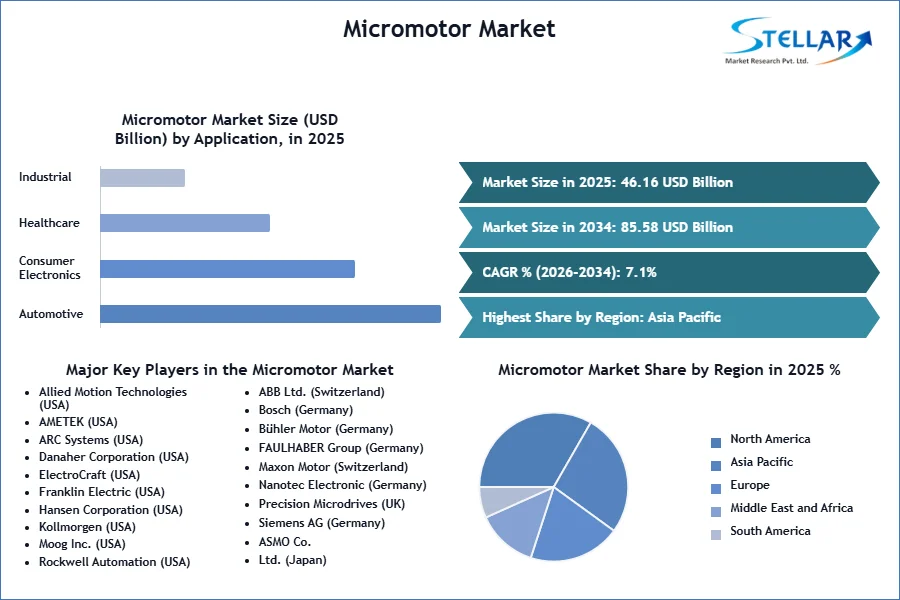
Micromotor Market was valued at USD 46.16 Bn in 2025, and its total revenue is expected to grow at a CAGR of 7.1% from 2026 to 2034, reaching nearly USD 85.58 Bn by 2034.
The Micromotor Market is witnessing strong growth as industries increasingly demand compact, efficient, and high-precision motion solutions for advanced applications. Micromotors are small electric motors designed to deliver controlled rotational movement in limited spaces while maintaining high efficiency and reliability. These motors are widely used across automotive systems, medical devices, consumer electronics, industrial automation, robotics, aerospace equipment, and household appliances.
Micromotors include various technologies such as brushed DC motors, brushless DC (BLDC) motors, stepper motors, and coreless motors. Their compact size, low energy consumption, accurate control capabilities, and ability to support automated systems have made them essential components in next-generation electronic and mechanical applications.
𝐃𝐨𝐰𝐧𝐥𝐨𝐚𝐝 𝐅𝐫𝐞𝐞 𝐏𝐃𝐅 𝐁𝐫𝐨𝐜𝐡𝐮𝐫𝐞: https://www.stellarmr.com/report/req_sample/micromotor-market/2671
Market Growth Drivers and Opportunities
Rising Demand for Automotive Automation
The automotive industry is one of the largest contributors to micromotor demand. Modern vehicles integrate multiple compact motors for power windows, seat adjustment systems, electric mirrors, HVAC controls, braking systems, steering mechanisms, and advanced driver assistance systems.
The rapid growth of electric vehicles (EVs) is further creating new opportunities for micromotor manufacturers. EVs require efficient motorized components for battery cooling systems, charging mechanisms, automated features, and intelligent vehicle controls. As automotive manufacturers continue developing connected and autonomous vehicles, demand for high-performance micromotors is expected to increase significantly.
Expansion of Industrial Automation and Robotics
The growth of Industry 4.0, smart factories, and robotics is accelerating the adoption of precision micromotors. Manufacturing industries are increasingly deploying robotic arms, automated assembly systems, and intelligent machines that require compact motion-control components.
Micromotors enable precise positioning, faster operation, and improved energy efficiency in industrial equipment. The increasing need for automation to improve productivity, reduce labor dependency, and enhance manufacturing accuracy is creating significant growth opportunities for suppliers.
Growing Healthcare Applications
The healthcare sector represents a major opportunity area for the Micromotor Market. These motors are widely used in surgical instruments, dental equipment, medical pumps, diagnostic devices, prosthetics, and drug delivery systems.
The rising adoption of minimally invasive surgeries and advanced medical technologies is increasing demand for miniature, reliable, and precise motors. Medical device manufacturers are focusing on developing compact systems that improve patient outcomes while reducing procedure complexity.
Emerging Trends Shaping the Micromotor Market
Shift Toward Brushless Micromotors
Brushless DC (BLDC) micromotors are gaining popularity due to their longer operational life, reduced maintenance requirements, higher efficiency, and improved performance compared with traditional brushed motors.
Industries such as automotive, healthcare, and robotics are increasingly adopting brushless technologies because they offer better reliability and quieter operation. This trend is expected to continue as manufacturers prioritize energy efficiency and durability.
Miniaturization of Electronic Devices
The growing demand for smaller and smarter electronic products is driving innovation in micromotor design. Smartphones, wearable devices, smart home appliances, cameras, and personal care products increasingly require compact motion solutions.
Manufacturers are investing in advanced materials, precision engineering, and improved manufacturing processes to develop smaller motors with enhanced torque and efficiency.
Integration with Smart Technologies
Artificial intelligence, Internet of Things (IoT), and automation technologies are transforming micromotor applications. Smart motors equipped with sensors and digital controls enable real-time monitoring, predictive maintenance, and improved operational efficiency.
Connected micromotor systems are becoming increasingly important in industrial automation, robotics, and intelligent consumer products.
Regional Analysis
Asia-Pacific represents one of the fastest-growing regions in the Micromotor Market due to strong manufacturing capabilities, expanding electronics production, and increasing automotive output. Countries including China, Japan, South Korea, and India are major contributors due to their large-scale electronics, automotive, and industrial automation industries.
China remains a key manufacturing hub for micromotors due to its extensive electronics supply chain and growing electric vehicle industry. Japan and South Korea continue investing in advanced robotics, semiconductor equipment, and precision technologies.
North America holds a significant market position due to high adoption of advanced automotive technologies, medical devices, aerospace systems, and industrial automation solutions. The United States continues investing in robotics, EV manufacturing, and smart manufacturing infrastructure.
Europe is another important market supported by automotive innovation, industrial automation, and increasing demand for energy-efficient technologies. Germany, France, and the United Kingdom are investing heavily in electric mobility and advanced manufacturing.
Latin America and the Middle East & Africa are emerging markets as industrial modernization, infrastructure development, and automation adoption continue expanding.
Competitive Landscape
The Micromotor Market is highly competitive, with companies focusing on product innovation, energy efficiency, customization, and expansion into high-growth industries.
Leading players operating in the market include Mabuchi Motor Co., Ltd., Nidec Corporation, Johnson Electric Holdings Limited, Maxon Motor AG, MinebeaMitsumi Inc., Allied Motion Technologies, Faulhaber Group, Siemens AG, ABB Ltd., and AMETEK Inc.
Companies are investing in advanced motor technologies, brushless designs, precision manufacturing, and application-specific solutions to strengthen their market position. Strategic partnerships with automotive manufacturers, medical device companies, and automation providers are also helping companies expand their global presence.
For example, Mabuchi Motor introduced new DC brushless motor series featuring improved performance, waterproof construction, and reduced vibration characteristics for advanced applications.
𝐃𝐨𝐰𝐧𝐥𝐨𝐚𝐝 𝐅𝐫𝐞𝐞 𝐏𝐃𝐅 𝐁𝐫𝐨𝐜𝐡𝐮𝐫𝐞: https://www.stellarmr.com/report/req_sample/micromotor-market/2671
Future Outlook
The future of the Micromotor Market remains highly promising as industries continue moving toward automation, electrification, and miniaturization. Increasing demand for electric vehicles, smart devices, robotics, and advanced healthcare equipment will remain key growth factors through 2032.
Technological advancements in brushless motors, sensor integration, artificial intelligence-based monitoring, and energy-efficient designs will further expand application opportunities. Manufacturers are expected to focus on developing lightweight, durable, and intelligent micromotors capable of supporting next-generation systems.
The growing adoption of autonomous vehicles, smart factories, wearable healthcare devices, and connected consumer electronics will create new demand for precision motion technologies. At the same time, sustainability initiatives will encourage the development of low-power and environmentally efficient motor solutions.
Challenges such as rising raw material costs, supply chain disruptions, and increasing competition among manufacturers may impact market growth. However, continuous innovation and expanding applications across multiple industries are expected to maintain strong market momentum.
As industries increasingly rely on compact automation and intelligent motion systems, the Micromotor Market will remain a critical component of future technological development, enabling improved efficiency, precision, and performance across automotive, healthcare, electronics, and industrial sectors.
Media Contact
Stellar Market Research
Website: Stellar Market Research – Global Research Reports & Consulting
Email: sales@stellarmr.com
