Key Highlights
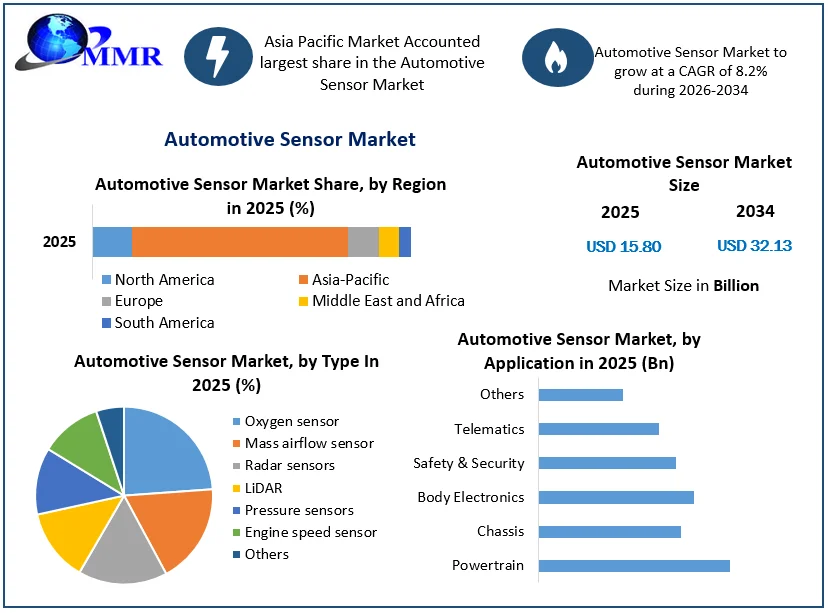
- Automotive Sensor Market was valued at USD 15.80 Bn. in 2025.
- Global revenue is projected to reach USD 32.13 Bn. by 2034, expanding at a CAGR of 8.2% from 2026 to 2034.
- Electrification and advanced driver assistance systems continue to increase sensor content per vehicle.
- Software-defined vehicle architectures are expanding demand for integrated sensing platforms.
- Autonomous driving initiatives are accelerating investments in radar, camera, ultrasonic, and other sensing technologies.
- Tier-1 suppliers are strengthening semiconductor partnerships to improve supply resilience.
- Connected vehicle ecosystems are increasing the strategic importance of real-time sensing and data processing.
Why This Matters Now
The automotive industry has entered a technology race where competitive advantage depends as much on software and sensing capability as on mechanical engineering. Every new vehicle platform is expected to deliver higher levels of automation, connectivity, safety, and efficiency, forcing manufacturers to redesign vehicle architectures around intelligent sensors.
The Automotive Sensor Market, valued at USD 15.80 billion in 2025 and expected to reach USD 32.13 billion by 2034 at a CAGR of 8.2%, signals more than expanding component demand. It indicates that sensors are becoming strategic assets for OEMs pursuing autonomous mobility, electrification, predictive maintenance, and software-defined vehicles.
Market Overview
The Automotive Sensor Market Size have become the digital nervous system of modern automobiles. They continuously collect information about vehicle performance, road conditions, driver behavior, battery health, emissions, and surrounding traffic environments. Their role has expanded well beyond traditional engine management into every major automotive function.
Vehicle electrification has significantly increased sensor deployment across battery systems, thermal management, power electronics, charging systems, and energy optimization. At the same time, increasingly stringent vehicle safety regulations are encouraging wider deployment of ADAS technologies that rely heavily on cameras, radar, ultrasonic devices, and multiple sensor fusion systems.
Manufacturers are also shifting toward centralized electronic architectures capable of supporting over-the-air software updates. This transition requires higher-quality sensing capabilities that deliver reliable, real-time data to centralized computing platforms.
Key Trends Driving Growth
Electrification is changing the economics of automotive electronics. Battery-electric vehicles require extensive monitoring of battery temperature, voltage, current flow, cooling systems, and power distribution. Every additional monitoring requirement increases sensor integration throughout the vehicle.
Software-defined vehicles represent another structural shift. Vehicle functionality is increasingly determined by software rather than hardware alone. Sensors now serve as continuous data generators supporting advanced software algorithms for safety, diagnostics, predictive maintenance, and autonomous driving.
ADAS deployment continues to expand globally as consumers prioritize safety and governments strengthen vehicle safety requirements. Lane keeping, adaptive cruise control, emergency braking, blind-spot detection, and parking assistance all depend on sophisticated sensor networks working together.
Automotive semiconductor strategies have also become more important following recent supply-chain disruptions. OEMs and Tier-1 suppliers are diversifying sourcing strategies while strengthening long-term technology partnerships to secure advanced sensor components.
Connectivity is creating additional opportunities. Connected vehicles continuously exchange data with cloud platforms, infrastructure, and fleet management systems. Accurate sensor information enables real-time diagnostics, predictive servicing, navigation optimization, and fleet efficiency improvements.
Segment Insights
- Dominant Segment: The report identifies the dominant market segment based on its analysis. This segment continues to lead industry demand due to broad deployment across modern passenger and commercial vehicles.
- Fastest-Growing Segment: According to the report, the fastest-growing segment is benefiting from increasing adoption of advanced safety systems, connected vehicle technologies, and electrified powertrains.
- ADAS applications continue expanding sensor integration across vehicle platforms.
- Electrified vehicles are increasing demand for battery monitoring, thermal management, and powertrain sensing technologies.
- Passenger vehicle manufacturers remain key adopters as software-defined vehicle strategies accelerate.
- Commercial fleets are incorporating more sensors to improve operational efficiency, predictive maintenance, and regulatory compliance.
Regional Growth Story
China continues to influence global automotive sensor demand through rapid EV production, aggressive autonomous driving development, and expanding domestic semiconductor capabilities. The country’s integrated manufacturing ecosystem enables faster commercialization of intelligent vehicle technologies.
The United States remains a major innovation hub for autonomous mobility, software-defined vehicles, connected transportation, and advanced automotive software platforms. Investment in AI-enabled driving systems continues to stimulate demand for increasingly sophisticated sensing technologies.
Germany maintains its leadership through premium automotive manufacturing, engineering excellence, and continued investment in vehicle automation. German OEMs are integrating advanced sensor suites into both luxury and mass-market vehicle platforms while pursuing carbon reduction objectives.
Japan and South Korea continue strengthening automotive electronics capabilities through innovation in semiconductors, sensing technologies, battery systems, and next-generation mobility solutions. Their established supplier ecosystems remain critical to global vehicle production.
India is becoming increasingly important as vehicle production expands and advanced safety technologies gain wider adoption. Rising consumer demand for connected vehicles and government initiatives supporting automotive modernization are creating new opportunities across the sensor value chain.
Competitive Landscape
Competition is no longer centered solely on manufacturing scale. The industry’s competitive balance increasingly depends on who can deliver integrated sensing platforms that combine hardware, embedded software, artificial intelligence, and cloud connectivity.
Tier-1 suppliers are repositioning themselves as technology partners rather than component vendors. Their investments in sensor fusion, semiconductor collaboration, and software integration signal a broader transition toward platform-based automotive electronics.
OEMs are simultaneously redesigning vehicle architectures to support centralized computing systems. This reduces complexity while enabling faster software deployment and enhanced vehicle functionality throughout the ownership lifecycle.
Technology leadership is increasingly determined by ecosystem strength. Companies capable of integrating sensors with AI, connectivity, cybersecurity, and over-the-air software capabilities are likely to secure stronger competitive positioning as software-defined mobility expands.
Supply-chain resilience has also become a strategic differentiator. Manufacturers are strengthening semiconductor partnerships and diversifying sourcing strategies to reduce production risks while maintaining access to advanced sensing technologies.
Recent Developments
- Expansion of software-defined vehicle programs across global OEM portfolios.
- Growing deployment of ADAS technologies in both premium and mainstream vehicle segments.
- Continued investment in connected vehicle ecosystems supporting real-time diagnostics.
- Increasing collaboration between automotive manufacturers and semiconductor companies.
- Expansion of EV production supporting higher sensor integration across battery and power management systems.
- Continued investment in autonomous driving research and intelligent mobility platforms.
Strategic Implications
Automotive sensors are evolving from supporting components into strategic technology enablers. Every improvement in vehicle automation, electrification, safety, connectivity, or predictive maintenance depends on reliable sensing capability.
For OEMs, higher sensor integration enables product differentiation through software features rather than traditional hardware upgrades. This creates recurring revenue opportunities through software services, feature subscriptions, and enhanced customer experiences.
Tier-1 suppliers face a similar transformation. Future competitiveness will depend on delivering complete sensing ecosystems that integrate hardware, embedded software, AI algorithms, cybersecurity, and cloud connectivity rather than individual sensor products.
Fleet operators also stand to benefit. Better sensor networks improve predictive maintenance, reduce downtime, optimize fuel or energy efficiency, and strengthen operational visibility across increasingly connected transportation networks.
Future Outlook
The next decade will redefine how vehicles perceive, interpret, and respond to their environments. As electrification, connectivity, autonomous driving, and software-defined architectures converge, sensor technologies will become central to every major automotive innovation.
Manufacturers that invest early in scalable sensing platforms, semiconductor partnerships, software integration, and intelligent vehicle ecosystems will establish stronger competitive advantages. Those relying solely on conventional component strategies risk losing relevance as mobility increasingly becomes data-driven.
The companies that master integrated sensing intelligence will define the next generation of global mobility, while those slow to adapt will struggle to compete in an industry increasingly led by software, automation, and connected transportation.
Analyst Perspective
“The Automotive Sensor Market is entering a new phase where intelligent sensing capabilities are becoming fundamental to vehicle competitiveness. As software-defined vehicles, electrification, and autonomous mobility advance simultaneously, OEMs and suppliers that prioritize integrated sensor ecosystems will be best positioned to capture long-term industry value.” — Tejaswini Kakade, Analyst
About Maximize Market Research
Maximize Market Research Pvt. Ltd. (MMR) is a global market research and consulting company that provides reliable, data-focused, and practical business insights. The firm serves a wide range of industries, including healthcare, pharmaceuticals, technology, automotive, electronics, chemicals, personal care, and consumer goods. Through market forecasts, competitive analysis, strategic consulting, and industry impact assessments, MMR helps organizations understand changing market conditions, identify growth opportunities, and make informed business decisions for long-term success.
2nd Floor, Navale IT Park Phase 3
Pune Banglore Highway, Narhe
Pune, Maharashtra 411041, India
+91 9607365656
sales@maximizemarketresearch.com
