Key Highlights
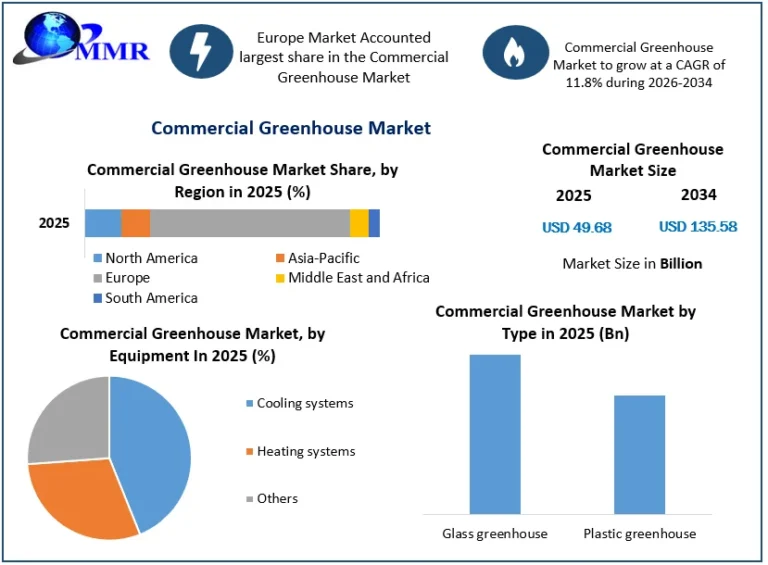
- Market valued at USD 49.68 billion in 2025.
- Forecast to reach USD 135.58 billion by 2034.
- Expected CAGR of 11.8% during 2026–2034.
- Europe remains the largest regional market.
- Vegetable cultivation represents the leading crop segment.
- Heating systems continue gaining importance in commercial greenhouse operations.
- Precision irrigation, AI-based crop management, and LED lighting are transforming greenhouse productivity.
- Water-efficient cultivation and food security initiatives continue to attract public and private investment.
Why This Matters Now
Commercial greenhouse farming is moving from a niche cultivation method to a strategic food production system. Climate uncertainty, declining arable land, and water shortages are forcing governments and commercial growers to invest in controlled-environment agriculture. Automation, artificial intelligence, precision irrigation, and energy-efficient greenhouse technologies are lowering operational risks while increasing crop consistency. These changes are reshaping global agricultural supply chains and creating new opportunities for equipment manufacturers, technology providers, and greenhouse developers.
Market Overview
Commercial greenhouses Market provide controlled environments for cultivating vegetables, fruits, flowers, and nursery crops regardless of external weather conditions. Temperature, humidity, irrigation, lighting, and carbon dioxide levels are managed precisely to maximize productivity and crop quality.
Demand is being supported by rising food consumption, shrinking agricultural land, climate volatility, and increasing consumer preference for year-round fresh produce. Commercial growers benefit from higher crop yields, predictable harvest cycles, and efficient resource utilization compared with conventional farming.
Supply-side investment is expanding rapidly as manufacturers introduce automated irrigation systems, climate control equipment, smart lighting, and digital crop management platforms. Technology providers are increasingly integrating sensors, artificial intelligence, and predictive analytics to improve greenhouse efficiency while reducing operating costs.
Macroeconomic factors including population growth, urbanization, government food security initiatives, and sustainability targets continue supporting long-term investment across the commercial greenhouse industry.
Key Trends Driving Growth
The market is shifting toward fully automated greenhouse operations. Artificial intelligence is increasingly managing irrigation schedules, nutrient delivery, harvest forecasting, and environmental controls. This reduces labor dependency while improving production accuracy.
Precision agriculture technologies are becoming standard across modern greenhouse facilities. Advanced sensors monitor crop health in real time, allowing operators to optimize growing conditions and reduce resource consumption.
Government policies encouraging sustainable agriculture and efficient water utilization continue accelerating greenhouse adoption. Several countries are supporting protected cultivation through agricultural modernization programs and infrastructure investments.
Sustainability has become a major competitive factor. Commercial greenhouses significantly reduce water consumption compared with conventional farming while enabling localized food production that lowers transportation emissions.
Energy efficiency is also receiving greater attention. LED horticulture lighting, heat recovery systems, and renewable energy integration are reducing operating costs while improving environmental performance.
Global trade disruptions and changing climate patterns are encouraging countries to strengthen domestic food production capabilities, increasing investments in greenhouse infrastructure.
Explore detailed analysis, insights, and growth opportunities
Segment Insights
Dominant Segment – Vegetables
Vegetables remain the largest crop category within the Commercial Greenhouse Market.
Vegetable cultivation benefits the most from controlled growing conditions because production cycles are shorter, yields are higher, and market demand remains consistent throughout the year. Greenhouses protect crops from pests, drought, frost, and extreme temperatures while maintaining optimal growing conditions.
For commercial growers, this translates into improved production reliability, higher product quality, and better contract fulfillment with retailers. Consistent year-round supply also supports premium pricing and reduces seasonal revenue fluctuations.
Fastest-Growing Segment – Heating Systems
Heating systems are expected to register strong growth throughout the forecast period.
Stable temperatures are essential for maintaining plant growth during colder seasons. Modern greenhouse heating technologies improve energy efficiency while maintaining precise environmental conditions required for high-value crops.
The business impact is significant because improved temperature management increases crop yields, shortens production cycles, and minimizes weather-related production losses.
Additional Key Segments
Glass Greenhouses
Glass structures continue attracting investments due to superior light transmission, durability, and long operational life. They are increasingly adopted for high-value horticultural production where productivity outweighs higher installation costs.
Plastic Greenhouses
Plastic greenhouse systems remain popular among cost-sensitive growers because they require lower upfront investment and offer operational flexibility for expanding agricultural production.
Cooling Systems
Cooling equipment is becoming increasingly important in regions experiencing rising temperatures. Advanced cooling technologies improve plant health while supporting continuous production during hot seasons.
Regional Growth Story
Europe
Europe remains the leading commercial greenhouse market due to decades of technological innovation and extensive greenhouse infrastructure.
Countries including the Netherlands, Spain, and Italy continue investing in high-efficiency greenhouse production. Scandinavian countries increasingly rely on controlled-environment agriculture because of challenging climatic conditions.
Strict environmental standards are encouraging adoption of energy-efficient greenhouse technologies and sustainable farming practices.
North America
North America continues expanding greenhouse investments as growers seek higher productivity and climate resilience. Automation, precision irrigation, and controlled-environment technologies are improving production efficiency while reducing resource consumption.
Asia Pacific
Asia Pacific represents one of the fastest-growing regions due to population growth, urbanization, and increasing food demand.
China, India, and several Southeast Asian countries are expanding protected cultivation to improve food security while addressing shrinking agricultural land and water constraints.
Middle East & Africa and South America
Water scarcity and climate challenges continue supporting greenhouse investments across the Middle East. South American countries are gradually adopting commercial greenhouse farming to improve agricultural productivity and export competitiveness.
Competitive Landscape
The Commercial Greenhouse Market remains moderately fragmented, with competition centered on automation, climate control technologies, irrigation systems, lighting solutions, and integrated greenhouse infrastructure.
Berry Global continues strengthening greenhouse covering materials that improve durability and crop protection.
Signify Holding is expanding smart horticultural lighting technologies that optimize plant growth while lowering electricity consumption.
Heliospectra AB focuses on intelligent LED lighting solutions integrated with environmental control systems.
Richel Group, Certhon, and Agra-tech continue expanding turnkey greenhouse infrastructure for commercial growers worldwide.
Argus Control Systems and Logiqs BV are strengthening digital greenhouse management through integrated automation platforms.
Technology partnerships are increasingly replacing traditional equipment competition as growers seek fully connected greenhouse ecosystems combining climate control, irrigation, lighting, and crop analytics.
Recent Developments
- February 2025: Netafim introduced the Hybrid Dripline precision irrigation system, simplifying irrigation installation and improving water management efficiency.
- March 2025: Source.ag launched three AI-powered software platforms supporting harvest forecasting, irrigation management, and greenhouse workflow optimization.
- May 2025: Rivenhall Greenhouse announced construction of a 40-hectare sustainable greenhouse facility in the United Kingdom, targeting annual tomato production of approximately 30,000 tonnes.
- June 2025: Ridder Drive Systems BV partnered with Signify to integrate intelligent lighting communication with greenhouse climate control systems.
- March 2026: Source.ag commercialized its next-generation AI harvest forecasting model, enabling tomato growers to predict production volumes up to eight weeks in advance.
Analyst Perspective – Komal Patil
Commercial greenhouse investment is increasingly shifting from infrastructure expansion toward intelligent production systems. Competitive advantage will depend less on greenhouse size and more on digital automation, predictive crop analytics, energy efficiency, and water optimization. Companies integrating AI, precision irrigation, and climate management into unified greenhouse platforms are positioned to capture higher-value commercial farming opportunities as governments prioritize food security and sustainable agriculture.
Future Outlook
Companies combining automation, precision irrigation, artificial intelligence, and energy-efficient greenhouse infrastructure will define the next phase of global commercial greenhouse leadership.
About Maximize Market Research
Maximize Market Research Pvt. Ltd. (MMR) is a global market research and consulting company that provides reliable, data-focused, and practical business insights. The firm serves a wide range of industries, including healthcare, pharmaceuticals, technology, automotive, electronics, chemicals, personal care, and consumer goods. Through market forecasts, competitive analysis, strategic consulting, and industry impact assessments, MMR helps organizations understand changing market conditions, identify growth opportunities, and make informed business decisions for long-term success.
Contact Us :
2nd Floor, Navale IT Park Phase 3
Pune Banglore Highway, Narhe
Pune, Maharashtra 411041, India
+91 9607365656
sales@maximizemarketresearch.com
