Key Highlights
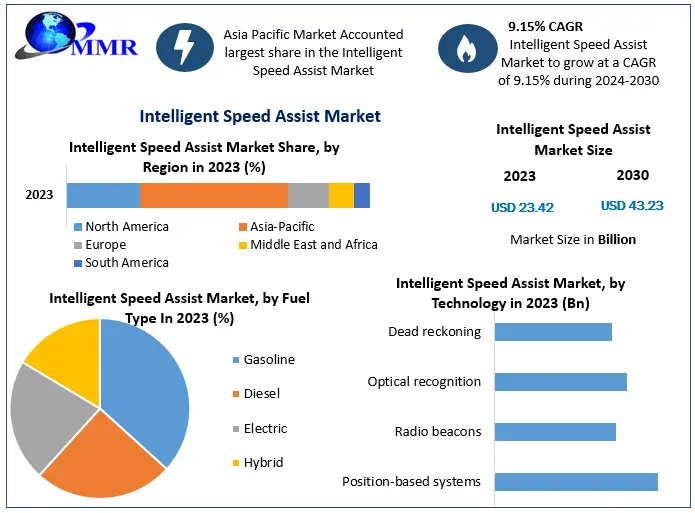
- Intelligent Speed Assist Market is expected to reach USD 43.23 Billion by 2030, growing at a CAGR of 9.15% during the forecast period.
- Regulatory mandates are accelerating Intelligent Speed Assist adoption across major automotive markets.
- ADAS integration is becoming a strategic differentiator for OEMs and Tier-1 suppliers.
- Connected vehicle ecosystems are improving speed recognition accuracy through digital mapping and onboard sensing.
- Software-defined vehicle architectures are enabling continuous performance improvements through software updates.
- Growing emphasis on road safety is expanding Intelligent Speed Assist deployment beyond premium vehicles.
Why This Matters Now
Vehicle safety has entered a new competitive phase where software is becoming as important as mechanical engineering. Intelligent Speed Assist (ISA) is moving from an optional driver-assistance feature toward a regulatory expectation, forcing automakers to rethink vehicle development strategies, electronics architecture, and software capabilities.
The Intelligent Speed Assist Market is expected to reach USD 43.23 Billion by 2030 at a CAGR of 9.15% during the forecast period. That growth signals more than expanding revenue—it reflects a structural shift in how regulators, OEMs, suppliers, and mobility providers prioritize accident prevention, connected mobility, and digital vehicle intelligence.
Market Overview
The automotive industry is rapidly transitioning toward vehicles that actively assist drivers rather than simply responding to driver inputs. Intelligent Speed Assist Market Size combines camera systems, navigation data, digital maps, GPS positioning, and advanced software algorithms to recognize speed limits and help drivers maintain compliant speeds.
The technology has become a central component of Advanced Driver Assistance Systems (ADAS), complementing adaptive cruise control, lane keeping assistance, collision avoidance, and traffic sign recognition. Rather than functioning as an isolated feature, ISA now contributes to broader software-defined vehicle strategies where multiple safety functions operate through integrated electronic platforms.
This transformation is reshaping investment priorities throughout the automotive value chain. OEMs are increasing software capabilities, semiconductor content, and sensor integration while Tier-1 suppliers continue expanding intelligent perception technologies that improve accuracy under increasingly complex driving conditions.
Key Trends Driving Growth
Road safety regulation remains the strongest catalyst behind Intelligent Speed Assist adoption. Governments continue strengthening vehicle safety requirements, encouraging manufacturers to integrate advanced driver assistance technologies into new vehicle platforms. Compliance is becoming a competitive necessity rather than simply a regulatory obligation.
Software-defined vehicles are also changing deployment economics. Modern vehicle architectures allow manufacturers to enhance driver assistance functions through software updates, extending product capabilities after production. This improves feature longevity while creating opportunities for continuous optimization as mapping databases and traffic recognition technologies evolve.
Vehicle connectivity is improving Intelligent Speed Assist performance through richer data sources. Cloud-connected navigation, high-definition digital maps, and increasingly capable onboard cameras allow speed assistance systems to operate with greater precision across diverse road environments.
Artificial intelligence is further strengthening traffic sign recognition by improving object detection, environmental interpretation, and real-time decision-making. As perception software advances, ISA systems become more reliable in complex weather, urban congestion, and changing road conditions.
Growing consumer awareness of vehicle safety is reinforcing regulatory momentum. Buyers increasingly evaluate vehicles based on ADAS capabilities, encouraging manufacturers to position intelligent safety technologies as competitive product differentiators rather than premium upgrades.
Segment Insights
- Dominant Segment: The report identifies the dominant market segment based on its detailed segmentation analysis.
- Fastest-Growing Segment: The report identifies the fastest-growing market segment during the forecast period.
- Intelligent Speed Assist adoption is expanding alongside broader ADAS deployment across passenger and commercial vehicle platforms.
- Integration with connected navigation systems and traffic sign recognition technologies continues improving overall system effectiveness.
- Increasing software integration enables future scalability through over-the-air functionality where supported by vehicle platforms.
Regional Growth Story
Regional adoption reflects different regulatory priorities, manufacturing capabilities, and digital infrastructure maturity.
Europe remains one of the most influential markets for Intelligent Speed Assist as vehicle safety regulations continue encouraging widespread ADAS deployment. Automotive manufacturers operating in Germany and across the European manufacturing ecosystem are accelerating software integration while balancing compliance with consumer acceptance.
The United States continues expanding investment in connected vehicle technologies, automotive software development, and intelligent mobility platforms. Growing adoption of ADAS features supports broader deployment of Intelligent Speed Assist across multiple vehicle categories.
China combines strong automotive manufacturing capacity with rapid connected vehicle innovation. Domestic manufacturers continue investing heavily in intelligent driving technologies, vehicle connectivity, and integrated electronics, strengthening ISA deployment alongside broader smart mobility initiatives.
Japan and South Korea continue leveraging their established leadership in automotive electronics, sensors, cameras, and semiconductor technologies. These capabilities support continued innovation across advanced driver assistance platforms.
India is gradually strengthening vehicle safety standards while automotive manufacturers expand production of technology-enabled vehicles for domestic and export markets. Rising awareness of road safety and increasing digitalization of the transportation sector are supporting long-term opportunities for intelligent driver assistance technologies.
Competitive Landscape
Competition is shifting beyond hardware toward integrated software ecosystems. Automotive manufacturers increasingly compete on their ability to deliver seamless driver assistance experiences that combine sensors, artificial intelligence, mapping data, cloud connectivity, and software updates within unified vehicle platforms.
For Tier-1 suppliers, Intelligent Speed Assist represents an opportunity to deepen long-term partnerships with OEMs by supplying complete ADAS platforms rather than individual components. Companies capable of integrating cameras, processors, software, connectivity, and cybersecurity into scalable solutions strengthen their competitive positioning across multiple vehicle programs.
Semiconductor suppliers also gain strategic importance as advanced processing capabilities become essential for real-time traffic sign recognition, sensor fusion, and intelligent decision-making. Reliable chip availability therefore becomes a competitive advantage throughout the automotive supply chain.
Technology investments increasingly focus on platform scalability rather than standalone products. Manufacturers capable of supporting future autonomous driving functions through today’s ADAS architectures position themselves more effectively for long-term mobility transformation.
Recent Developments
- Regulatory momentum continues encouraging wider Intelligent Speed Assist implementation within new vehicle platforms.
- OEMs are increasing investments in integrated ADAS architectures supporting multiple driver assistance functions.
- Connected vehicle ecosystems continue improving real-time speed limit recognition through enhanced digital mapping.
- Artificial intelligence is strengthening traffic sign recognition accuracy across increasingly complex driving environments.
- Software-defined vehicle development continues expanding opportunities for future Intelligent Speed Assist enhancements through software updates.
Strategic Implications
Intelligent Speed Assist is becoming a strategic investment rather than a compliance expense. Manufacturers that integrate ISA into comprehensive software-defined vehicle strategies can improve product differentiation while preparing for future autonomous mobility capabilities.
Fleet operators also benefit through improved safety performance, regulatory compliance, and potential reductions in accident-related operational costs. Commercial mobility providers increasingly recognize intelligent driver assistance technologies as operational assets that improve efficiency alongside safety.
Investors should view Intelligent Speed Assist as part of the broader automotive software transition. Value creation is moving toward companies with strong software capabilities, AI expertise, integrated electronics, and scalable ADAS platforms rather than manufacturers relying primarily on traditional vehicle engineering.
The aftermarket is also evolving. Calibration services, sensor maintenance, software diagnostics, and electronic system servicing are becoming increasingly important as advanced driver assistance technologies become standard across larger vehicle populations.
Future Outlook
The next phase of Intelligent Speed Assist development will increasingly depend on software innovation rather than hardware expansion alone. Connected infrastructure, artificial intelligence, high-definition mapping, and integrated vehicle operating systems will determine how effectively future platforms deliver safer driving experiences while supporting higher levels of vehicle automation.
As Intelligent Speed Assist becomes more closely integrated with autonomous driving technologies, manufacturers will compete on the intelligence of their software ecosystems instead of individual safety features. The companies that successfully combine regulatory compliance, scalable software platforms, connected mobility, and continuous technology upgrades will define the next generation of automotive leadership, while those treating ISA as a standalone compliance feature risk falling permanently behind.
Analyst Perspective
“Intelligent Speed Assist is becoming a foundational technology within the broader evolution of advanced driver assistance systems. As regulatory expectations rise and software-defined vehicles become mainstream, manufacturers that integrate intelligent safety technologies into scalable digital platforms will be best positioned for long-term competitiveness,” says Tejaswini Kakade, Analyst, Maximize Market Research.
About Maximize Market Research
Maximize Market Research Pvt. Ltd. (MMR) is a global market research and consulting company that provides reliable, data-focused, and practical business insights. The firm serves a wide range of industries, including healthcare, pharmaceuticals, technology, automotive, electronics, chemicals, personal care, and consumer goods. Through market forecasts, competitive analysis, strategic consulting, and industry impact assessments, MMR helps organizations understand changing market conditions, identify growth opportunities, and make informed business decisions for long-term success.
2nd Floor, Navale IT Park Phase 3
Pune Banglore Highway, Narhe
Pune, Maharashtra 411041, India
+91 9607365656
sales@maximizemarketresearch.com
