Key Highlights
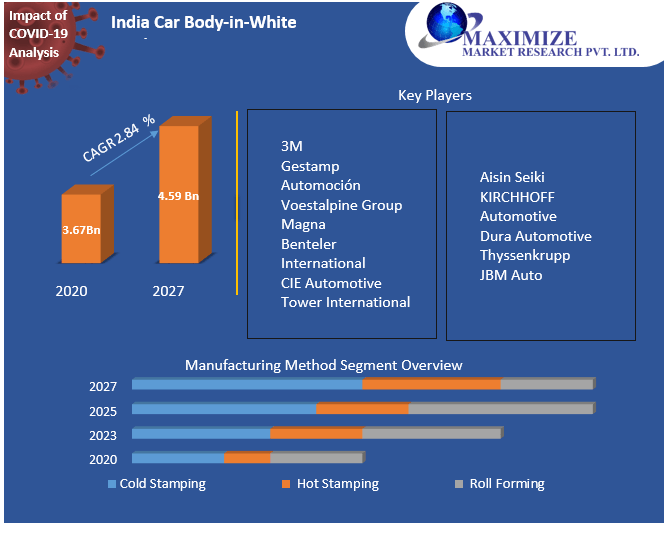
Market Valuation: The market was valued at US$ 3.67 billion in 2020 and is projected to grow at a CAGR of 2.84% through 2027.
Primary Growth Drivers: Stringent BS-VI emission standards, the integration of lightweight materials, and the rapid adoption of electric vehicles (EVs).
Technological Shift: Transition from traditional cold stamping to hot stamping and roll forming to meet crashworthiness and weight reduction mandates.
Competitive Landscape: Heavy reliance on global partnerships and local manufacturing capabilities, with key players including Gestamp Automoción, Magna, and JBM Auto.
Why This Matters Now
The Body-in-White—the stage in automotive manufacturing where a car’s frame is joined before painting and sub-assembly—is no longer a passive structural requirement. It is now the primary determinant of a vehicle’s range and safety profile. As the industry grapples with the ICE-to-EV transition, the BIW must accommodate heavy battery packs while maintaining chassis rigidity. OEMs failing to innovate their structural assembly processes face immediate obsolescence as competitors leverage lightweight composites and precision digital manufacturing to meet increasingly rigid emissions and safety regulations.
Market Overview
The Indian BIW market is navigating a complex landscape defined by supply chain globalization and rigorous regulatory mandates. Despite temporary demand contractions caused by pandemic-related disruptions, the sector is experiencing a period of renewed investment.
The mandate for BS-VI standards has compelled manufacturers to overhaul production lines, focusing on higher efficiency and lower CO2 footprints. This shift has forced a departure from outdated assembly methods, pushing engineers toward 3D CAD modeling, 3D scanning, and reverse engineering to optimize the crashworthiness of passenger vehicle structures.
Key Trends Driving Growth
The industry is pivoting toward three core pillars:
Lightweighting: The hunt for high-strength steel, aluminum, and magnesium alloys is intense. Reducing vehicle weight is no longer an engineering preference but a commercial necessity for meeting range requirements in the EV segment.
Digitalization of Manufacturing: The rise of “digital workshops” is transforming how BIW components are conceptualized and produced. Firms like ThyssenKrupp are setting the pace by using software solutions to handle multi-flexible production lines that can adapt to a vast variety of vehicle models on a single floor.
Regulatory Compliance: As government establishments enforce stricter CO2 emission limits, builders are integrating cleaner technologies into the production process itself, moving beyond the vehicle’s end-use performance to its total lifecycle impact.
Segment Insights
Dominant Segment: Passenger Vehicles remain the primary consumer of BIW solutions, driven by the persistent volume demand for personal mobility.
Manufacturing Method Trends: While cold stamping remains standard, hot stamping is the fastest-growing method, essential for creating complex, high-strength geometries required for modern crash safety standards.
Material Trends: The industry is witnessing a gradual shift away from traditional steel-only compositions toward aluminum and advanced composites to balance strength and weight requirements.
Regional Growth Story
The Indian market is fragmented by regional manufacturing hubs, with North, South, West, and East India each playing a distinct role in the supply chain. Manufacturers are increasingly utilizing government-backed initiatives, such as reduced trade tariffs and localized manufacturing incentives, to foster a competitive advantage. The focus is on attracting foreign direct investment by creating specialized automotive clusters that prioritize high-output, low-cost assembly processes.
Competitive Landscape
The competitive environment in the Indian BIW market is characterized by high-stakes consolidation, with key players—including 3M, Gestamp Automoción, Voestalpine Group, Magna, Benteler International, CIE Automotive, Tower International, Martinrea International, Aisin Seiki, KIRCHHOFF Automotive, Dura Automotive, Thyssenkrupp, and JBM Auto—investing heavily in operational joint ventures and M&A.
This activity signals a move toward global standardization. Strategic partnerships are being used to gain access to proprietary software for digital process planning and the latest in crash-safety testing equipment. By focusing on multi-flexible manufacturing, these incumbents are positioning themselves to provide “top hats”—modular structures—that can be adapted for multiple vehicle architectures, significantly reducing R&D costs for OEM clients.
Recent Developments
M&A and JVs: Expansion of joint ventures to strengthen localized supply chains and increase customer bases.
Infrastructure Investment: Growth in the number of digital workshops equipped with AI-driven CAD and 3D simulation tools to reduce manufacturing lead times.
R&D Focus: Increased collaboration between automotive manufacturers and engineering firms for custom structural facilities to test lightweight projects.
Strategic Implications
For stakeholders, the implication is clear: modularity is the new currency. The complexity of modern BIW, particularly for EVs, requires manufacturers to manage high-strength material combinations and complex geometrics without sacrificing production speed. Companies that ignore the shift toward digital-first, flexible assembly lines will find their manufacturing costs ballooning as they attempt to reconcile legacy production techniques with next-generation vehicle requirements.
Future Outlook
The transition to EV-centric BIW design will be the definitive marker of success for market participants. The market will split between those who successfully implement high-speed, automated, and lightweight-focused assembly processes and those trapped in traditional, labor-intensive, and less-efficient production models. Future market leaders will be those who master the art of integrating disparate battery packaging requirements into the fundamental structure of the vehicle, turning the BIW from a static frame into a smart, modular platform.
Analyst Perspective
“The India Car Body-in-White market is evolving from a foundational manufacturing sector into a high-tech engineering discipline. As manufacturers prioritize crash-safety, lightweighting, and EV-readiness, the adoption of digital process planning and advanced material sciences will dictate who leads the industry by 2027.” — Tejaswini Kakade, Analyst at Maximize Market Research.
About Maximize Market Research
Maximize Market Research Pvt. Ltd. (MMR) is a global market research and consulting company that provides reliable, data-focused, and practical business insights. The firm serves a wide range of industries, including healthcare, pharmaceuticals, technology, automotive, electronics, chemicals, personal care, and consumer goods. Through market forecasts, competitive analysis, strategic consulting, and industry impact assessments, MMR helps organizations understand changing market conditions, identify growth opportunities, and make informed business decisions for long-term success.
2nd Floor, Navale IT Park Phase 3
Pune Banglore Highway, Narhe
Pune, Maharashtra 411041, India
+91 9607365656
sales@maximizemarketresearch.com
