Key Highlights
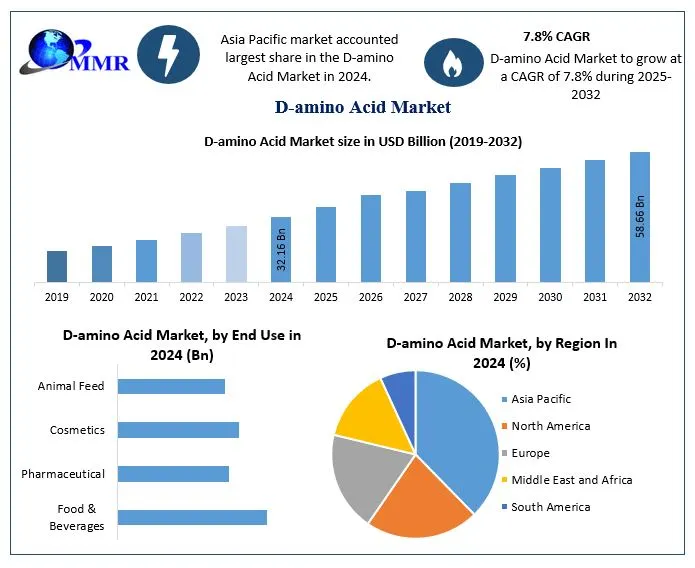
- Global market valued at USD 32.16 billion in 2024.
- Market projected to reach USD 58.66 billion by 2032.
- Expected CAGR stands at 7.8% during 2025–2032.
- Pharmaceutical applications remain the largest revenue contributor.
- Asia Pacific dominates global production and consumption.
- Peptide therapeutics continue to expand commercial demand.
- Cosmetic and functional food applications are creating new revenue streams.
- Pharmaceutical manufacturing expansion in China, India, and Japan strengthens regional supply.
Why This Matters Now
Healthcare manufacturers are increasing investments in peptide-based medicines, biologics, and specialty therapeutics. These products depend heavily on high-purity D-amino acids for stability, efficacy, and synthesis. At the same time, consumer demand for functional nutrition, sports supplements, and premium cosmetics is expanding commercial applications beyond pharmaceuticals. Companies capable of ensuring consistent quality, regulatory compliance, and large-scale production are positioned to capture higher-value contracts across healthcare, food, and personal care industries.
Market Overview
The D-amino Acid Market comprises chiral amino acid compounds widely used in pharmaceutical synthesis, peptide production, cosmetics, food ingredients, animal nutrition, and biotechnology applications. Unlike naturally occurring L-amino acids, D-amino acids provide enhanced stability and biological activity, making them valuable building blocks for advanced therapeutics.
Pharmaceutical manufacturing remains the primary demand center. Peptide-based medicines for cancer, neurological disorders, metabolic diseases, and pain management increasingly incorporate D-amino acids to improve drug performance and resistance to enzymatic degradation.
Growing healthcare expenditure, expanding pharmaceutical production, and increasing investments in biotechnology are strengthening global demand. Rising consumer awareness of preventive healthcare also supports greater use in nutritional supplements and functional foods.
Supply remains concentrated among manufacturers with advanced fermentation and chemical synthesis capabilities. Asia Pacific continues to benefit from lower production costs, established pharmaceutical infrastructure, and expanding export capacity.
Key Trends Driving Growth
Expansion of peptide therapeutics
The rapid development of peptide drugs increases demand for specialty D-amino acids. Pharmaceutical companies benefit from improved therapeutic stability and longer drug activity.
Growing cosmetic applications
Dermatology and skincare manufacturers increasingly formulate products using D-amino acids for moisturization, wrinkle reduction, and skin repair. Premium cosmetic brands gain product differentiation through scientifically validated ingredients.
Increasing functional food adoption
Food manufacturers are introducing peptide-based ingredients that support sports nutrition, recovery, and wellness. Rising health awareness continues to expand commercial opportunities.
Advances in production technologies
Improved synthesis methods reduce manufacturing costs while increasing purity levels. Higher production efficiency enables suppliers to meet growing pharmaceutical quality requirements.
Global pharmaceutical manufacturing expansion
China, India, Japan, Europe, and North America continue investing in pharmaceutical production capacity. This strengthens long-term demand for pharmaceutical-grade amino acids and related intermediates.
Explore detailed analysis, insights, and growth opportunities
Segment Insights
Dominant Segment: Pharmaceutical
The pharmaceutical segment accounts for the largest market share.
D-amino acids are essential intermediates for peptide synthesis, antibiotic production, Alzheimer’s therapies, oncology treatments, and advanced biologics. Their ability to improve molecular stability and therapeutic effectiveness makes them indispensable in modern drug development.
Growing investments in biotechnology and precision medicine directly translate into higher consumption of pharmaceutical-grade D-amino acids. Suppliers capable of meeting stringent quality standards gain long-term contracts with global drug manufacturers.
Business impact: Pharmaceutical expansion creates higher-margin opportunities and long-term demand stability for manufacturers.
Fastest-Growing Segment: Cosmetics
Cosmetics represent the fastest-growing application.
Manufacturers increasingly incorporate D-amino acids into anti-aging creams, moisturizers, therapeutic skincare products, and premium dermatology formulations. Consumers continue shifting toward scientifically backed ingredients with proven skin health benefits.
Business impact: Cosmetic applications diversify revenue beyond healthcare while increasing demand for specialty amino acid formulations.
Additional Key Sub-segments
Food & Beverages
D-amino acid-containing peptides are increasingly used as sweeteners and functional ingredients. Growing demand for sports nutrition and wellness products supports continued market expansion.
Animal Feed
Livestock producers utilize amino acid supplementation to improve feed efficiency, animal health, and nutritional performance. Commercial farming continues to generate consistent demand.
Product Categories
D-Alanine, D-Glutamic Acid, D-Aspartic Acid, D-Methionine, D-Tryptophan, D-Leucine, D-Phenylalanine, D-Valine, and D-Threonine collectively support pharmaceutical synthesis, industrial biotechnology, food processing, and research applications.
Regional Growth Story
Asia Pacific
Asia Pacific leads the global market. China remains the largest production hub due to its extensive pharmaceutical manufacturing ecosystem. India and Japan continue expanding biotechnology investments, strengthening regional competitiveness. Lower manufacturing costs and established export networks reinforce the region’s leadership.
North America
North America benefits from advanced pharmaceutical research, peptide drug development, and biotechnology innovation. Growing R&D expenditure supports demand for specialty amino acids used in high-value therapeutics.
Europe
Europe maintains steady growth through pharmaceutical manufacturing, food innovation, and cosmetic production. Strong regulatory standards encourage production of high-purity amino acids for healthcare applications.
Middle East, Africa, and South America
These regions continue expanding pharmaceutical manufacturing and healthcare infrastructure. Increasing healthcare investment creates emerging opportunities for amino acid suppliers seeking geographic diversification.
Competitive Landscape
The D-amino Acid Market remains moderately consolidated, with competition centered on production quality, technological capabilities, pharmaceutical partnerships, and manufacturing scale.
Evonik Industries AG maintains a strong competitive position through advanced specialty chemical manufacturing and pharmaceutical-grade amino acid production.
Asian manufacturers including Zhangjiagang Huachang Pharmaceutical Co. Ltd., Sichuan Tongsheng Amino Acid Co., Ltd., Sekisui Medical Co. Ltd., and Kyowa Hakko Kirin Co. Ltd. benefit from integrated pharmaceutical manufacturing ecosystems and cost-efficient production.
Specialty chemical and research suppliers such as Tokyo Chemical Industry Co., Ltd., AnaSpec, Inc., Sigma-Aldrich Co. LLC, IRIS Biotech GmbH, Prinova Group LLC, and Daesang Corporation strengthen competition by serving pharmaceutical research, biotechnology, and laboratory markets.
Competitive advantage increasingly depends on manufacturing efficiency, pharmaceutical compliance, product purity, and long-term supply agreements rather than pricing alone.
Recent Developments
- Market participants continue investing in advanced production technologies to reduce manufacturing time and improve process efficiency.
- Companies are strengthening research activities focused on next-generation peptide synthesis and specialty amino acid applications.
- Strategic collaborations, supply chain agreements, mergers, and acquisitions remain central expansion strategies among leading manufacturers.
- Pharmaceutical manufacturers continue expanding production capacity across Asia Pacific to support increasing peptide drug demand.
Analyst Perspective – Komal Patil
The D-amino Acid Market is transitioning from a specialty chemical segment into a strategic component of modern pharmaceutical manufacturing. Demand is increasingly linked to peptide therapeutics, biologics, and precision medicine rather than traditional industrial applications. Manufacturers investing in high-purity production, advanced synthesis technologies, and regulatory compliance will secure stronger positions as pharmaceutical companies prioritize reliable global supply chains. Expansion into cosmetics, nutraceuticals, and functional foods further diversifies revenue opportunities while reducing dependence on a single end-use industry.
Future Outlook
Companies that combine pharmaceutical-grade manufacturing capabilities with innovation in peptide synthesis and global supply partnerships will define the next phase of leadership in the D-amino Acid Market.
About Maximize Market Research
Maximize Market Research Pvt. Ltd. (MMR) is a global market research and consulting company that provides reliable, data-focused, and practical business insights. The firm serves a wide range of industries, including healthcare, pharmaceuticals, technology, automotive, electronics, chemicals, personal care, and consumer goods. Through market forecasts, competitive analysis, strategic consulting, and industry impact assessments, MMR helps organizations understand changing market conditions, identify growth opportunities, and make informed business decisions for long-term success.
Contact Us :
2nd Floor, Navale IT Park Phase 3
Pune Banglore Highway, Narhe
Pune, Maharashtra 411041, India
+91 9607365656
sales@maximizemarketresearch.com
