Key Highlights
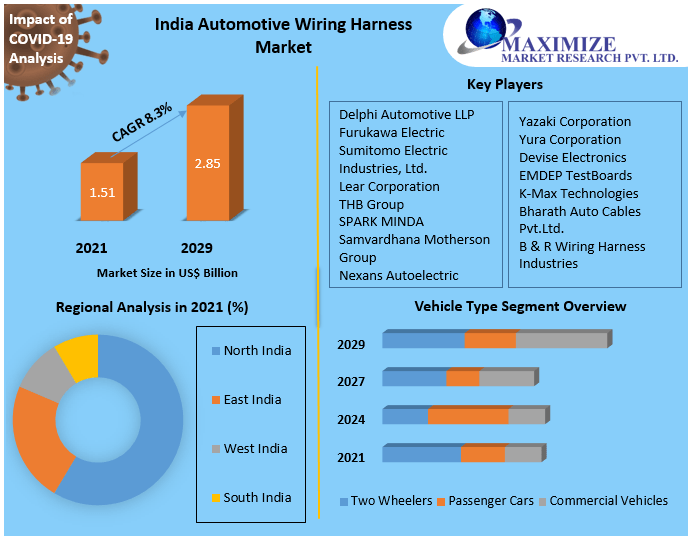
India Automotive Wiring Harness Market is valued at US$ 1.51 billion in 2021 and is expected to reach US$ 2.85 billion by 2029, growing at a CAGR of 8.3%, signaling strong, sustained demand for electrical connectivity as India’s vehicle parc expands.
Rising electrification, active safety features, and connectivity in passenger and commercial vehicles are pushing harness content per vehicle higher, increasing value even in mature ICE platforms.
Domestic and global OEMs are localizing wiring harness sourcing in India, creating strategic opportunities for Tier-1 and specialist suppliers with design, validation, and high-volume manufacturing capabilities.
EV programs and higher-voltage architectures are reshaping harness specifications, driving demand for advanced materials, improved insulation, and robust high-voltage assemblies.
Why This Matters Now
India’s automotive sector is in the middle of a structural transition: vehicle volumes are rising, EV and hybrid programs are scaling, and connected, software-rich models are moving mainstream. The wiring harness sits at the center of this transformation, acting as the nervous system that links sensors, controllers, and powertrain components.
For OEMs and Tier-1 suppliers, an 8.3% CAGR through 2029 in harness demand is more than a growth story; it signals that every new vehicle architecture decision—EV, ICE, hybrid, or SDV—has direct implications for wiring complexity, sourcing strategies, and cost. Investors and fleet operators see wiring harness robustness as a proxy for reliability in safety-critical and high-uptime fleets.
Market Overview
The India Automotive Wiring Harness Market, growing from US$ 1.51 billion in 2021 to an expected US$ 2.85 billion by 2029, is riding a broad wave of automotive expansion and technology upgrades. This growth mirrors increasing vehicle production across passenger cars, two-wheelers, commercial vehicles, and emerging EV segments.
Wiring harnesses, once treated as low-visibility commodities, are now strategic components because they determine how reliably power and data flow through increasingly complex vehicles. As OEMs add ADAS, infotainment, telematics, and power electronics, harness architectures must support more circuits, higher data rates, and stricter safety requirements.
Key Trends Driving Growth
The first major change is the shift toward electrified and feature-rich vehicles, which significantly increases harness content per unit. EVs, hybrids, and vehicles with advanced infotainment and ADAS depend on dense networks of cables, connectors, and terminals that handle both power and high-speed communication.
The second trend is India’s growing role as a global manufacturing base. As multinational OEMs scale production in India for domestic and export markets, they push harness suppliers to meet global standards in performance, weight optimization, and electromagnetic compatibility. This raises the bar for local suppliers and encourages capacity additions and technology upgrades.
A third trend is regulatory tightening around safety and emissions. As vehicles incorporate more sensors, controllers, and diagnostic modules to comply with safety, crash, and emission norms, harness designs must accommodate more nodes and provide reliable power and data paths. This regulatory environment effectively hardwires demand for higher-quality harness solutions.
Request a Free Sample Copy or View Report Summary: https://www.maximizemarketresearch.com/request-sample/43390/
Segment Insights
Dominant Segment – Passenger Vehicle Wiring Harness
Passenger vehicles typically constitute the largest share of wiring harness demand, driven by high production volumes and rapid feature upgrades.
With rising adoption of connected infotainment, telematics, and advanced safety systems in Indian cars, passenger vehicle harnesses gain value and complexity, making them a primary focus for design innovation and localization.
Fastest-Growing Segment – EV and High-Voltage Harnesses
EV and hybrid powertrains require specialized high-voltage harness assemblies, often with enhanced insulation, shielding, and thermal performance.
As India’s EV programs expand in passenger and commercial segments, high-voltage harnesses are expected to grow faster than conventional ICE harnesses, creating a new product line for capable Tier-1 suppliers.
Application Layers – Engine, Body, and Chassis Harness
Engine harnesses remain critical in ICE vehicles but face gradual redefinition as powertrains electrify and control modules proliferate.
Body and chassis harnesses see content growth from ADAS, convenience features, and connectivity—power windows, lighting, sensors, and control units—which are becoming standard even in mass-market models.
Regional Growth Story
India itself is the focus market, but its wiring harness growth cannot be separated from the global automotive hubs it serves, particularly the United States, Europe (Germany), China, Japan, and South Korea. Vehicles assembled in India for export carry harness systems that must be compliant with destination market regulations and OEM global platforms.
Japanese and Korean OEMs with strong bases in India drive specific harness standards and supplier development programs, while European and American OEMs push for harmonized global architectures. India’s harness suppliers that can align with these requirements gain access to export opportunities and multi-region platform programs.
China and other Asian manufacturing centers provide competitive pressure and alternative sourcing options, forcing Indian suppliers to differentiate through cost, quality, and responsiveness. As supply chains diversify, India has the opportunity to become a key node in global harness supply—if capacity, quality, and technology investments keep pace.
Competitive Landscape
The India automotive wiring harness market features a mix of global Tier-1s, domestic champions, and specialized SMEs. Global players bring platform experience, advanced engineering, and testing capabilities, while domestic suppliers bring cost efficiency, localization strengths, and agile manufacturing.
OEM strategies increasingly favor suppliers that can provide end-to-end solutions: design from electrical schematics, wire size calculations, connector and terminal selection, prototyping, validation, and mass production. This shifts the competitive field away from simple assembly toward integrated engineering and manufacturing services.
For technology leadership, suppliers investing in lightweight materials, high-voltage harness design, ADAS and data harnesses, and robust process automation will gain pricing power. Those stuck in low-margin, commodity harness production risk being sidelined as OEMs consolidate their supplier base around high-capability partners.
Recent Developments
OEMs are broadening EV and hybrid portfolios in India, prompting harness suppliers to develop high-voltage and battery pack harness solutions tailored to local driving and climate conditions.
Several Indian wiring harness manufacturers are adding new lines and upgrading tooling to meet rising demand and global quality standards, particularly for export programs.
Design and engineering service offerings are expanding, with suppliers offering co-development with OEMs for new vehicle platforms, reducing time-to-market and integration risks.
Automation and quality control investments—such as advanced testing benches, automated cutting and crimping, and digital traceability—are becoming more common among larger suppliers, signaling a move toward higher process maturity.
Strategic Implications
For OEMs, wiring harness strategy is now tied directly to platform architecture, EV ramp-up, and software-defined vehicle design. Choosing the right harness partners affects not only cost and quality, but also the ability to integrate new features quickly and manage complexity as software content rises.
Tier-1 suppliers face a strategic fork: either stay on basic, low-value harnesses and risk margin erosion, or move into high-voltage, ADAS, and connectivity harness segments that align with electrification and SDV trends. The latter path demands investment in engineering talent, materials R&D, and advanced testing capabilities.
For investors, the 8.3% CAGR through 2029 indicates that wiring harness providers aligned with EV and connectivity shifts could offer attractive growth and export potential. Meanwhile, fleet operators and mobility platforms depend on harness reliability for uptime; poor harness quality can translate into electrical faults, sensor failures, and higher maintenance costs, directly impacting mobility economics.
Future Outlook
By 2029, India’s automotive wiring harness market is expected to reach US$ 2.85 billion, driven by vehicle volume growth, electrification, and connectivity gains. As EV penetration increases and SDV architectures mature, wiring harnesses will carry more power and data, pushing suppliers toward high-voltage, high-bandwidth solutions and tighter integration with software and semiconductor ecosystems.
Leading OEMs and suppliers will treat harness design as a core part of vehicle architecture, investing in co-development, advanced materials, and modular harness platforms that support rapid feature updates and multiple powertrain types. Laggards that continue to treat harnesses as low-value, commodity components—without upgrading engineering, process, and technology capabilities—will find themselves excluded from next-generation EV, ADAS-rich, and connected vehicle platforms.
Related Reports
VVT and StartStop Systems Market https://www.maximizemarketresearch.com/market-report/vvt-start-stop-systems-market/2899/
Global Artificial Intelligence (AI) in Automotive Market https://www.maximizemarketresearch.com/market-report/artificial-intelligence-ai-automotive-market/1752/
Global Cargo Handling Equipment Market https://www.maximizemarketresearch.com/market-report/global-cargo-handling-equipment-market/10972/
Analyst Perspective
“India’s wiring harness industry is moving from basic commodity production to a strategic role in EV, safety, and connected vehicle architectures,” said Tejaswini Kakade, lead analyst for the India Automotive Wiring Harness Market. “Suppliers who invest in high-voltage, ADAS, and software-ready harness solutions will be the ones that ride the next decade of growth in India’s automotive sector.”
About Maximize Market Research
Maximize Market Research Pvt. Ltd. (MMR) is a global market research and consulting company that provides reliable, data-focused, and practical business insights. The firm serves a wide range of industries, including healthcare, pharmaceuticals, technology, automotive, electronics, chemicals, personal care, and consumer goods. Through market forecasts, competitive analysis, strategic consulting, and industry impact assessments, MMR helps organizations understand changing market conditions, identify growth opportunities, and make informed business decisions for long-term success.
2nd Floor, Navale IT Park Phase 3
Pune Banglore Highway, Narhe
Pune, Maharashtra 411041, India
+91 9607365656
sales@maximizemarketresearch.com
