Key Highlights
The Rebound Phase: By mid-2026, battery-electric vehicles (BEVs) command a 24–26% market share of new registrations, with monthly peaks reaching 32%.
Consumer Shift: Private buyer registrations surged by 85% in April 2026, signaling a definitive move away from fleet-dominated adoption to broad retail acceptance.
Market Growth: Q1 2026 saw a 41.3% increase in BEV registrations, totaling 159,630 units, outperforming the overall market’s modest 5.2% growth.
Manufacturing Expansion: Tesla and Volkswagen have accelerated domestic cell production, targeting 18 GWh and 20–40 GWh annual capacities, respectively.
Why This Matters Now
Germany’s electric mobility sector has evolved from a policy-dependent niche into a self-sustaining industrial engine. The 2026 “rebound phase” proves that the market can maintain momentum even as legacy subsidies fade, demonstrating that vehicle affordability, increased model variety, and charging democratization have become the new primary drivers. For investors and stakeholders, this shift signals that the German automotive ecosystem is no longer merely “transitioning” but is actively capturing the next phase of global electrification scale.
Market Overview
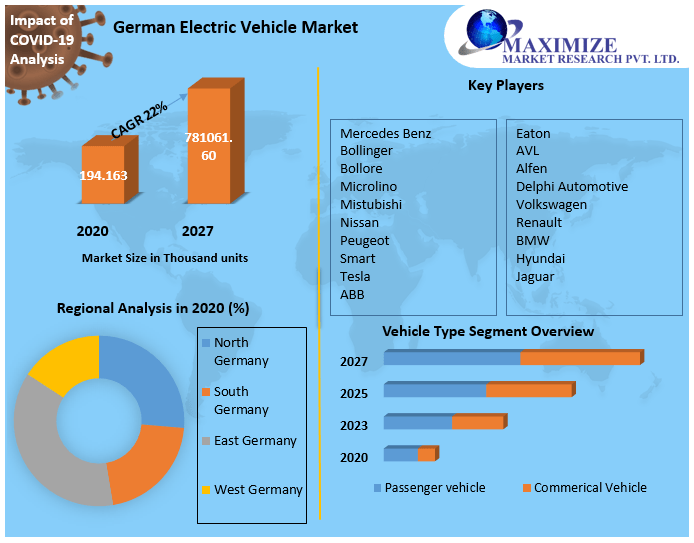
In 2026, Germany solidified its role as Europe’s largest Electric Vehicle Market and the world’s second-largest EV producer. The recovery from the late-2023 subsidy cliff was driven by a sharp 6% decline in average BEV prices and a substantial expansion in model availability, which grew from 17 to 29 compact models in just two years. This maturity is reflected in the registration data, where private buyers now account for over 32% of the market, effectively flipping the historical trend of corporate-led adoption.
Key Trends Driving Growth
Democratization of Charging: The federal government’s €500 million residential charging initiative is targeting the “apartment-dweller gap,” providing subsidies for pre-cabling and bidirectional wallboxes. This addresses the single largest barrier to retail EV adoption in Germany’s dense urban centers.
Vertical Integration: Automakers are aggressively pursuing battery sovereignty. By bringing standardized “Unified Cell” production and high-format 4680-cell manufacturing in-house, OEMs are cutting costs by up to 50%, allowing for more aggressive retail pricing.
Competitive Landscape Shift: While Volkswagen and Skoda lead in volume, Chinese entrants are posting triple-digit percentage growth, forcing domestic incumbents to accelerate software-defined vehicle (SDV) development and feature-set differentiation.
Get a free sample
Segment Insights
Dominant Segment (Propulsion): Battery Electric Vehicles (BEVs) are the undisputed market leaders, currently accounting for approximately 25% of all new passenger car registrations.
Fastest-Growing Segment (Consumer Type): Private Buyers are the fastest-growing segment, having surged past fleet procurement to become the primary driver of 2026 registration growth.
Leading Vehicle Class: The Compact/Small car segment has seen the most significant expansion, with model availability nearly doubling, catering directly to the middle-income demographic now targeted by recent federal incentives.
Regional Growth Story
Southern Germany—specifically the industrial hubs of Munich and Stuttgart—remains the epicenter of EV production and innovation. However, the Western region, including Cologne and Frankfurt, is seeing the highest infrastructure utilization rates due to the density of its highway networks. This regional divide is shrinking as the federal residential charging push prioritizes multi-unit dwellings in densely populated urban centers nationwide, ensuring that EV readiness is no longer tied to specific regional geography.
Competitive Landscape
The German market is a high-stakes arena where legacy brand equity is being tested against rapid innovation. Volkswagen remains the volume leader, but the success of the Skoda Elroq and the rapid recovery of Tesla model registrations signal that German consumers are prioritizing software integration and energy efficiency over traditional branding.
The competitive landscape is defined by “vertical control.” Tesla’s $250 million expansion in battery production and VW’s ramp-up of its battery subsidiary indicate that the winners of this cycle are those who control the battery value chain. Chinese brands, while still smaller in total volume, are growing at over 200%, using aggressive pricing and high-tech cabin features to erode the margins of premium German models. For Tier-1 suppliers, this means the pressure to deliver “smart” components—ranging from intelligent power electronics to modular thermal management systems—has never been higher.
Recent Developments
Battery Capacity Ramps: Tesla and VW are significantly increasing domestic battery cell production to 18 GWh and 20–40 GWh, respectively, reducing the reliance on Asian imports.
Residential Incentives: A new federal “E-Auto-Prämie” and the residential charging subsidy program have provided the necessary retail push to sustain sales volume through 2026.
New Entrant Success: The Skoda Elroq has emerged as a top-selling model, proving that mid-market, affordable BEVs are the key to capturing the next layer of the retail consumer market.
Strategic Implications
For OEMs, the message is clear: software-defined vehicles and battery cost parity are now the only paths to volume sustainability. The era of relying on government handouts is over; success in 2026 and beyond requires the ability to manufacture high-density batteries domestically and integrate user-centric software ecosystems that match the expectations of a consumer-driven market. Suppliers that fail to align their R&D with these two priorities risk being displaced by more agile, vertically integrated competitors.
Future Outlook
Germany has successfully navigated the “innovator” phase of EV adoption and is now entering a period of industrial maturity where scale and cost-efficiency dictate success. The market leaders will be those who master the full vertical integration of the battery cell and vehicle software, effectively reducing the “cost-to-consumer” gap to match ICE-vehicle pricing. Those who remain hesitant, or who continue to rely on fragmented, outsourced electric architectures, will find their market share rapidly depleted by both aggressive domestic innovators and high-growth global disruptors.
Analyst Perspective
“Germany has moved past the ‘subsidies-or-bust’ era. We are now seeing a market where consumer choice, driven by competitive pricing and model variety, is the primary force. The battle for leadership is no longer about who can sell the most EVs, but who can build them the most efficiently while maintaining total control over the digital and battery ecosystems,” states Tejaswini Kakade, Analyst at Maximize Market Research.
About Maximize Market Research
Maximize Market Research Pvt. Ltd. (MMR) is a global market research and consulting company that provides reliable, data-focused, and practical business insights. The firm serves a wide range of industries, including healthcare, pharmaceuticals, technology, automotive, electronics, chemicals, personal care, and consumer goods. Through market forecasts, competitive analysis, strategic consulting, and industry impact assessments, MMR helps organizations understand changing market conditions, identify growth opportunities, and make informed business decisions for long-term success.
2nd Floor, Navale IT Park Phase 3
Pune Banglore Highway, Narhe
Pune, Maharashtra 411041, India
+91 9607365656
sales@maximizemarketresearch.com
