Key Highlights
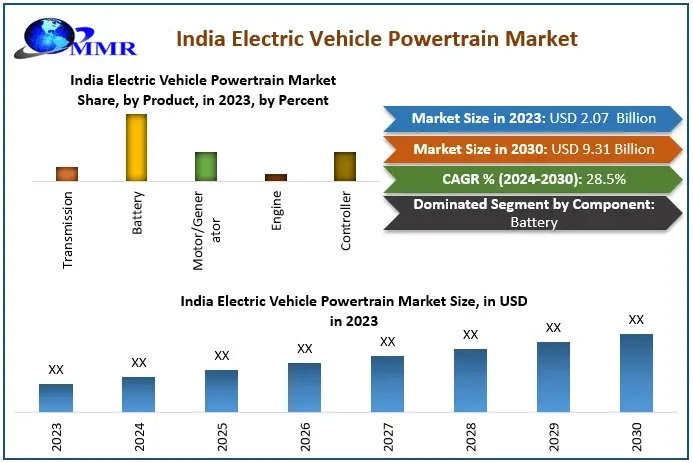
India Electric Vehicle Powertrain Market is expected to reach USD 9.31 billion by 2030, at a CAGR of 28.5% over the forecast period; powertrain moves from niche to core growth engine in India’s auto sector.
Sustained 28.5% annual expansion forces OEMs and Tier‑1s to re‑prioritize capital from ICE engines and transmissions to motors, inverters, and battery‑centric architectures.
Domestic powertrain capacity becomes critical for India’s broader EV ambitions, influencing cost curves, technology ownership, and export readiness.
The market spans two‑wheeler, three‑wheeler, passenger, and commercial EVs, making India a multi‑segment lab for scalable, low‑cost powertrain platforms.
Policy incentives and “Make in India” imperatives raise the stakes for localization of high‑value EV sub‑systems instead of long‑term dependence on imported kits.
Why This Matters Now
A powertrain market growing at 28.5% annually to USD 9.31 billion by 2030 is no side business; it is the new heart of India’s automotive industrial strategy. That growth compresses multiple cycles of engine‑to‑e‑motor technology transition into a single decade.
For boardrooms, this changes the capital allocation logic. Investments that once flowed into ICE engine plants, gearboxes, and fuel systems now need to chase traction motors, inverters, power electronics, and battery‑centric vehicle architectures. Miss the turn, and an OEM or Tier‑1 risks watching its legacy portfolio lose relevance while new players seize the emerging EV value pools.
Market Overview
India’s EV powertrain opportunity is being driven by three converging forces: accelerating EV demand, national decarbonization and import‑reduction goals, and a policy push to build domestic manufacturing depth. A 28.5% CAGR to 2030 signals durable structural change, not a short‑lived policy bump.
Powertrain in this context goes well beyond motors. It includes inverters, DC‑DC converters, power distribution units, gear reduction units or e‑axles, battery interface components, and the software layers that manage torque, efficiency, and diagnostics. As volumes rise, the balance of value in a vehicle tilts toward these electric and electronic subsystems rather than mechanical ICE hardware.
Key Trends Driving Growth
What changed first is the policy and cost narrative around EVs. Central and state incentives, combined with improving battery economics and growing urban use cases, gave EVs a credible total‑cost‑of‑ownership advantage in two‑ and three‑wheelers and an emerging edge in selected passenger and fleet segments. That advantage pulls demand through the powertrain stack.
Second, India is moving from import‑led to capability‑led growth. Early EV models leaned heavily on imported powertrain kits. The new wave is leaning into localization of motors, inverters, and control units, supported by design centers and testing facilities in India. This reduces forex outflow and creates a platform for exports.
Third, software is fusing with hardware faster than expected. Torque vectoring, regenerative braking, thermal management, and predictive maintenance sit increasingly in code rather than metal. Powertrain control software, calibration stacks, and OTA‑capable controllers are turning what used to be a “black box” component into a continuous performance‑tuning platform.
Request a Free Sample Copy or View Report Summary: https://www.maximizemarketresearch.com/request-sample/20097/
Segment Insights
Dominant Segment — Core Traction Motor and Inverter Assemblies
Motors and inverters together form the beating heart of the EV powertrain, capturing the largest share of system value as each EV sold needs a reliable, high‑efficiency drivetrain.
For OEMs, control over motor and inverter supply—through in‑house design or deep partnerships—determines vehicle performance, efficiency, and ability to differentiate driving feel.
Fastest‑Growing Segment — Integrated e‑Axles and Power Electronics Packages
As platforms mature, integrated e‑axles and consolidated power electronics (combining inverter, DC‑DC, and charger) are gaining share by reducing weight, cost, and assembly complexity.
This integration raises the bar for Tier‑1 suppliers and opens room for new entrants that can co‑optimize hardware and software to deliver higher efficiency at lower cost.
Other Critical Segments
Battery‑to‑powertrain integration hardware and software—BMS to inverter communication, high‑voltage junction boxes, safety and isolation components—are emerging as key differentiation areas.
Aftermarket and remanufacturing for motors, inverters, and power electronics will grow as early EV cohorts age, reshaping service networks and component life‑cycle models.
Regional Growth Story
India is the focal geography, but the country’s EV powertrain pathway is tightly linked with global hubs like China, South Korea, Japan, Europe, and the US through cells, semiconductors, magnets, and design IP. India’s aim is clear: reduce structural dependence on imported powertrain content while tapping global technology.
Within India, high‑adoption states and metropolitan clusters—where EV penetration, charging density, and policy support are strongest—will become anchor markets for localized powertrain production. Plants set up near these demand clusters can serve both domestic OEMs and, over time, export programs into other price‑sensitive markets in Asia, Africa, and Latin America.
This regional mosaic has strategic consequences. Powertrain suppliers that embed early in key Indian automotive hubs can leverage logistics, skilled labor, and ecosystem partners, building scale advantages that are hard for late entrants to replicate.
Competitive Landscape
The competitive dynamic is shifting from a few global powertrain incumbents to a more open field where domestic engineering houses, start‑ups, and joint ventures compete for platform slots. Established engine and transmission suppliers are repositioning toward e‑axles, motors, and power electronics, but they face cultural and technical transitions.
OEMs are making strategic choices on vertical integration. Some are pulling critical powertrain components in‑house to protect IP and ensure supply, while others are leaning on specialist Tier‑1s to share risk and accelerate time‑to‑market. Those choices will shape who owns technology leadership and pricing power by 2030.
New players focused on inverters, SiC and GaN‑based power modules, and compact e‑axles are using India as a scale market for cost‑optimized designs. Their success would signal a break from traditional supply hierarchies and could push legacy suppliers to either acquire capabilities or risk marginalization in the EV era.
Recent Developments
Announcements of new or expanded motor and inverter manufacturing lines tailored to India‑specific duty cycles and ambient conditions.
Joint ventures between Indian OEMs and international technology partners to co‑develop e‑axles, power electronics, and control software for local platforms.
Increased investment in validation, testing, and calibration centers to handle high‑voltage systems and durability requirements across India’s diverse climates.
Moves by semiconductor and materials players to deepen presence in India’s automotive hubs, supporting power module, controller, and sensor demand.
Early pilots of advanced software features—such as over‑the‑air drivability updates and energy‑optimization algorithms—linked tightly with the powertrain control stack.
Strategic Implications
For OEMs, the India Electric Vehicle Powertrain Market is no longer just a procurement catalog; it is a core piece of brand and margin strategy. Owning or tightly governing powertrain tech allows better energy efficiency, unique drive characteristics, and a smoother path to software‑defined services. Without that control, vehicle makers risk commoditization.
Tier‑1 suppliers must decide whether to double down on hardware scale or evolve into full system partners that combine hardware, embedded software, and lifecycle services. The winners are likely to be those that can co‑design with OEMs, support multiple vehicle classes, and localize aggressively while keeping a technology bridge to global R&D centers.
Fleet operators and mobility platforms will feel the impact through TCO, uptime, and flexibility. High‑quality, locally supported powertrains reduce downtime and enable more granular energy and maintenance management—vital for ride‑hailing, logistics, and public transport fleets betting on electrification. Poorly chosen or weakly supported powertrain stacks, by contrast, will show up as unexpected maintenance bills and lost revenue hours.
Future Outlook
By 2030, a USD 9.31 billion India EV powertrain market growing at 28.5% annually will have rewired how vehicles are designed, sourced, and serviced in the country. Powertrain choices made over the next three to five years will lock in platform economics and technology trajectories well into the 2030s.
As software‑defined vehicles gain ground, powertrain hardware will increasingly serve as a high‑value but reconfigurable platform for new features, business models, and performance upgrades delivered via code. The future leaders will be OEMs and suppliers that treat India as a core design and manufacturing base for integrated, software‑rich powertrains—laggards will be those that keep betting on legacy ICE portfolios and bolt‑on EV adaptations in a market that is clearly moving on.
Related Reports
Global Infection Surveillance Solutions Market https://www.maximizemarketresearch.com/market-report/global-infection-surveillance-solutions-market/5497/
Global Automotive Robotics Market https://www.maximizemarketresearch.com/market-report/automotive-robotics-market/13009/
Off-Highway Electric Vehicle Market https://www.maximizemarketresearch.com/market-report/off-highway-electric-vehicle-market/165261/
Analyst Perspective
“India’s Electric Vehicle Powertrain Market growing at 28.5% a year to reach USD 9.31 billion by 2030 shows how quickly value is migrating from engines and gearboxes to motors, inverters, and software,” said Tejaswini Kakade, Analyst at Maximize Market Research. “Companies that lock in local, scalable, and software‑ready powertrain capabilities now will set the performance and cost benchmarks for India’s next generation of electric mobility.”
About Maximize Market Research
Maximize Market Research Pvt. Ltd. (MMR) is a global market research and consulting company that provides reliable, data-focused, and practical business insights. The firm serves a wide range of industries, including healthcare, pharmaceuticals, technology, automotive, electronics, chemicals, personal care, and consumer goods. Through market forecasts, competitive analysis, strategic consulting, and industry impact assessments, MMR helps organizations understand changing market conditions, identify growth opportunities, and make informed business decisions for long-term success.
2nd Floor, Navale IT Park Phase 3
Pune Banglore Highway, Narhe
Pune, Maharashtra 411041, India
+91 9607365656
sales@maximizemarketresearch.com
