The Wood Plastic Composite Market is witnessing strong growth as industries increasingly adopt sustainable, durable, and low-maintenance alternatives to traditional wood and plastic materials. Wood Plastic Composite (WPC) combines wood fibers or wood flour with thermoplastics to create materials that offer improved moisture resistance, durability, recyclability, and aesthetic appeal. Rising demand from construction, automotive, furniture, and consumer goods industries is driving global market expansion.
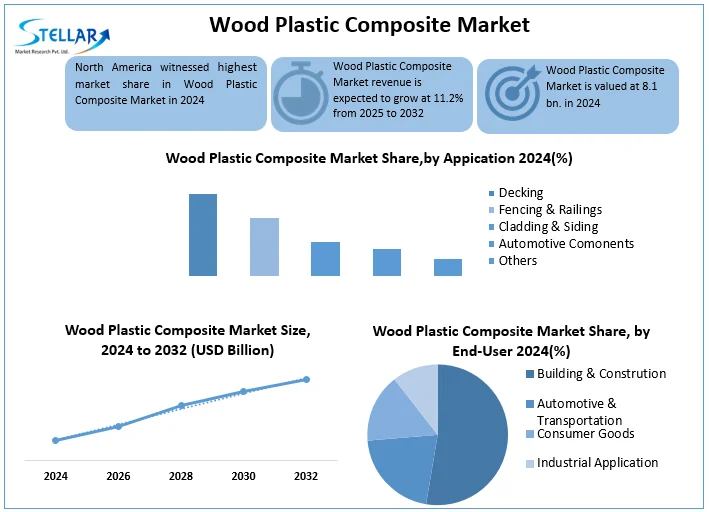
According to Stellar Market Research, the Wood Plastic Composite Market was valued at USD 8.1 billion in 2024 and is projected to reach nearly USD 18.94 billion by 2032, expanding at a CAGR of 11.2% during 2025–2032. Increasing adoption of green building materials, recycled plastics utilization, and sustainable infrastructure development are expected to remain key growth drivers throughout the forecast period.
Sustainable Construction Drives Wood Plastic Composite Demand
The global construction industry is undergoing a major shift toward environmentally responsible materials, creating significant opportunities for the Wood Plastic Composite Market. Builders, architects, and developers are increasingly seeking alternatives that reduce environmental impact while maintaining durability and performance.
WPC materials are gaining popularity in outdoor applications such as decking, fencing, cladding, railing, and landscaping structures due to their resistance to moisture, insects, and decay. Unlike traditional wood, WPC requires minimal maintenance and offers longer service life, making it attractive for residential and commercial construction projects.
Growing emphasis on green buildings, circular economy initiatives, and sustainable urban development is encouraging greater adoption of recycled-content composite materials across global construction markets.
𝐃𝐨𝐰𝐧𝐥𝐨𝐚𝐝 𝐅𝐫𝐞𝐞 𝐏𝐃𝐅 𝐁𝐫𝐨𝐜𝐡𝐮𝐫𝐞: https://www.stellarmr.com/report/req_sample/wood-plastic-composite-market/2760
Building and Construction Segment Leads Market Growth
Among application segments, building and construction represents the dominant segment of the Wood Plastic Composite Market. Increasing demand for outdoor living spaces, residential renovation projects, and sustainable architectural solutions is supporting widespread WPC adoption.
Decking remains one of the largest applications due to consumer preference for weather-resistant and visually appealing alternatives to natural wood. WPC fencing, wall panels, and exterior cladding are also gaining traction because they provide enhanced durability while reducing maintenance requirements.
The furniture and automotive industries are additionally creating new opportunities as manufacturers explore lightweight and recyclable composite materials for interior components and design applications.
Recycled Materials and Circular Economy Strengthen Market Opportunities
The increasing focus on plastic waste reduction is becoming a major factor influencing market development. WPC production utilizes recycled plastics and wood waste, supporting resource conservation and reducing landfill dependency.
Governments and industries worldwide are implementing sustainability regulations that encourage the use of recycled materials in manufacturing and construction. These initiatives are creating favorable conditions for WPC producers by promoting environmentally responsible material solutions.
The growing consumer preference for eco-friendly products is also encouraging manufacturers to develop innovative WPC formulations with higher recycled content, improved strength, and enhanced aesthetic characteristics.
Technological Advancements Improve WPC Performance
Continuous innovation in material engineering is expanding the capabilities of wood plastic composites.
Manufacturers are focusing on:
Improved wood-polymer bonding technologies
Higher recycled material integration
Enhanced UV and moisture resistance
Advanced extrusion processes
Bio-based composite development
New manufacturing techniques are improving mechanical strength, durability, and design flexibility, allowing WPC materials to enter applications previously dominated by conventional materials.
Research into bio-based polymers and advanced additives is also supporting the development of next-generation composites with improved environmental performance and lifecycle benefits.
Automotive Industry Creates Additional Growth Potential
Beyond construction, the automotive sector is emerging as a promising application area for Wood Plastic Composite materials.
Automakers are increasingly adopting lightweight and sustainable materials to improve fuel efficiency and meet environmental regulations. WPC materials are being explored for interior automotive components such as panels, trims, storage compartments, and decorative elements.
The growing production of electric vehicles is further increasing interest in lightweight materials that can contribute to improved vehicle efficiency. As automotive manufacturers continue focusing on recyclable and renewable materials, WPC adoption is expected to expand beyond traditional construction applications.
North America Leads While Asia-Pacific Shows Strong Growth
North America dominates the Wood Plastic Composite Market due to strong demand for outdoor decking, residential renovation activities, and sustainable construction materials. The region has witnessed widespread consumer adoption of WPC products as homeowners and builders increasingly prefer durable alternatives to natural wood.
The United States remains a major contributor due to established composite decking manufacturers, strong construction activity, and increasing demand for low-maintenance outdoor products.
Meanwhile, Asia-Pacific is expected to register the fastest growth during the forecast period. Rapid urbanization, infrastructure expansion, rising construction investments, and increasing awareness of sustainable materials are driving market opportunities across China, India, Japan, and Southeast Asian countries.
Sustainability Regulations Influence Industry Development
Environmental regulations and sustainability standards are significantly shaping the future of the Wood Plastic Composite Market.
Governments are introducing policies focused on reducing plastic waste, promoting recycled materials, and encouraging sustainable construction practices. These regulations are motivating manufacturers to improve recycling capabilities and develop environmentally friendly composite solutions.
Green building certifications and sustainability-focused construction standards are also increasing demand for materials with lower environmental footprints. WPC products align well with these trends because they combine recycled content, durability, and reduced maintenance requirements.
Competitive Landscape
The Wood Plastic Composite Market is competitive, with companies focusing on product innovation, sustainable manufacturing, capacity expansion, and strategic partnerships.
Key market participants include Trex Company Inc., Fiberon, AZEK Company Inc., UPM Biocomposites, MoistureShield, UFP Industries, CertainTeed LLC, Jelu-Werk J. Ehrler GmbH & Co. KG, Beologic, and Green Dot Bioplastics.
Leading companies are investing in recycled material technologies, advanced composite formulations, expanded production facilities, and environmentally responsible product lines to strengthen their market position.
𝐃𝐨𝐰𝐧𝐥𝐨𝐚𝐝 𝐅𝐫𝐞𝐞 𝐏𝐃𝐅 𝐁𝐫𝐨𝐜𝐡𝐮𝐫𝐞: https://www.stellarmr.com/report/req_sample/wood-plastic-composite-market/2760
Market Challenges
Despite strong growth prospects, the Wood Plastic Composite Market faces certain challenges. Compared with traditional wood products, WPC materials may have higher initial costs, which can influence adoption among price-sensitive consumers.
Additionally, WPC products generally have lower load-bearing capacity compared with materials such as steel or concrete, limiting their use in certain structural applications. Manufacturers are addressing these limitations through improved formulations, reinforcement technologies, and advanced processing methods. (
Raw material price fluctuations, particularly for polymers, and supply chain challenges may also impact production costs. However, continuous innovation is expected to improve competitiveness and expand application opportunities.
Future Outlook
The Wood Plastic Composite Market is expected to maintain strong growth through 2032 as sustainability, durability, and circular economy principles become increasingly important across industries. Rising demand for green construction materials, recycled-content products, and lightweight composites will continue driving market expansion.
Future growth will be shaped by advancements in bio-based composites, smart manufacturing technologies, automotive applications, and sustainable building solutions. Companies investing in innovative materials, recycling technologies, and environmentally responsible production methods are expected to gain a competitive advantage.
As industries worldwide move toward greener alternatives, Wood Plastic Composite materials are positioned to become a key component of sustainable construction and manufacturing ecosystems.
Media Contact
Stellar Market Research
Website: Stellar Market Research – Global Research Reports & Consulting
Email: sales@stellarmr.com
