The Heparin Market is witnessing steady expansion as the global healthcare sector experiences increasing demand for anticoagulant therapies used in cardiovascular treatments, surgical procedures, dialysis, and prevention of blood clot-related disorders. Heparin remains one of the most widely used anticoagulant medications due to its effectiveness in preventing and treating conditions such as venous thromboembolism (VTE), deep vein thrombosis (DVT), pulmonary embolism, and other cardiovascular complications.
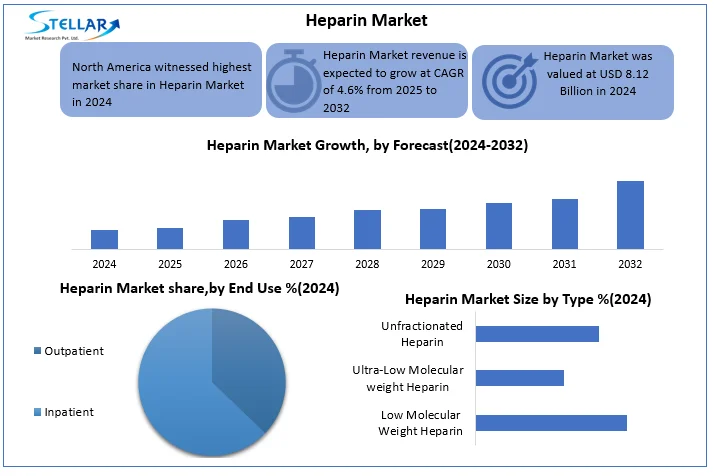
According to Stellar Market Research, the Heparin Market was valued at USD 8.12 billion in 2024 and is projected to reach nearly USD 11.64 billion by 2032, growing at a CAGR of 4.6% during 2025–2032. Increasing prevalence of chronic diseases, rising surgical procedures, expanding dialysis requirements, and advancements in heparin manufacturing technologies are expected to support market growth during the forecast period.
𝐃𝐨𝐰𝐧𝐥𝐨𝐚𝐝 𝐅𝐫𝐞𝐞 𝐏𝐃𝐅 𝐁𝐫𝐨𝐜𝐡𝐮𝐫𝐞: https://www.stellarmr.com/report/req_sample/Heparin-Market/2763
Growing Burden of Cardiovascular Diseases Supports Market Expansion
The increasing global burden of cardiovascular diseases is one of the primary factors driving demand for heparin-based therapies. Aging populations, sedentary lifestyles, obesity, and rising cases of hypertension and diabetes are contributing to higher incidences of blood clotting disorders worldwide.
Heparin plays a crucial role in preventing clot formation during cardiovascular surgeries, catheterization procedures, and long-term hospital treatments. Its widespread clinical application in hospitals and healthcare facilities continues to strengthen market demand.
The growing number of surgical procedures, including cardiac surgeries and orthopedic operations, is further increasing the requirement for anticoagulant therapies. In addition, the expansion of dialysis treatments for chronic kidney disease patients is creating sustained demand for low molecular weight heparin (LMWH) products.
Low Molecular Weight Heparin Dominates Product Demand
Among product segments, Low Molecular Weight Heparin (LMWH) represents the leading segment due to its improved safety profile, predictable anticoagulant effects, longer duration of action, and ease of administration compared with unfractionated heparin.
LMWH products are widely preferred in clinical applications such as venous thromboembolism prevention, post-surgical care, and outpatient anticoagulation therapy. Their reduced monitoring requirements and lower risk of certain complications have increased adoption among healthcare professionals.
Unfractionated heparin (UFH) continues to maintain importance in emergency care settings due to its rapid action and reversibility. Meanwhile, ultra-low molecular weight heparin products are gaining attention as manufacturers explore advanced anticoagulant solutions with improved therapeutic performance.
Rising Dialysis Procedures Create New Growth Opportunities
The expanding prevalence of chronic kidney disease is creating significant opportunities for the Heparin Market. Dialysis procedures require anticoagulants to prevent blood clot formation within dialysis equipment, making heparin an essential component of renal care.
Increasing healthcare access in emerging economies, improved diagnosis of kidney disorders, and rising investments in dialysis infrastructure are supporting market growth. Countries across Asia-Pacific, Latin America, and the Middle East are witnessing increased demand as healthcare systems expand treatment availability.
Additionally, growing awareness regarding early diagnosis and management of chronic diseases is expected to increase the number of patients receiving long-term anticoagulant therapies.
Biotechnology Innovation Addresses Supply Chain Challenges
Technological advancements are reshaping the future of heparin production and supply management.
Traditional heparin production relies heavily on animal-derived sources, particularly porcine intestinal mucosa. However, supply chain disruptions, raw material availability concerns, and quality control requirements are encouraging companies to explore alternative production methods.
Research into synthetic and bioengineered heparin technologies is gaining momentum as manufacturers aim to improve product consistency, safety, and supply reliability. Advanced purification techniques and improved manufacturing processes are also helping pharmaceutical companies enhance product quality.
The development of next-generation anticoagulants and improved formulation technologies is expected to create new opportunities for market participants.
North America Leads Global Market Growth
North America dominates the global Heparin Market, accounting for approximately 38% of market share in 2024. The region’s leadership is supported by advanced healthcare infrastructure, high prevalence of cardiovascular diseases, increasing surgical procedures, and the presence of major pharmaceutical companies.
The United States remains a major contributor due to strong demand for anticoagulant therapies, well-established hospital networks, and significant healthcare spending. Leading pharmaceutical companies continue investing in product development and supply chain strengthening to meet growing demand.
Meanwhile, Asia-Pacific is emerging as a high-growth region due to increasing healthcare investments, expanding patient populations, rising cardiovascular disease prevalence, and improved access to advanced medical treatments. Countries such as China, India, Japan, and South Korea are expected to provide significant growth opportunities.
Regulatory Standards Influence Manufacturing and Supply
The Heparin Market is highly influenced by strict regulatory requirements related to drug safety, quality control, and manufacturing processes. Regulatory agencies worldwide emphasize contamination prevention, traceability of raw materials, and compliance with pharmaceutical production standards.
Following historical concerns related to heparin contamination, manufacturers have increased investments in advanced testing methods and quality assurance systems.
Regulatory focus on pharmaceutical supply chain transparency is encouraging companies to strengthen sourcing strategies and develop more reliable manufacturing networks.
Sustainability and Alternative Production Trends
Sustainability is becoming an emerging consideration within the pharmaceutical industry. The dependence on animal-derived raw materials has encouraged research into environmentally responsible and technologically advanced alternatives.
Bioengineered heparin production may offer advantages such as improved consistency, reduced dependency on animal sources, and enhanced supply chain resilience. Companies are increasingly exploring sustainable biotechnology approaches to meet future healthcare demands.
Competitive Landscape
The Heparin Market is competitive, with pharmaceutical companies focusing on product innovation, manufacturing expansion, strategic partnerships, and supply chain optimization.
Key players operating in the market include Pfizer Inc., Sanofi, Amphastar Pharmaceuticals, B. Braun Melsungen AG, Fresenius Kabi, Teva Pharmaceuticals, Aspen Pharmacare, LEO Pharma, Dr. Reddy’s Laboratories, and Hikma Pharmaceuticals.
Companies are investing in low molecular weight heparin product development, manufacturing capacity expansion, regulatory compliance, and partnerships to strengthen their global presence.
Recent strategic developments include:
Bharat Serums and Vaccines Ltd. (2024): Launched a new low molecular weight heparin product line aimed at strengthening domestic availability and reducing dependency on imported products.
Pfizer Inc. (2024): Entered a long-term supply agreement for porcine mucosa-based heparin API to improve supply chain resilience.
𝐃𝐨𝐰𝐧𝐥𝐨𝐚𝐝 𝐅𝐫𝐞𝐞 𝐏𝐃𝐅 𝐁𝐫𝐨𝐜𝐡𝐮𝐫𝐞: https://www.stellarmr.com/report/req_sample/Heparin-Market/2763
Market Challenges
Despite strong growth prospects, the Heparin Market faces several challenges. Dependence on animal-derived raw materials creates supply chain vulnerabilities, while geopolitical disruptions and trade restrictions can affect availability and pricing.
Strict regulatory requirements and complex manufacturing processes also increase production costs. Additionally, competition from alternative anticoagulant therapies may influence long-term demand patterns.
However, ongoing biotechnology advancements and increasing healthcare demand are expected to support sustainable market growth.
Future Outlook
The Heparin Market is expected to maintain steady growth through 2032 as healthcare systems continue expanding cardiovascular care, surgical treatments, and dialysis services. Increasing demand for low molecular weight heparin, technological advancements in pharmaceutical manufacturing, and investments in supply chain security will remain key market drivers.
Future growth will be shaped by innovative production methods, improved drug formulations, regulatory compliance, and expansion into emerging healthcare markets.
As cardiovascular disease prevention and advanced medical procedures become increasingly important worldwide, heparin will continue to play a critical role in modern anticoagulant therapy, supporting long-term opportunities for pharmaceutical manufacturers and healthcare providers.
Media Contact
Stellar Market Research
Website: Stellar Market Research – Global Research Reports & Consulting
Email: sales@stellarmr.com
